
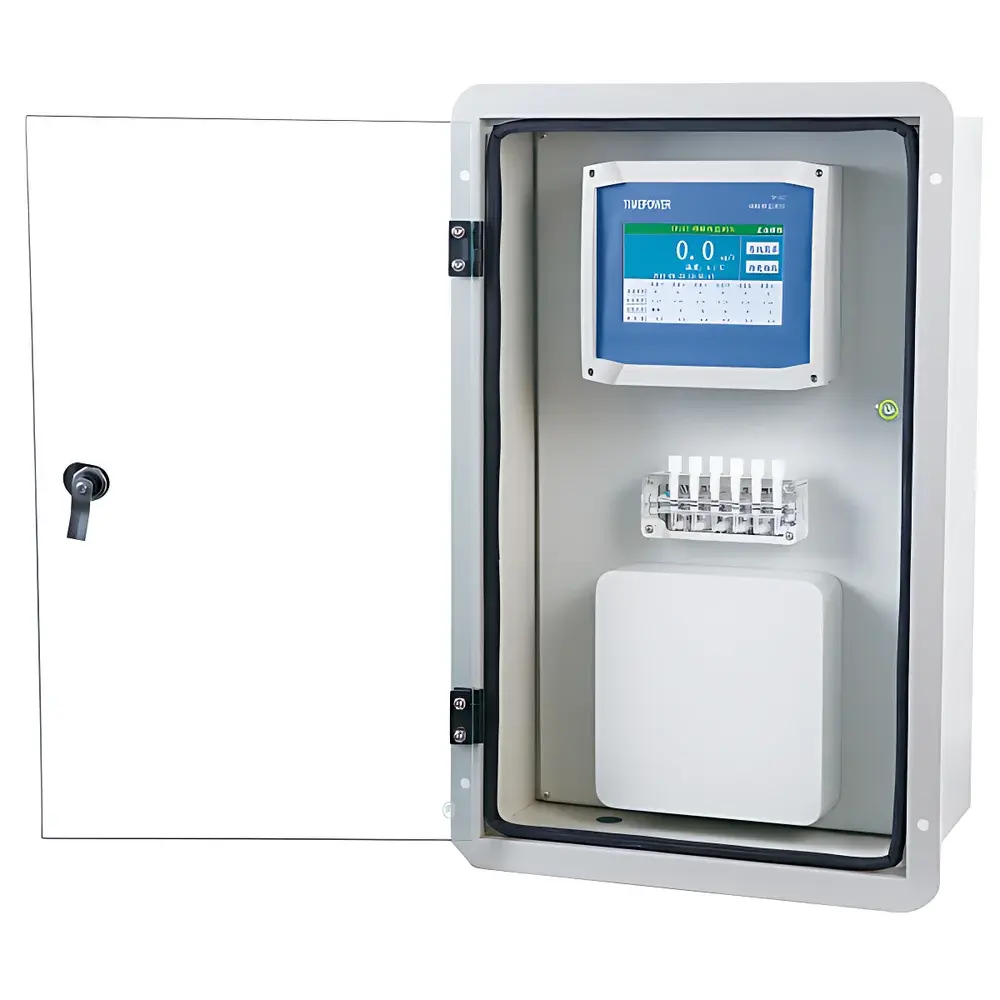
TimePower TP107 Phosphate Analyzer
| Brand | TimePower |
|---|---|
| Origin | Beijing, China |
| Manufacturer Type | OEM/ODM Producer |
| Country of Origin | China |
| Model | TP107 |
| Pricing | Available Upon Request |
Overview
The TimePower TP107 Phosphate Analyzer is a dedicated online photometric analyzer engineered for continuous, real-time monitoring of orthophosphate (PO₄³⁻) concentration in aqueous process streams. It operates on the phosphovanadomolybdate colorimetric principle — a well-established, standardized method referenced in GB/T 6913–2008 (equivalent to ISO 6878 and ASTM D515-18 for orthophosphate determination). In acidic medium, orthophosphate reacts quantitatively with ammonium metavanadate and ammonium molybdate to form a yellow heteropoly acid complex (phosphovanadomolybdic acid), whose absorbance at ~420 nm is linearly proportional to phosphate concentration according to the Beer–Lambert law. Designed for industrial reliability rather than laboratory spot analysis, the TP107 integrates optical stability, reagent management, and multi-channel scalability into a single rack-mountable unit suitable for unattended operation in demanding utility and process environments.
Key Features
- Configurable 1–6 independent measurement channels — enables cost-effective monitoring of multiple sample points without redundant instrumentation.
- High-precision imported solenoid valves with >1 million cycle lifetime — ensure repeatable reagent dosing, precise sample aspiration, and long-term metrological integrity.
- Automated dual-point calibration at user-defined intervals (e.g., every 6 or 24 hours) — maintains traceability and minimizes manual intervention while complying with routine QA/QC protocols.
- Embedded data logger retaining 30 days of timestamped measurements per channel — supports root-cause analysis, regulatory review, and trend-based maintenance planning.
- Stable monochromatic cold LED light source (420 nm ±2 nm bandwidth) — eliminates thermal drift and lamp replacement cycles common in tungsten-halogen systems.
- Isolated analog outputs (0–20 mA / 4–20 mA / 0–10 mA, field-selectable) — compatible with PLCs, DCS, and automated chemical feed controllers for closed-loop phosphate control.
- 7-inch capacitive touchscreen LCD with multicolor real-time curve overlay — displays live concentration trends, historical profiles, and alarm status across all active channels simultaneously.
- Modular open-panel mounting design (cutout: 670 × 410 mm) — simplifies integration into existing control cabinets or wall-mounted enclosures with minimal structural modification.
Sample Compatibility & Compliance
The TP107 is validated for use with clarified liquid samples meeting the following physical specifications: suspended solids < 5 µm (no colloidal interference), temperature range 5–50 °C, and flow rate 10–40 L/h. It complies with national standard GB/T 6913–2008 for boiler water and cooling water analysis, and its measurement methodology aligns with internationally recognized practices under ISO 6878:2004 and ASTM D515-18. While not certified to IEC 61508 or SIL standards, its architecture supports implementation within GLP- and GMP-aligned facilities when deployed with documented SOPs, calibration logs, and audit trails. Reagent consumption is optimized at approximately 3 L/month per active channel under typical operating conditions.
Software & Data Management
The embedded firmware provides local data storage, time-synchronized logging, and configurable alarm thresholds (high/low limit, flow loss, reagent depletion). All events — including calibration actions, alarm triggers, and system faults — are timestamped and retained in non-volatile memory. The device does not require external PC software for basic operation; however, optional RS485 Modbus RTU communication enables integration into centralized SCADA platforms for remote configuration, data aggregation, and export to CSV or Excel formats. Audit trail functionality meets foundational requirements for FDA 21 CFR Part 11 compliance when paired with secure network access controls and electronic signature procedures defined by end-user validation protocols.
Applications
The TP107 serves critical phosphate monitoring roles across multiple regulated sectors: boiler feedwater and condensate treatment in thermal power plants; corrosion inhibitor dosing control in HVAC cooling towers; effluent compliance verification in municipal wastewater and industrial discharge streams; nutrient dosing verification in pharmaceutical clean-in-place (CIP) rinse validation; and quality assurance in food-grade process water systems. Its robustness against ambient humidity (≤90% RH, non-condensing) and wide operating temperature range (5–45 °C) make it suitable for both indoor control rooms and semi-outdoor utility skids.
FAQ
What is the detection principle used by the TP107?
It employs the phosphovanadomolybdate spectrophotometric method, measuring absorbance at 420 nm following color development in acidic medium.
Can the TP107 be integrated into an existing DCS system?
Yes — via isolated 4–20 mA analog outputs or optional Modbus RTU over RS485.
How often does the instrument require recalibration?
User-configurable automatic two-point calibration ensures stability; typical intervals range from 6 to 24 hours depending on application criticality and matrix variability.
What reagents are required for operation?
Vanadomolybdophosphoric acid reagent kit (including acidifier, vanadate, molybdate, and reducing agent), plus certified phosphate standard solutions (e.g., 1 mg/mL PO₄–P stock).
Is the TP107 suitable for high-turbidity samples?
No — samples must be pre-filtered to remove particles >5 µm and free of colloidal silica or organic macromolecules that could interfere with color formation or clog fluidic paths.




