
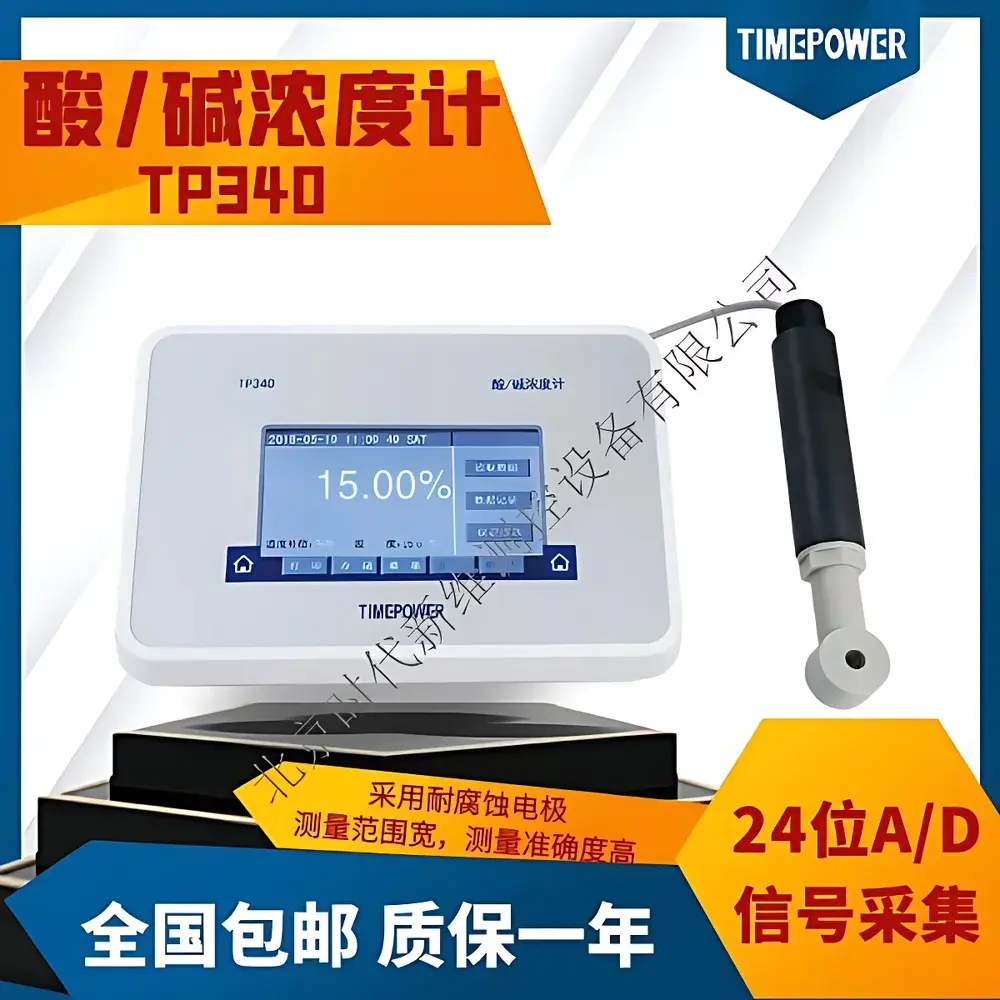
TP340 Acid-Base Concentration Meter (Benchtop, Laboratory-Grade Electrochemical Analyzer)
| Brand | TimePower |
|---|---|
| Origin | Beijing, China |
| Manufacturer | TimePower Measurement & Control Co., Ltd. |
| Model | TP340 |
| Type | Benchtop Conductometric Acid-Base Concentration Analyzer |
| Measurement Principle | Conductivity-based concentration inference with temperature-compensated dual-electrode cell |
| Display | 5.0-inch color TFT touchscreen (800 × 480 resolution) |
| Data Storage | Cyclic non-volatile memory (≥10 years data retention after power loss) |
| A/D Resolution | 24-bit |
| Microcontroller Architecture | Embedded industrial-grade single-chip system |
| Enclosure | IP54-rated corrosion-resistant housing |
| Compliance | Designed per IEC 61000-4 EMC standards |
Overview
The TP340 Acid-Base Concentration Meter is a benchtop electrochemical analyzer engineered for precise, repeatable determination of acid and base concentrations in aqueous solutions via conductivity-based measurement. Unlike pH meters—which report hydrogen ion activity—the TP340 operates on the fundamental principle that electrolyte concentration directly correlates with solution conductivity, provided temperature is accurately compensated and electrode polarization effects are minimized. The instrument employs a dual-electrode conductometric cell constructed from chemically inert, corrosion-resistant materials (e.g., platinum-coated stainless steel or graphite composites), enabling stable operation in aggressive environments typical of boiler feedwater, caustic soda recovery streams, pickling baths, and pharmaceutical buffer preparation. Its measurement algorithm applies real-time temperature compensation using a built-in Pt1000 sensor (±0.1 °C accuracy), referencing standard conductivity–concentration calibration curves for HCl, H₂SO₄, NaOH, KOH, and NH₃ solutions across defined ranges. Designed for laboratory and quality control environments, the TP340 delivers traceable, operator-independent results without requiring titration reagents or consumable electrodes.
Key Features
- Corrosion-resistant dual-electrode conductivity cell optimized for acidic and alkaline media—no glass membrane degradation or liquid junction clogging
- 24-bit high-resolution analog-to-digital conversion ensures minimal quantization error and excellent signal-to-noise ratio in low-conductivity regimes
- Integrated Pt1000 temperature sensor with automatic linear and non-linear compensation algorithms compliant with ISO 7888 and ASTM D1125
- Benchtop enclosure rated IP54 for dust resistance and limited water ingress protection—suitable for shared lab benches near fume hoods or wet chemistry stations
- Embedded industrial microcontroller architecture with watchdog timer and brown-out detection—guarantees operational integrity during voltage fluctuations
- 5.0-inch capacitive touchscreen with 800 × 480 resolution, supporting intuitive Chinese-language menu navigation and context-sensitive soft keys
- Non-volatile FRAM memory retains ≥100,000 measurement records with full time/date stamping, user ID tagging, and auto-rollover overwrite policy
Sample Compatibility & Compliance
The TP340 is validated for use with homogeneous aqueous solutions containing strong monoprotic and diprotic acids (e.g., HCl, HNO₃, H₂SO₄ up to 20 wt%) and strong alkalis (e.g., NaOH, KOH up to 30 wt%). It is not intended for non-aqueous solvents, suspensions, or highly viscous fluids (>50 mPa·s). Electrode fouling mitigation is achieved through programmable auto-cleaning cycles using reverse-polarity pulsing. From a regulatory perspective, the device supports Good Laboratory Practice (GLP) workflows: all measurements include immutable audit trails (operator ID, timestamp, calibration status, temperature reading), and stored data may be exported via USB 2.0 as CSV files for external validation. While not FDA 21 CFR Part 11 certified out-of-the-box, its firmware architecture permits integration into validated systems when deployed with controlled access protocols and electronic signature modules.
Software & Data Management
Data acquisition, storage, and export are handled entirely onboard—no PC dependency is required for routine operation. Each measurement record contains: conductivity value (µS/cm or mS/cm), inferred concentration (% w/w or mol/L), temperature (°C), measurement duration, electrode condition flag, and calibration expiration date. Historical data can be browsed chronologically or filtered by concentration range or date interval. USB mass-storage mode enables direct file transfer to Windows/Linux workstations for statistical analysis in Excel, JMP, or LIMS platforms. Firmware updates are performed via signed binary files loaded from FAT32-formatted USB drives, ensuring version traceability and cryptographic integrity. Optional PC software (TimePower LabLink v2.1) provides real-time graphing, multi-parameter trend overlays, and automated report generation compliant with ISO/IEC 17025 documentation requirements.
Applications
- Power generation: Monitoring amine concentration in condensate polishing systems and hydrazine residuals in feedwater circuits
- Chemical manufacturing: In-process verification of sulfuric acid strength in alkylation units and sodium hydroxide titer in chlor-alkali cell effluents
- Pharmaceutical production: Quantitative verification of cleaning-in-place (CIP) rinse solution neutrality prior to equipment sterilization
- Food & beverage: Validation of phosphoric acid dosing in carbonated soft drink formulation and lye concentration in peel removal baths
- Metallurgical processing: Control of nitric-hydrofluoric acid mixtures in stainless steel passivation lines
- Academic research: Teaching laboratories demonstrating colligative property relationships between conductivity and ionic strength
FAQ
What concentration ranges does the TP340 support for common acids and bases?
The instrument provides factory-calibrated curves for HCl (0.1–10 wt%), H₂SO₄ (0.5–20 wt%), NaOH (0.1–30 wt%), and KOH (0.1–25 wt%). Custom calibration tables may be imported via USB for proprietary electrolytes.
Is temperature compensation mandatory—and how is it implemented?
Yes. Conductivity is intrinsically temperature-dependent. The TP340 uses a built-in Pt1000 sensor and applies either linear (α = 2.0 %/°C default) or polynomial compensation per IEC 60746-3, selectable per calibration profile.
Can the TP340 replace titration for QC release testing?
It serves as a rapid screening tool with ±1.5% full-scale accuracy under controlled conditions. For regulatory release, confirm equivalence against ASTM D1091 or USP via method validation per ICH Q2(R2).
How often must the electrode be recalibrated?
Initial calibration is required before first use. Subsequent recalibration intervals depend on usage frequency and matrix severity; typical practice is daily for high-throughput labs or per batch for intermittent use, verified against NIST-traceable KCl standards.
Does the device support output to PLC or SCADA systems?
Analog 4–20 mA isolated current loop output is available as an optional hardware module (TP340-IO), configurable for concentration or conductivity transmission with HART protocol support.




