
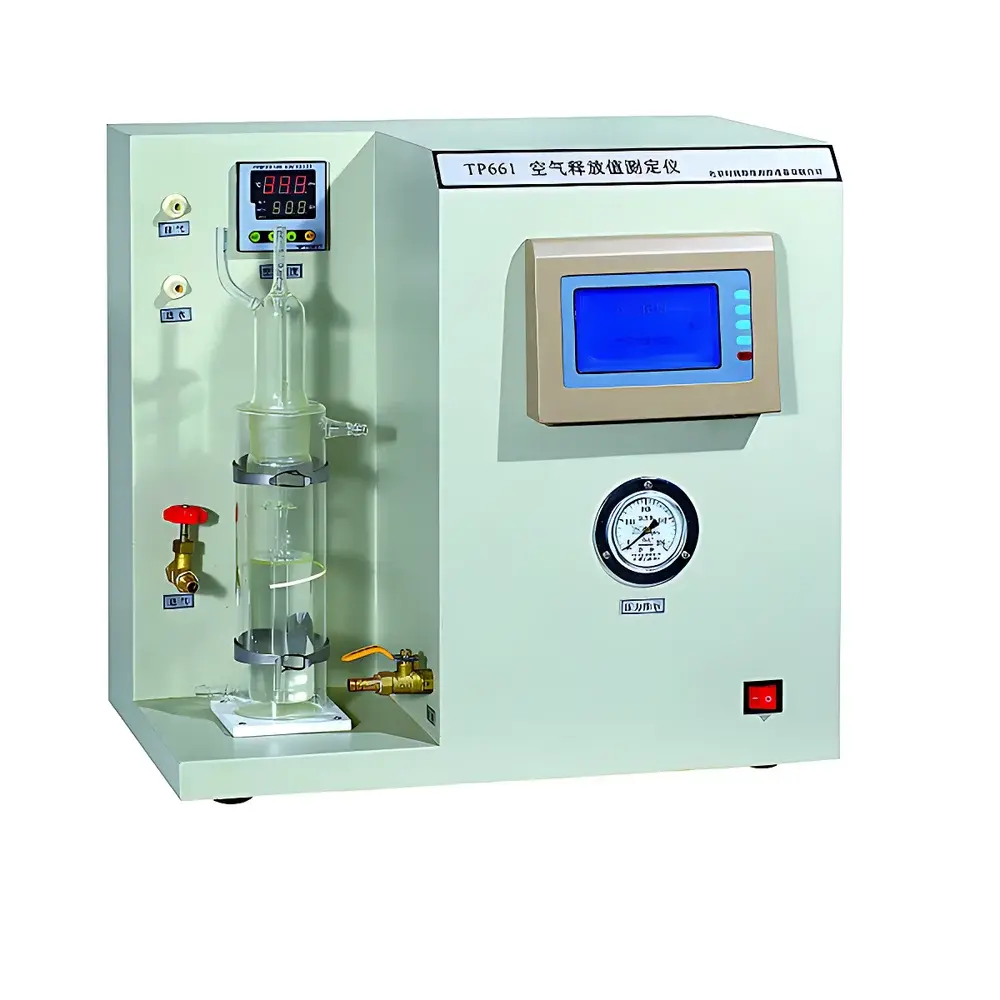
TimePower TP 661 Air Release Value Tester for Petroleum Oils
| Brand | TimePower |
|---|---|
| Origin | Beijing, China |
| Manufacturer Type | Direct Manufacturer |
| Country of Origin | China |
| Model | TP 661 |
| Temperature Control Range | Ambient to 99.9°C |
| Temperature Accuracy | ±0.3°C (bath), ±1°C (air) |
| Air Pressure Regulation Range | 0–98 kPa |
| Timing Accuracy | ±1 s |
| Display | LCD |
| Power Supply | AC 220 V ±10%, 50 Hz ±2.5% |
| Power Consumption | 1100 VA |
| Dimensions | 560 × 350 × 490 mm |
| Weight | 24 kg |
Overview
The TimePower TP 661 Air Release Value Tester is a dedicated benchtop instrument engineered for the quantitative determination of air release properties in petroleum-based lubricants, hydraulic fluids, turbine oils, and other refined mineral or synthetic oils. It operates in strict accordance with ASTM D3427, ISO 9120, and GB/T 12579 standards—methods that define air release value (ARV) as the time required for entrained air to separate from a heated oil sample under controlled airflow and pressure conditions. The instrument employs a dual-temperature control architecture: one PID-regulated thermal bath maintains precise oil temperature (±0.3°C), while an independent heating zone stabilizes incoming compressed air temperature (±1°C). This decoupled thermal management ensures thermodynamic consistency across replicate tests—a critical requirement for method-compliant data generation in quality control laboratories operating under ISO/IEC 17025 or API Q1 frameworks.
Key Features
- Dual-channel PID temperature control system with real-time digital feedback, enabling simultaneous stabilization of oil bath and air stream temperatures to specification tolerances.
- Integrated silent diaphragm air pump delivering stable, pulse-free airflow—eliminating mechanical vibration artifacts that compromise bubble coalescence dynamics.
- Adjustable regulated air pressure (0–98 kPa) via calibrated needle valve, supporting both standard test conditions (e.g., 70 kPa per ASTM D3427) and method development protocols.
- High-resolution LCD interface with intuitive menu navigation, displaying real-time bath temperature, air temperature, elapsed time, and pressure setpoint.
- Robust stainless-steel and borosilicate glass construction compliant with laboratory safety standards; designed for continuous operation in QC environments with ambient fluctuations (10–40°C, ≤95% RH).
- Self-contained design requiring only single-phase AC power (220 V ±10%, 50 Hz); no external chillers, gas cylinders, or auxiliary controllers needed.
Sample Compatibility & Compliance
The TP 661 accommodates standard 200 mL glass test vessels conforming to ASTM D3427 geometry specifications. It supports viscosity ranges typical of industrial lubricants (ISO VG 32 to VG 680) and is validated for use with mineral oils, polyalphaolefins (PAOs), phosphate esters, and polyalkylene glycols (PAGs). All operational parameters—including temperature ramp profiles, pressure hold durations, and timing thresholds—are fully configurable to align with internal SOPs or regulatory submissions. Instrument qualification documentation supports IQ/OQ protocols, and audit trails (via optional RS232/USB logging) satisfy GLP and FDA 21 CFR Part 11 requirements when paired with validated third-party data acquisition software.
Software & Data Management
While the TP 661 operates as a standalone unit with embedded firmware, its serial interface enables integration into centralized LIMS or ELN platforms. TimePower provides optional PC-based software (TP-AirLog v2.1) that captures timestamped temperature, pressure, and timing events with checksum-verified data integrity. Export formats include CSV and XML, compatible with statistical process control (SPC) tools such as Minitab or JMP. All raw measurements retain traceability to NIST-traceable reference thermometers and pressure transducers, facilitating metrological chain-of-custody reporting.
Applications
- Quality assurance of turbine oils prior to commissioning or after on-site regeneration.
- Formulation screening of anti-foam additives (e.g., silicone polymers, acrylate copolymers) during R&D.
- Root-cause analysis of air entrapment failures in hydraulic systems—correlating ARV shifts with oxidation byproducts or particulate contamination.
- Contract testing laboratories performing routine compliance verification against OEM specifications (e.g., GEK 32568, Siemens TLV 9013).
- Educational use in tribology and lubricant science curricula for hands-on demonstration of interfacial gas–liquid separation kinetics.
FAQ
What standards does the TP 661 comply with?
ASTM D3427, ISO 9120, IP 313, and GB/T 12579—fully supported through hardware configuration and documented calibration procedures.
Can the instrument be used for synthetic ester-based aviation oils?
Yes, provided the oil’s flash point exceeds 100°C and it remains thermally stable at 75°C for ≥30 minutes; validation per ASTM D6185 is recommended prior to first use.
Is external air supply required?
No—the integrated quiet diaphragm pump generates sufficient flow and pressure; ambient air filtration is advised in dusty environments.
How often must the temperature sensors be recalibrated?
Annually, or per laboratory quality manual; NIST-traceable calibration certificates are available from TimePower Service Centers.
Does the TP 661 support automated pass/fail evaluation against specification limits?
Not natively—but TP-AirLog software allows user-defined acceptance criteria and auto-flagging of out-of-spec results during batch processing.






