
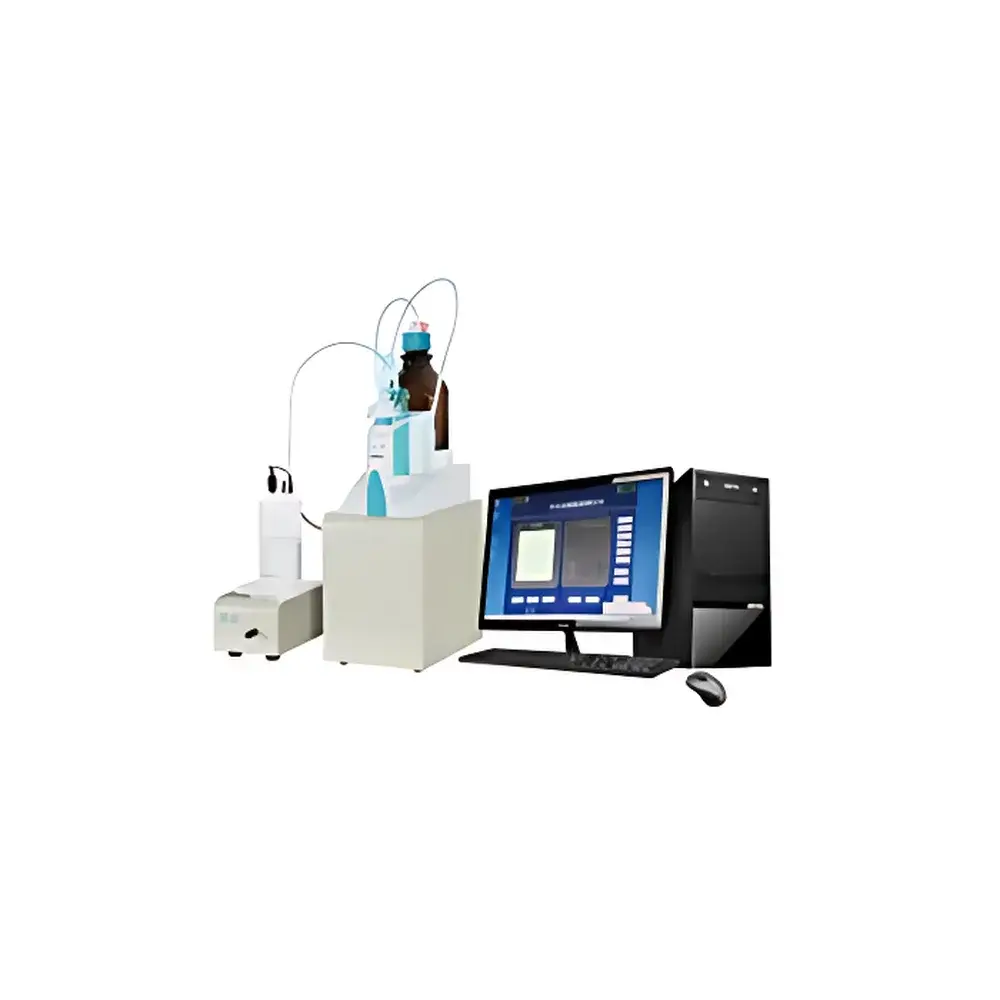
TP632 Automated Acid Number Titrator by TimePower
| Brand | TimePower |
|---|---|
| Origin | Beijing, China |
| Manufacturer | TimePower Measurement & Control Equipment Co., Ltd. |
| Model | TP632 |
| Compliance | GB/T 18609, GB/T 7304 |
| Electrode System | Triple-electrode, high-impedance input (Ri ≥ 1 × 10¹² Ω) |
| Measuring Range | 0–260 mg KOH/g |
| Resolution | 0.001 mg KOH/g |
| Accuracy | ≤5% |
| Precision | Conforms to GB/T 18609 |
| Burette Volume | 10 mL |
| Burette Accuracy | ±0.1% F.S. |
| Dispensing Time | (60 ± 10) s F.S. |
| Potential Measurement Range | 0 to ±1999.5 mV |
| Electronic Unit Error | ±0.5 mV or ±0.1% of full scale |
| Operating Environment | 5–35 °C, RH ≤85% |
| Power Supply | AC 220 V ±10%, 50 Hz ±10% |
| Dimensions (W × D × H) | 350 × 280 × 178 mm |
| Net Weight (main unit) | 8 kg |
Overview
The TP632 Automated Acid Number Titrator is a microprocessor-controlled potentiometric titration system engineered for precise and reproducible determination of acid number in petroleum products, lubricants, biodiesel, and related hydrocarbon-based samples. Designed in strict accordance with GB/T 18609 (petroleum products — determination of acid number by potentiometric titration) and GB/T 7304 (crude oil and petroleum products — determination of acid number by potentiometric titration), the instrument implements a non-aqueous, solvent-based titration protocol using standardized alcoholic potassium hydroxide (KOH) titrant. Unlike colorimetric methods requiring visual endpoint detection, the TP632 employs a robust three-electrode potentiometric cell with dual high-impedance inputs to continuously monitor electrode potential shifts during titration, enabling objective, reagent-independent endpoint recognition. Its integrated architecture combines a precision burette drive mechanism, automated liquid handling modules, and a dedicated Windows-based control interface—eliminating manual intervention across rinse, fill, titrant delivery, and data logging phases.
Key Features
- Triple-electrode potentiometric detection system with input impedance ≥1 × 10¹² Ω, ensuring stable electrode potential response even in low-conductivity petroleum matrices
- Automated sequence execution: auto-rinse, auto-refill, fixed-volume dispensing, and real-time potential monitoring—all synchronized under closed-loop control
- 10 mL glass burette with ±0.1% full-scale accuracy and consistent delivery kinetics (60 ± 10 s per full stroke), minimizing volumetric drift across repeated analyses
- Endpoint algorithm compliant with GB/T 18609 criteria—capable of resolving inflection points in both light-colored and dark, highly colored oils without indicator dyes
- Configurable titration parameters—including titrant concentration, sample mass, solvent ratio, and slope threshold—enabling method adaptation across diverse sample types (e.g., transformer oil, jet fuel, used engine oil)
- Integrated PC workstation preloaded with proprietary titration software; optional standalone configuration available upon request
Sample Compatibility & Compliance
The TP632 is validated for use with crude oil, refined distillates, residual fuels, lubricating oils, synthetic esters, and bio-derived fuels—including samples with high aromatic content or thermal degradation byproducts. It accommodates standard ASTM D664 and ISO 6618 methodologies through parameter mapping, though formal certification under those standards requires user-specific validation per laboratory quality management protocols. All hardware components—including solenoid valves, peristaltic tubing, and electrode housings—are chemically resistant to common titration solvents (e.g., isopropanol/toluene mixtures) and KOH solutions. The system supports GLP-compliant operation: audit trails record operator ID, method version, timestamped raw potential curves, final acid number, and calibration history—fully traceable for internal QA review or regulatory inspection (e.g., ISO/IEC 17025 accredited labs).
Software & Data Management
Control and analysis are executed via a native Windows application supporting multilingual UI (English default). Each titration generates a structured dataset comprising time-stamped potential vs. volume curve, first-derivative plot, calculated equivalence point, acid number (mg KOH/g), and associated uncertainty metrics. Data exports to CSV or PDF formats include metadata headers (sample ID, analyst, date/time, method ID), facilitating integration into LIMS environments. Software permits retrospective reprocessing—applying alternate baseline corrections or slope thresholds to archived raw curves—without re-running physical samples. User access levels (operator, supervisor, administrator) enforce role-based permissions for method editing, calibration updates, and report deletion—aligned with FDA 21 CFR Part 11 requirements when electronic signatures and audit trail integrity are enabled.
Applications
- Monitoring acid number progression in transformer oil to assess oxidation stability and predict insulation failure risk
- Quality control of new lubricants prior to dispatch, verifying conformance to OEM specifications (e.g., API SP, ACEA C5)
- Condition-based maintenance of turbine and hydraulic oils in power generation and industrial plants
- R&D screening of antioxidant package efficacy in formulated base stocks
- Acid number verification of biodiesel (B100) per EN 14214 and ASTM D6751 compliance protocols
- Forensic analysis of degraded fuels in failure investigation laboratories
FAQ
Does the TP632 support ASTM D664 or ISO 6618 methods out-of-the-box?
The instrument’s core potentiometric algorithm and hardware specifications align with the technical requirements of ASTM D664 and ISO 6618. However, full method compliance requires laboratory-specific validation—including reagent qualification, system suitability testing, and uncertainty estimation—as mandated by ISO/IEC 17025.
Can the TP632 analyze highly viscous or sediment-laden samples?
Samples must be homogenized and filtered (≤5 µm) prior to analysis. For viscous feeds (e.g., heavy fuel oil), pre-dilution in xylene or toluene is recommended to ensure homogeneous mixing and electrode immersion. Optional heated sample compartment integration is available for select configurations.
Is the electrode system compatible with alternative titrants such as lithium hydroxide?
The triple-electrode cell is optimized for alcoholic KOH titrations per GB/T 18609. Use of non-standard titrants requires recalibration of the potential-to-acid-number conversion model and independent verification of endpoint sharpness and reproducibility.
How is data integrity maintained during power interruption?
The embedded controller retains volatile assay state in non-volatile memory. Upon recovery, the system resumes titration from the last confirmed dispensing step, preserving intermediate potential readings and preventing data loss.
What maintenance intervals are recommended for the burette and electrode assembly?
Burette piston seals should be inspected every 500 titrations; electrodes require weekly cleaning with ethanol and storage in pH 4 buffer. Full calibration (electrode slope, zero potential, burette linearity) is advised before each analytical batch or at least daily in high-throughput environments.




