
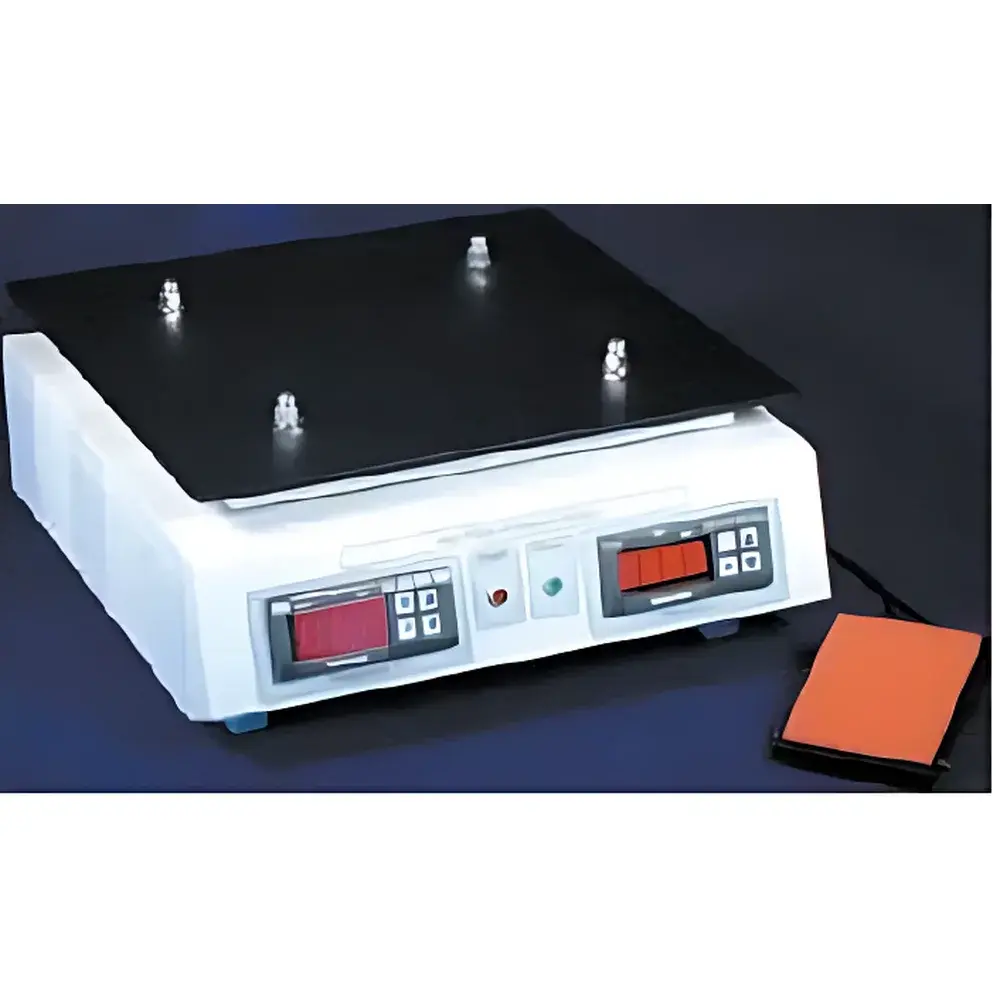
Panlab Hot Plate Analgesia Meter
| Brand | Panlab |
|---|---|
| Origin | Spain |
| Model | Hot Plate Analgesia Meter |
| Temperature Range | 35–65 °C |
| Temperature Accuracy | ±0.3 °C |
| Timer Resolution | 0.1 s |
| Timer Range | 0–9 min 59 s |
| Compatible Species | Mice and Rats |
| Regulatory Compliance | Designed for GLP-compliant preclinical pain research |
Overview
The Panlab Hot Plate Analgesia Meter is a precision-engineered thermal nociception testing system designed for standardized, reproducible assessment of centrally mediated analgesic effects in rodent models. Operating on the principle of radiant thermal stimulation, the instrument delivers a controlled, uniform heat flux to the plantar surface of unrestrained animals placed on a thermostatically regulated metal plate. Latency to a defined nociceptive endpoint—typically hind-paw licking, shaking, or jumping—is measured with millisecond-level temporal resolution. This paradigm leverages the well-characterized spinal-thalamic-cortical pathway activated by noxious thermal stimuli, making it highly sensitive to opioid receptor agonists (e.g., morphine, codeine), non-opioid analgesics, and novel CNS-active compounds under preclinical evaluation.
Key Features
- Digitally regulated heating plate with closed-loop PID temperature control, ensuring thermal stability within ±0.3 °C across the full operating range (35–65 °C)
- High-contrast LED display and intuitive front-panel interface enabling rapid parameter configuration without software dependency
- 0.1-second timer resolution with automatic start/stop triggering via integrated motion detection or manual override
- Thermal overshoot suppression algorithm minimizes transient excursions during ramp-up, preserving experimental consistency and animal welfare
- Robust stainless-steel plate construction with uniform thermal conductivity and rapid equilibration (<60 s from ambient to setpoint)
- Dedicated rodent containment design compatible with both mice (18–30 g) and rats (150–300 g), supporting standard IACUC-approved protocols
Sample Compatibility & Compliance
The system is validated for use with adult Sprague-Dawley and Wistar rats, as well as C57BL/6 and CD-1 mice. It conforms to widely adopted methodological standards including NIH Guide for the Care and Use of Laboratory Animals and EMA/CHMP/SWP/751456/2012 guidelines for preclinical analgesic assay validation. While not intrinsically FDA 21 CFR Part 11 compliant (as a stand-alone hardware device), raw latency data output supports traceable integration into validated LIMS or ELN environments when paired with timestamped CSV export via optional RS-232 interface. All operational parameters—including actual plate temperature at time of response, ambient humidity/temperature logs, and user ID—are recordable per GLP Annex 11 principles when used within auditable workflows.
Software & Data Management
The Hot Plate Analgesia Meter operates autonomously but supports external data capture via TTL-compatible trigger output and ASCII-formatted serial communication (baud rate 9600, 8N1). Optional Panlab BioSENIOR™ software enables synchronized multi-unit acquisition, automated endpoint classification (lick/shake/jump discrimination via configurable thresholds), batch metadata tagging (dose group, treatment day, operator ID), and statistical export compliant with JMP, GraphPad Prism, and SAS formats. Audit trails, electronic signatures, and version-controlled protocol templates are available in licensed enterprise deployments aligned with ISO/IEC 17025 and OECD GLP Principles.
Applications
- Primary screening of opioid and non-opioid analgesic candidates in acute thermal hyperalgesia models
- Dose-response characterization and ED50 determination for centrally acting analgesics
- Pharmacodynamic interaction studies (e.g., opioid-sparing effects of adjuvant agents)
- Neuropathic and inflammatory pain model validation (e.g., CCI, SNL, CFA) when combined with baseline thermal threshold profiling
- Educational training in behavioral pharmacology and ethical rodent nociception methodology
- Regulatory submission support for IND-enabling toxicology and efficacy packages
FAQ
What species and strain ranges are supported?
The system accommodates standard laboratory mice (18–30 g) and rats (150–300 g), including common outbred (CD-1) and inbred (C57BL/6, Wistar, Sprague-Dawley) strains. Strain-specific thermal sensitivity baselines should be established prior to compound testing.
Is calibration traceable to national standards?
Yes—Panlab provides NIST-traceable calibration certificates for temperature sensors (PT100 Class A) and timer modules upon request; annual recalibration is recommended per ISO/IEC 17025 requirements.
Can the device be integrated into automated behavioral phenotyping platforms?
Via TTL trigger output and RS-232 serial interface, the meter synchronizes with third-party systems including EthoVision XT, ANY-maze, and custom LabVIEW-based automation suites.
How does the system mitigate thermal habituation or sensitization across trials?
The instrument enforces mandatory inter-trial cooling intervals (configurable 5–15 min) and includes a built-in thermal drift compensation routine that verifies plate homogeneity before each test session.
What safety features prevent unintended thermal injury?
Hardware-limited maximum temperature (65 °C), real-time overtemperature cutoff (65.5 °C), and automatic shutdown after 10 minutes of continuous operation ensure strict adherence to AAALAC and FELASA thermal exposure limits.



