
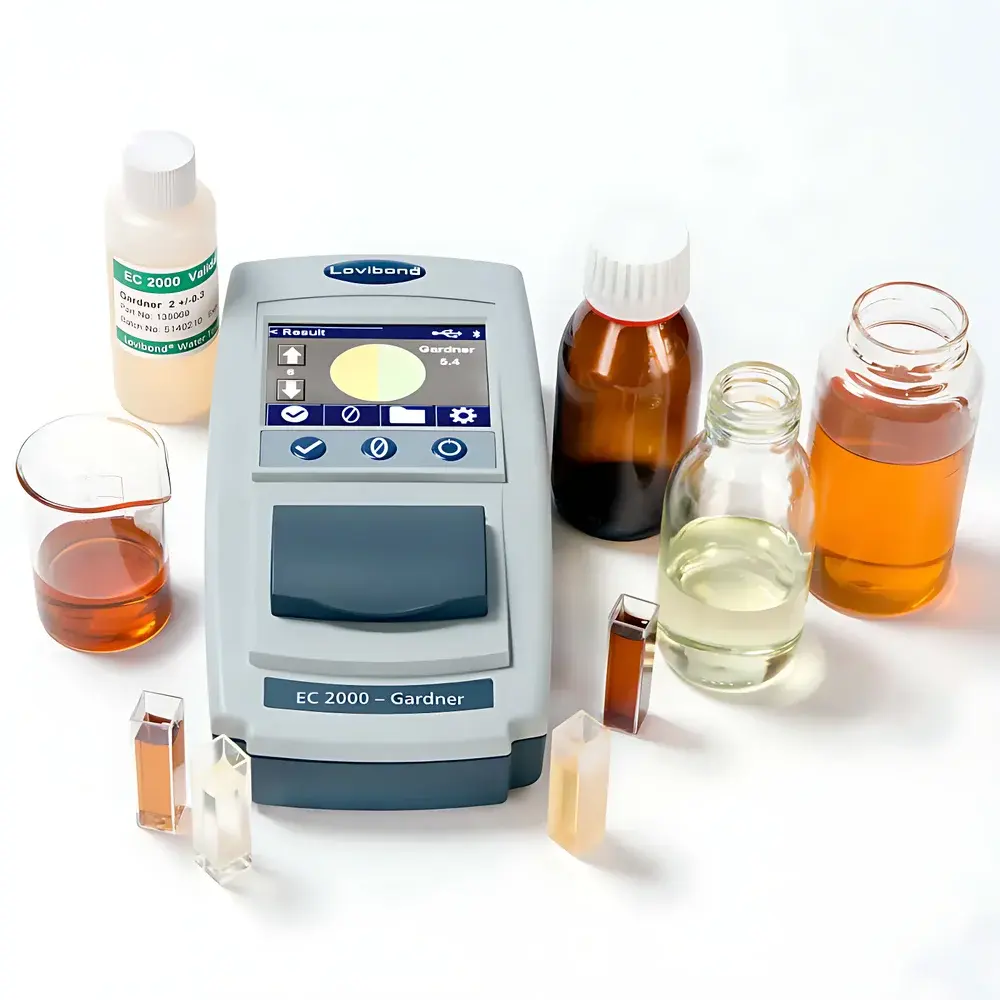
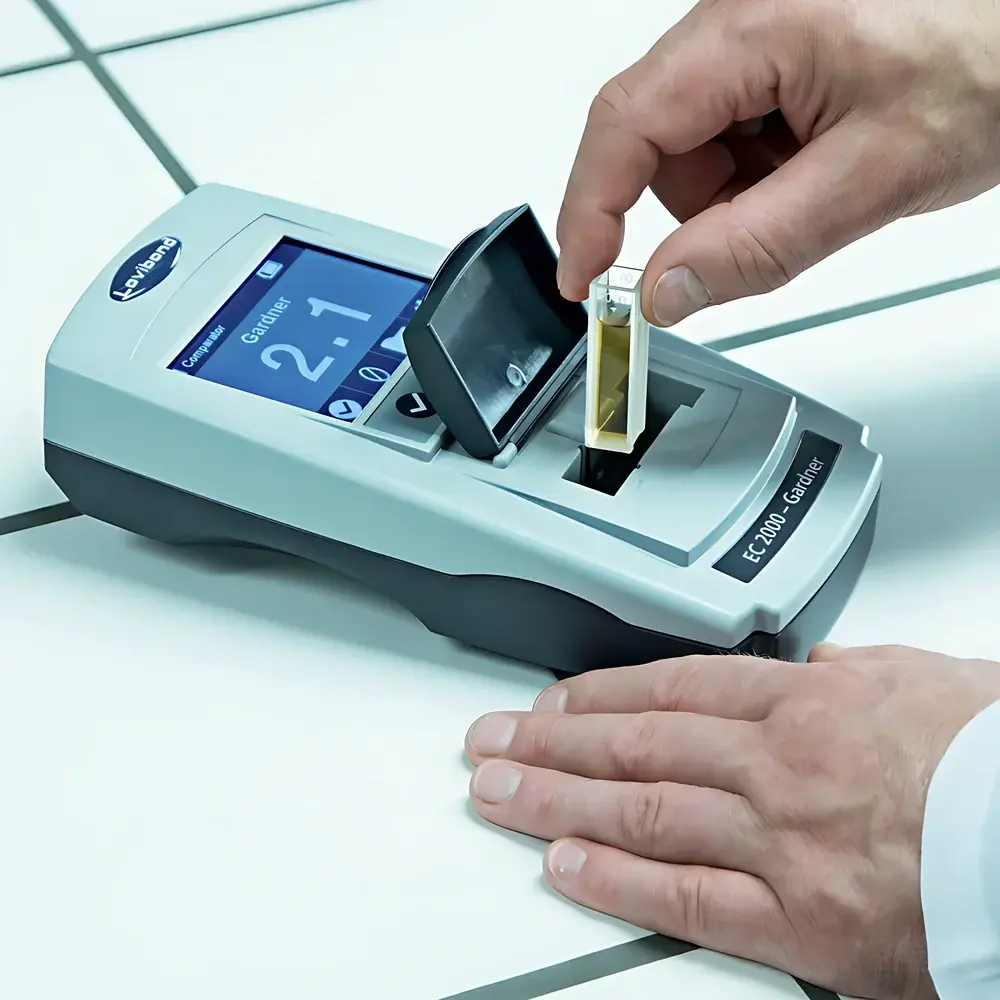
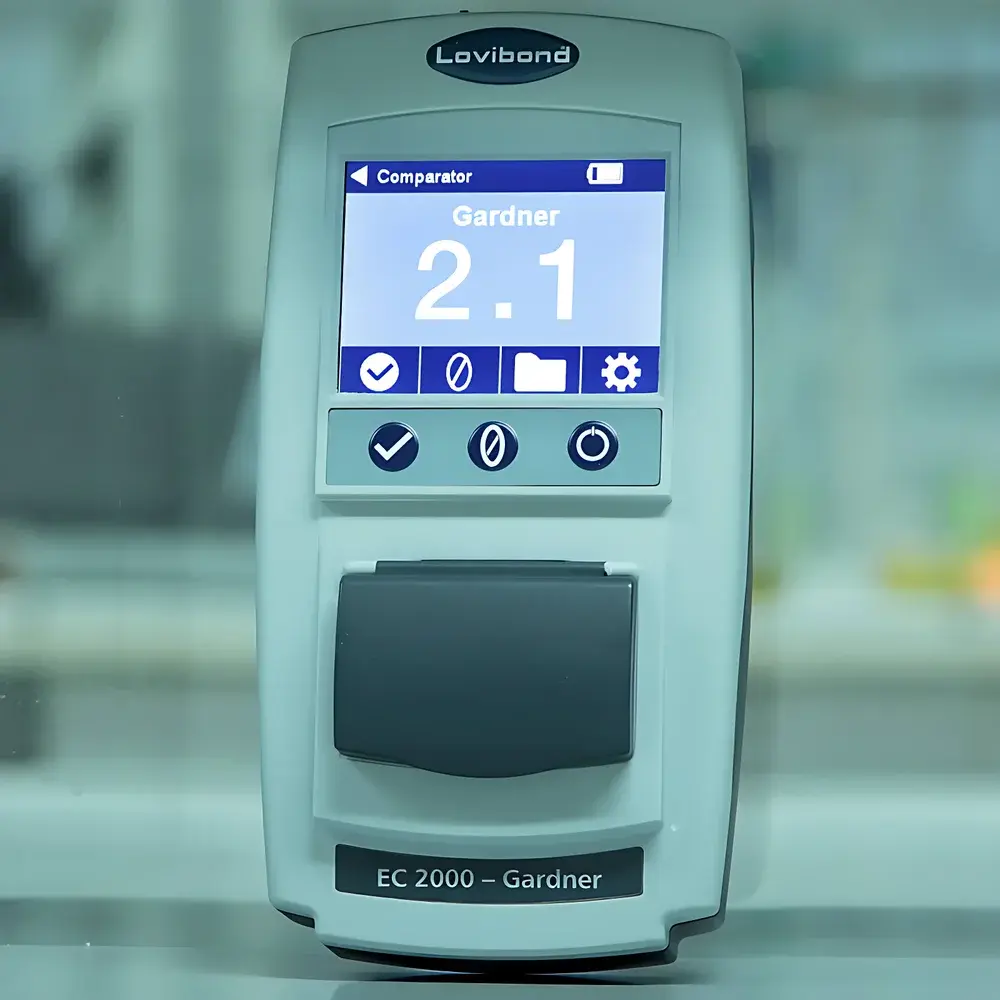
Lovibond EC2000 Gardner Colorimeter
| Brand | Lovibond (Tintometer) |
|---|---|
| Origin | United Kingdom |
| Model | EC2000 Gardner |
| Measurement Range | 0–18 Gardner |
| Resolution | 0.1 Gardner |
| Repeatability | ±0.2 Gardner |
| Path Length | 10 mm |
| Compliance | ASTM D1544, ASTM D6166 |
| Viewing Field | Dual-field |
| Cuvettes | 3 × 10 mm plastic (W100), 1 × 10 mm glass (W100) |
| Calibration Standards | 60 mL reference liquid vial, certified filter set |
Overview
The Lovibond EC2000 Gardner Colorimeter is a precision optical instrument engineered for objective, repeatable quantification of yellow-to-amber color intensity in transparent liquids according to the Gardner color scale. Based on photometric measurement principles—specifically, spectrally weighted transmittance at defined wavelengths—the EC2000 eliminates subjective visual assessment inherent in traditional comparator-based methods. It operates by measuring light attenuation through a standardized 10 mm path length sample cell and converting the signal into a single Gardner unit value (0–18), fully aligned with the empirical Gardner scale defined in ASTM D1544 and referenced in ASTM D6166. Designed for laboratories requiring traceable, operator-independent color evaluation, the EC2000 serves as a bridge between legacy visual practices and modern quality control workflows in coatings, resins, edible oils, fatty acids, and pharmaceutical excipients.
Key Features
- Single-parameter Gardner scale output (0–18) with 0.1-unit resolution and ±0.2-unit repeatability under controlled ambient conditions
- Dual-field viewing system enabling simultaneous comparison of sample and internal reference or blank—supporting both absolute measurement and relative delta-color assessment
- Optimized optical path architecture with stable tungsten-halogen illumination and interference-filtered detection centered near 430 nm, matching the spectral sensitivity profile of the Gardner scale
- Pre-calibrated with NIST-traceable liquid standards (60 mL vial) and certified solid filter sets, ensuring long-term stability and inter-instrument comparability
- Rugged, benchtop housing with ESD-safe casing and integrated cuvette holder accommodating both W100 plastic (3-position) and W100 glass (1-position) 10 mm path-length cells
- No software dependency for basic operation—fully functional as a standalone instrument with LED display, tactile keypad, and auto-zero function
Sample Compatibility & Compliance
The EC2000 is validated for use with low-turbidity, optically clear liquids including alkyd resins, linseed oil, sunflower oil, soybean oil, tall oil fatty acids, lecithin solutions, and solvent-borne varnishes. Samples must be free of suspended particles (filtration via 0.45 µm membrane recommended) and measured at 25 °C ± 1 °C per ASTM D1544 protocol. The instrument conforms to the photometric methodology and reporting requirements of ASTM D1544 (Standard Test Method for Color of Transparent Liquids [Gardner Color Scale]) and ASTM D6166 (Standard Practice for Color Measurement of Transparent Liquids Using Tristimulus Colorimetry), and supports GLP-compliant documentation when paired with external lab notebooks or LIMS integration. It is not intended for opaque, highly viscous, or fluorescent samples.
Software & Data Management
While the EC2000 functions autonomously without software, optional RS-232 serial interface enables direct data logging to PC-based applications or laboratory information management systems (LIMS). Exported data includes timestamp, sample ID (user-entered), Gardner value, instrument serial number, and calibration status flag. All measurements comply with audit-trail prerequisites for regulated environments: no data can be edited post-acquisition, and calibration events are logged with date/time stamps. Though not 21 CFR Part 11–certified out-of-the-box, the instrument’s deterministic output and immutable record structure support validation protocols required under ISO/IEC 17025, USP , and GMP Annex 11 frameworks when deployed within documented SOPs.
Applications
- Quality release testing of drying oils and modified resins in paint and ink manufacturing
- Batch-to-batch consistency verification of vegetable oil refining processes (e.g., degumming, bleaching)
- Stability monitoring of lipid-based pharmaceutical formulations during accelerated aging studies
- Raw material acceptance testing for fatty acid derivatives used in surfactant synthesis
- Regulatory submission support for color specifications in FDA IND/ANDA dossiers where Gardner units are cited
- Method transfer from visual Gardner tubes to instrumental measurement in contract testing laboratories
FAQ
Does the EC2000 require annual recalibration?
No mandatory annual recalibration is specified; however, users must perform performance verification using the supplied reference liquid before each analytical session or at least daily in high-throughput labs, per ASTM D1544 Section 8.1.
Can the EC2000 measure APHA/Pt-Co or Hazen color?
No—it is purpose-built for the Gardner scale only. Conversion to APHA is not mathematically valid due to differing spectral weighting functions and reference standards.
Is temperature control built into the instrument?
No. External thermostatted sample conditioning (e.g., water bath or Peltier stage) is required to maintain 25 °C ± 1 °C during measurement, as mandated by ASTM D1544.
What cuvette materials are supported?
Both W100-grade polystyrene plastic cuvettes (3-pack) and W100 borosilicate glass cuvettes (1-unit) are compatible; glass is recommended for solvents that may craze or dissolve plastic.
How does the dual-field view improve measurement reliability?
It allows real-time side-by-side assessment of sample vs. air blank or reference standard, minimizing observer bias and facilitating immediate identification of cell contamination or improper fill height.



