
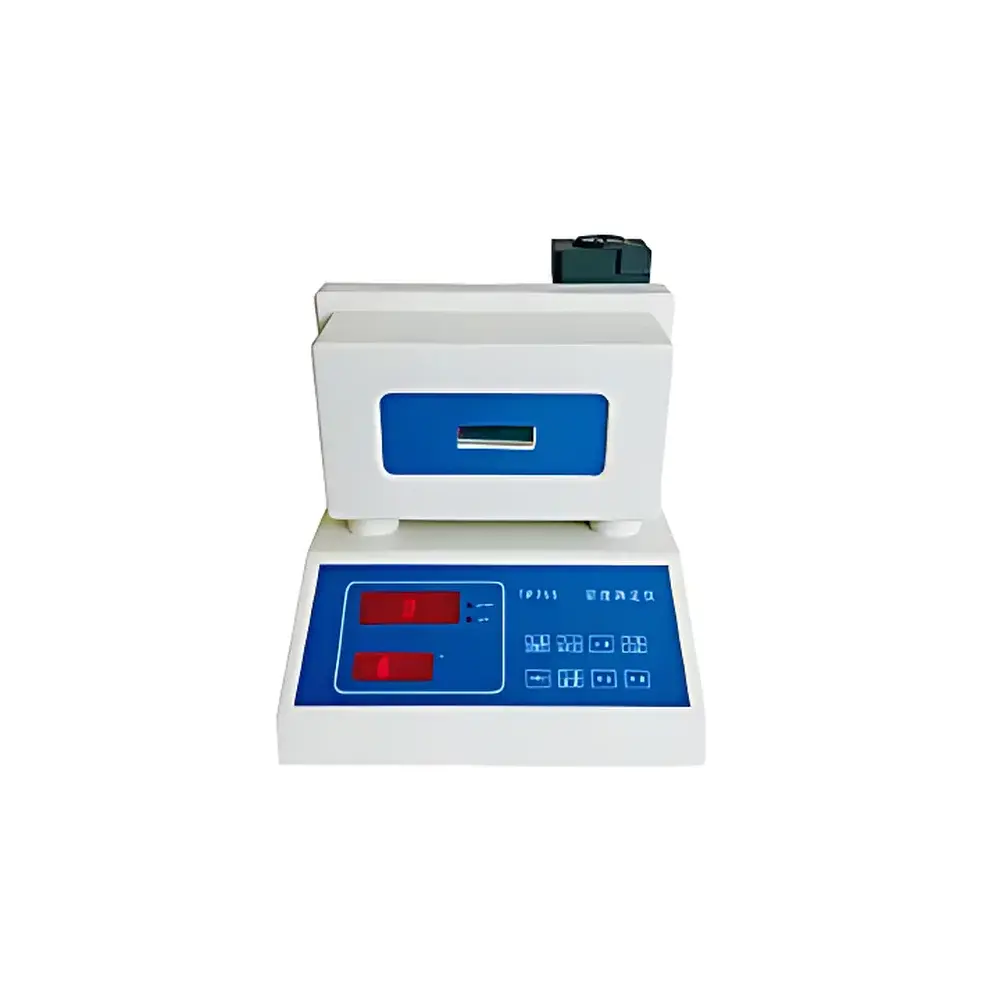
Timepower TP755 Vibrating Tube Density Analyzer for Petrochemical & Pharmaceutical Applications
| Brand | Timepower |
|---|---|
| Origin | Beijing, China |
| Manufacturer Type | Direct Manufacturer |
| Country of Origin | China |
| Model | TP755 |
| Pricing | Upon Request |
| Measurement Principle | Vibrating Tube (Oscillating U-tube) |
| Density Range | 0–1999.9 kg/m³ |
| Alcohol Concentration Range | 0–100% vol |
| Accuracy | ±0.5 kg/m³ (±0.0005 g/cm³) |
| Temperature Control | 20 °C ±0.1 °C (Dual-Chamber Thermostatic Bath) |
| Sample Volume | 2 mL per measurement (auto- or manual aspiration) |
| Sample Throughput | Up to 80 stored measurements |
| Power Supply | AC 220 V ±10%, 50 Hz ±10% |
| Dimensions | 265 × 210 × 205 mm |
| Weight | 3.4 kg |
| Ambient Operating Temperature | 5–40 °C |
| Wetted Materials | Acid/alkali-resistant fluoropolymer tubing (standard optional), general-purpose PTFE/PFA tubing |
| Calibration Standard | Certified pure water (ASTM D1250-compliant procedure recommended) |
Overview
The Timepower TP755 Vibrating Tube Density Analyzer is an engineered solution for high-precision liquid density determination in regulated industrial and research environments. It operates on the fundamental physical principle of oscillating U-tube densitometry: a hollow, U-shaped glass tube—hermetically sealed and filled with the sample—is induced to vibrate at its natural resonant frequency. This frequency exhibits an inverse-square-root dependence on the mass of the contained liquid; by precisely measuring the period of oscillation (typically via piezoelectric excitation and optical or capacitive detection), the instrument calculates density with traceable metrological rigor. The TP755 integrates a dual-chamber thermostatic system to maintain sample temperature at 20 °C ±0.1 °C—aligned with ISO 5725-2 and ASTM D1298 reference conditions—ensuring compliance with standard test methods for petroleum products, pharmaceutical solvents, and aqueous formulations. Its compact benchtop footprint (265 × 210 × 205 mm), low sample consumption (2 mL per analysis), and robust architecture make it suitable for QC laboratories operating under GLP or GMP frameworks where space, reagent economy, and thermal stability are critical constraints.
Key Features
- Vibrating tube sensor with temperature-compensated resonance frequency detection for direct density output in kg/m³ or g/cm³
- Dual-chamber thermostatic bath delivering stable 20 °C ±0.1 °C control—critical for viscosity- and volatility-sensitive samples (e.g., ethanol/water blends, hydrocarbon fractions)
- Automated sample aspiration system reducing operator intervention and cross-contamination risk; manual mode available for viscous or volatile liquids
- Chemically inert fluid path: standard configuration includes acid/alkali-resistant fluoropolymer (FEP/PFA) tubing compliant with USP Class VI and ISO 10993-5 requirements
- Onboard calibration function using certified pure water (conductivity < 1 µS/cm); drift correction routine supports long-term measurement stability
- Integrated temperature sensor co-located with the vibrating tube ensures simultaneous density–temperature pair acquisition per measurement
- Non-volatile memory storing up to 80 measurement records with timestamp, density value, and temperature reading—exportable via USB or RS-232 interface (optional)
Sample Compatibility & Compliance
The TP755 accommodates a broad spectrum of Newtonian and mildly non-Newtonian liquids, including crude oil fractions, refined fuels (gasoline, diesel, jet fuel), pharmaceutical excipients (propylene glycol, PEGs, ethanol–water mixtures), active pharmaceutical ingredient (API) solutions, and food-grade syrups. Its wetted-path design excludes elastomers and metals susceptible to corrosion, enabling reliable operation with aggressive media such as 37% hydrochloric acid, 50% sodium hydroxide, and concentrated organic acids. The instrument meets essential performance criteria outlined in ASTM D4052 (Standard Test Method for Density of Liquids by Digital Density Meter), ISO 12185 (Crude Petroleum and Liquid Petroleum Products — Determination of Density — Digital Density Meters), and USP (Density and Specific Gravity). Its thermal management and repeatability (≤0.2 kg/m³ RSD over 10 replicates) support audit readiness for FDA 21 CFR Part 11–compliant data integrity protocols when paired with validated software.
Software & Data Management
While the TP755 operates autonomously with an integrated LCD display showing real-time density and temperature, optional PC-based software (Timepower DensityLink v3.x) enables advanced functionality: automated report generation (PDF/CSV), statistical process control (SPC) charting, user-access-level management (administrator/operator), electronic signature capture, and full audit trail logging—including parameter changes, calibration events, and data exports. All data entries are time-stamped and immutable post-acquisition, satisfying ALCOA+ principles (Attributable, Legible, Contemporaneous, Original, Accurate, Complete, Consistent, Enduring, Available) required for regulatory submissions to EMA, PMDA, or Health Canada.
Applications
- Petrochemical QA/QC: Density grading of naphtha, kerosene, and lubricant base oils per ASTM D1298 and IP 160
- Pharmaceutical manufacturing: Verification of solvent composition in API synthesis batches; density-based concentration checks for oral solutions and injectables
- Federal metrology labs: Quantitative packaging verification for prepackaged liquids under NIST Handbook 133 or EU Directive 2007/45/EC
- Academic research: Thermophysical property studies of binary and ternary liquid mixtures at controlled temperatures
- Food & beverage R&D: Alcohol content verification in spirits (via density–alcohol correlation tables per OIML R 22), sugar concentration estimation in syrups
FAQ
What calibration standard is required for routine verification?
Certified Type I ultrapure water (resistivity ≥18.2 MΩ·cm, TOC < 5 ppb) is mandatory. Prior to calibration, flush the tube three times with deaerated water and verify absence of microbubbles via visual inspection or acoustic damping signal stabilization.
Can the TP755 measure slurries or suspensions?
No. The vibrating tube principle requires homogeneous, particle-free liquids. Suspended solids may dampen resonance or cause tube clogging; filtration (≤5 µm) is required prior to analysis.
Is the instrument compatible with hazardous area classifications (e.g., ATEX or NEC Class I Div 2)?
The TP755 is rated for general laboratory use only (IEC 61010-1, Pollution Degree 2). It lacks intrinsic safety certification and must be operated outside classified zones.
How often should recalibration be performed?
Daily calibration is recommended for regulated environments; weekly verification suffices for routine academic or internal QC use—provided environmental conditions remain stable and no maintenance has occurred.
Does the device support temperature-controlled measurements at setpoints other than 20 °C?
No. The dual-chamber bath is fixed at 20 °C ±0.1 °C per ISO/ASTM standardization requirements. Non-standard temperatures require external thermostatted baths and manual density–temperature correction using published reference data.





