
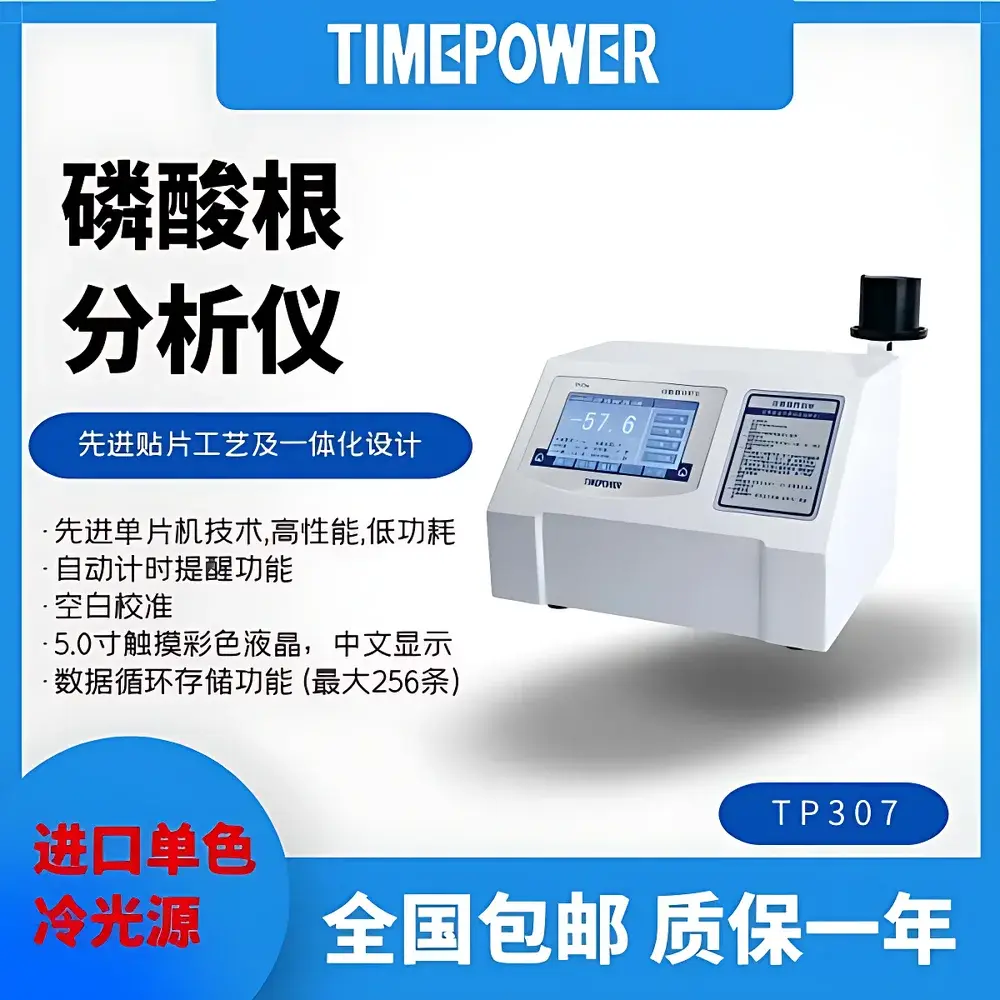
TimePower TP307 Laboratory Phosphate Analyzer
| Brand | TimePower |
|---|---|
| Origin | Beijing, China |
| Manufacturer Type | Direct Manufacturer |
| Instrument Type | Benchtop Laboratory Analyzer |
| Model | TP307 |
| Measurement Method | Phosphovanadomolybdate Colorimetric Method (ISO 6878, ASTM D859) |
| Display | 5.0-inch TFT color touchscreen with Chinese UI |
| Optical Source | Imported monochromatic cold-light LED (λ = 420 nm ± 2 nm) |
| Data Storage | Cyclic memory for ≤256 measurement records with auto-overflow overwrite |
| Calibration | Zero-point blank calibration with drift compensation |
| Power Supply | AC 220 V ± 10 %, 50/60 Hz |
| Dimensions | 320 × 260 × 180 mm |
| Weight | 4.2 kg |
| Compliance | Designed for ISO/IEC 17025-compliant labs |
Overview
The TimePower TP307 Laboratory Phosphate Analyzer is a benchtop photometric instrument engineered for precise, routine quantification of orthophosphate (PO₄³⁻) in ultra-pure and process water matrices. It operates on the internationally standardized phosphovanadomolybdate colorimetric principle—where orthophosphate reacts with ammonium metavanadate and ammonium molybdate under acidic conditions to form a yellow-colored heteropoly acid complex (phosphovanadomolybdic acid), with absorbance measured at 420 nm. This method is fully aligned with ISO 6878:2004 (Water quality — Determination of phosphorus — Ammonium molybdate spectrophotometric method) and ASTM D859-22 (Standard Test Method for Silica in Water), enabling trace-level detection down to 0.01 mg/L PO₄ as P in high-resistivity samples such as power plant condensate, boiler feedwater, and pharmaceutical-grade purified water. The TP307 is not intended for field deployment or continuous online monitoring; it is strictly optimized for controlled laboratory environments where reproducibility, operator traceability, and method compliance are critical.
Key Features
- 5.0-inch high-resolution TFT color touchscreen with intuitive Chinese-language interface—designed for rapid method navigation and parameter entry without external PC dependency.
- Stable optical architecture featuring an imported monochromatic cold-light LED source (420 nm ± 2 nm bandwidth), eliminating thermal drift and ensuring long-term photometric stability over >10,000 measurement cycles.
- Integrated microcontroller platform based on industrial-grade ARM Cortex-M4 architecture—enabling low-power operation (<8 W standby), real-time signal processing, and deterministic timing control for reaction incubation and endpoint detection.
- Onboard zero-point blank calibration routine that compensates for both optical baseline drift and electronic offset, improving measurement repeatability across daily operational shifts.
- Cyclic non-volatile data storage supporting up to 256 timestamped results (date, time, sample ID, concentration, operator code), with automatic overwrite logic to prevent memory overflow—fully compliant with basic GLP record-keeping requirements.
- Modular hardware design using surface-mount technology (SMT) and conformal-coated PCBs—enhancing resistance to humidity and ambient particulate exposure typical in utility chemistry labs.
Sample Compatibility & Compliance
The TP307 accepts aqueous liquid samples within pH 4–9 and conductivity <5 µS/cm (e.g., demineralized water, steam condensate, deaerator outlet water). It is validated for use with reagent-grade phosphoric acid standards traceable to NIST SRM 3139a. Interference mitigation protocols are included for common co-ions: silicate (up to 10 mg/L SiO₂) is suppressed via tartaric acid masking; arsenate interference is minimized by strict adherence to reaction temperature (25 ± 1 °C) and digestion time (120 s). The analyzer meets mechanical and electrical safety requirements per GB 4793.1-2019 (equivalent to IEC 61010-1), and its analytical workflow supports alignment with power industry guidelines including DL/T 502.7–2006 (Thermal Power Plant Chemistry Supervision Regulations) and USP Phosphate in Purified Water.
Software & Data Management
While the TP307 operates autonomously via embedded firmware, optional USB-to-PC connectivity enables raw data export in CSV format—including absorbance values, calibration coefficients, and user-entered metadata. Exported files retain full timestamping (YYYY-MM-DD HH:MM:SS) and support import into LIMS platforms or Excel-based QA review workflows. Audit trail functionality is implemented through immutable internal logging: each calibration event, measurement execution, and parameter change is recorded with operator ID (manually entered) and system-generated UTC timestamp. For regulated environments (e.g., GMP pharmaceutical water systems), optional software modules provide 21 CFR Part 11–compliant electronic signatures and change-control logs upon integration with validated third-party data management systems.
Applications
- Steam cycle chemistry control in fossil-fueled and nuclear power plants—monitoring phosphate hideout in drum-type boilers and detecting carryover in turbine condensate.
- Pharmaceutical water system validation per USP and EU Annex 1—verifying orthophosphate levels in purified water (PW) and water for injection (WFI) distribution loops.
- Chemical process water quality assurance in synthetic fiber production, where phosphate scaling in heat exchangers must be preemptively controlled.
- Environmental lab analysis of low-phosphate surface waters (e.g., reservoirs feeding power station intake) using EPA Method 365.1–derived adaptations.
- Educational laboratories conducting quantitative analytical chemistry experiments on spectrophotometric assay development and method validation.
FAQ
What is the detection range and LOD for the TP307?
The instrument is calibrated for 0.01–10.00 mg/L PO₄ as P, with a limit of detection (LOD) of 0.008 mg/L determined per IUPAC definition (3σ of blank response).
Does the TP307 require daily recalibration?
No—blank calibration is recommended before each analytical batch (≤8 samples), but full multi-point calibration is required only after reagent lot changes or every 72 operational hours, whichever occurs first.
Can the TP307 measure total phosphorus?
No—it measures only orthophosphate (reactive phosphorus). Total phosphorus determination requires prior UV/persulfate digestion, which is outside the scope of this instrument’s design.
Is the reagent kit supplied with the analyzer?
Yes—each TP307 shipment includes one starter kit of certified phosphovanadomolybdate reagents (sufficient for ~200 tests), with lot-specific calibration certificates traceable to CNAS-accredited reference materials.
How is maintenance performed?
Routine maintenance consists of weekly optical path cleaning with lint-free wipes and isopropyl alcohol, quarterly verification of LED intensity using built-in reference check, and annual verification of photodiode linearity against NIST-traceable neutral density filters.
Related Products







