
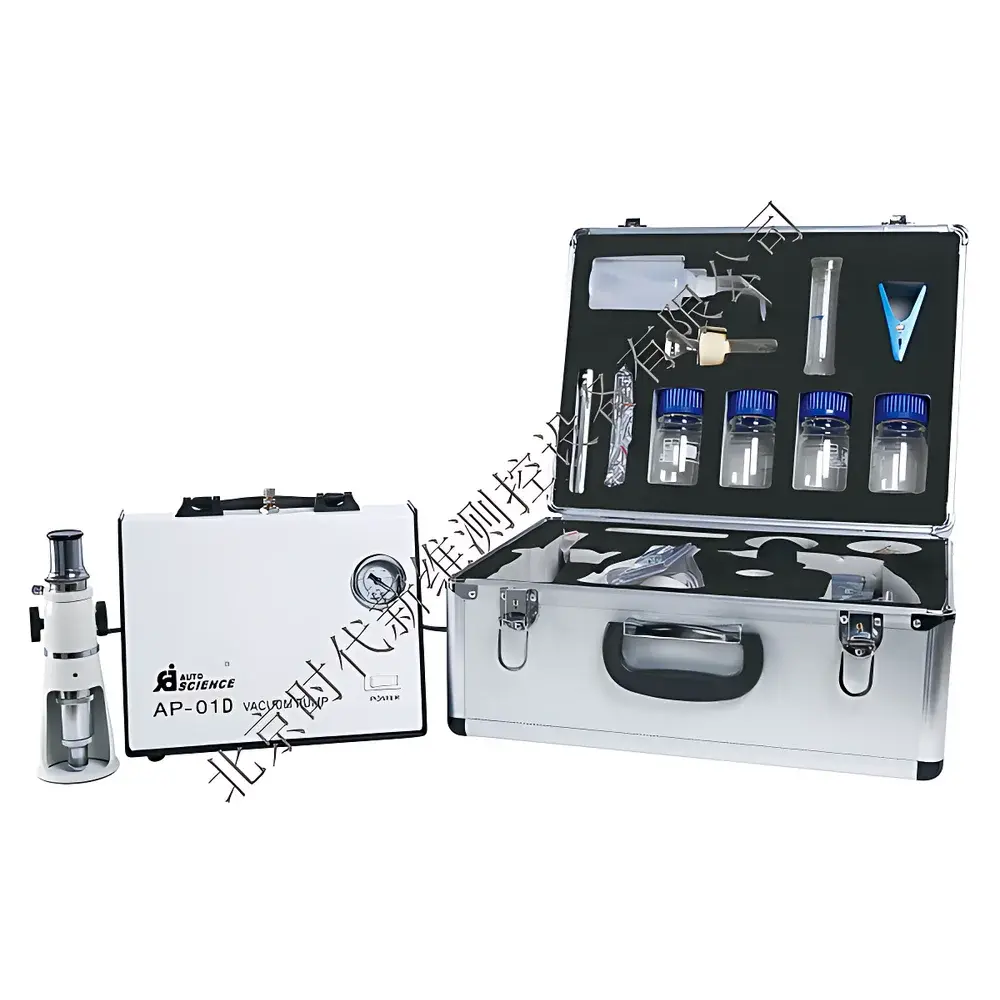
TP691 Portable Oil Particle Contamination Analyzer (TimePower)
| Brand | TimePower |
|---|---|
| Origin | Beijing, China |
| Manufacturer Type | Direct Manufacturer |
| Country of Origin | China |
| Model | TP691 |
| Pricing | Upon Request |
| Measurement Principle | Microscopic Filtration Method (Incident-Light Optical Microscopy) |
| Particle Detection Threshold | ≥5 µm (maximum length dimension) |
| Standard Compliance | DL/T 432, GB/T 20082, ISO 4406, NAS 1638, GB/T 18854, ISO 11171, GJB 420B, GJB 380.4A |
| Magnification | 100× with Integrated Illumination |
| Sample Volume | Standardized for Quantitative Membrane Filtration |
| Contamination Grade Range | NAS Class 4 to 12 |
| Dimensions | 410 mm × 310 mm × 230 mm |
| Weight | 6.4 kg |
| Vacuum Filtration | Manual and Optional Automatic Pump Support |
| Filter Membrane | Standard Microporous Membrane (Pore Size: 0.45 µm or 0.8 µm per application) |
| Counting Method | Manual Particle Enumeration under Microscope |
Overview
The TP691 Portable Oil Particle Contamination Analyzer is an engineered solution for quantitative assessment of solid particulate contamination in industrial lubricants and hydraulic fluids. Designed and manufactured by TimePower in Beijing, this instrument implements the standardized microscopic filtration method—defined in ISO 11171 and referenced by ISO 4406, NAS 1638, and multiple national defense and power industry standards (GJB 420B, DL/T 432). It operates on the principle of quantitative membrane capture followed by optical enumeration: a precisely measured volume of oil sample is vacuum-filtered through a microporous membrane; retained particles are then visualized using incident-light optical microscopy at 100× magnification. Particle size is reported as maximum linear dimension, with detection sensitivity calibrated for particles ≥5 µm. Unlike laser-based or light-obscuration methods, this approach maintains fidelity for non-spherical, agglomerated, or highly viscous samples—including emulsified phosphate ester anti-wear fluids and high-viscosity turbine oils—where optical scattering or flow disruption compromises alternative techniques.
Key Features
- Field-deployable portable architecture (6.4 kg, compact footprint: 410 × 310 × 230 mm) optimized for on-site testing in power plants, refineries, and maintenance workshops.
- Vacuum-assisted filtration system compatible with both manual and optional automated vacuum pumps—reducing filtration time for high-viscosity or water-contaminated oils without compromising particle retention integrity.
- Dedicated incident-light microscope with integrated illumination and calibrated 100× objective lens, ensuring consistent contrast and resolution for reliable manual counting per ASTM D2276 / ISO 4406 Annex A protocols.
- Standardized grading templates aligned to NAS 1638 and ISO 4406 numeric codes, enabling direct correlation between observed particle counts and internationally recognized contamination classes (NAS Class 4–12).
- No consumable electronics or fluidic path components—mechanical robustness ensures long-term stability across variable ambient conditions (10–40 °C, <85% RH).
Sample Compatibility & Compliance
The TP691 is validated for use with a broad spectrum of hydrocarbon- and synthetic-based oils, including but not limited to: phosphate ester anti-wear fluids (e.g., Fyrquel, Skydrol), steam turbine oils (ISO VG 32–68), transformer insulating oils (IEC 60296), and auxiliary system lubricants. Its membrane-based methodology eliminates flow-rate dependency and refractive index limitations—making it uniquely suitable for samples exhibiting severe emulsification, oxidation byproducts, or suspended sludge. The analyzer supports full traceability in regulated environments: documentation workflows align with GLP requirements; raw count data, operator ID, date/time stamp, and filter lot number can be manually logged in accordance with 21 CFR Part 11–compliant recordkeeping practices when integrated into QA/QC laboratory procedures.
Software & Data Management
The TP691 operates as a hardware-only platform with no embedded firmware or proprietary software. All data acquisition and reporting are performed externally via standardized laboratory notebooks or LIMS-integrated spreadsheets. This design eliminates software validation overhead and ensures compatibility with existing digital quality management systems. Users may generate ISO 4406 or NAS 1638 reports using pre-validated Excel templates (supplied with instrument), which implement the exact particle count thresholds and statistical rounding rules specified in ISO 4406:2021 and NAS 1638 Revision E. For audit readiness, each test record includes space for observer signature, environmental conditions, filter membrane batch ID, and vacuum pressure log—supporting full compliance with ISO/IEC 17025 clause 7.7 (Reporting of Results).
Applications
- Condition monitoring of turbine lube oil in thermal and nuclear power generation facilities, per DL/T 432 and IEC 60300-3-3 maintenance guidelines.
- Acceptance testing of new transformer oil prior to commissioning, in accordance with GB/T 7595 and IEEE C57.106.
- Root-cause analysis of servo-valve failures in hydraulic control systems, where ≥5 µm hard particles directly correlate with wear initiation.
- Quality verification of bulk oil deliveries in petrochemical terminals, satisfying GB/T 20082 and ISO 4406 contractual specifications.
- Research-grade particle morphology assessment in tribology laboratories, leveraging manual enumeration to distinguish metallic wear debris from silica or fiber contaminants.
FAQ
What particle size range does the TP691 detect?
The instrument quantifies particles with a maximum linear dimension ≥5 µm, as defined by ISO 11171 and applied in ISO 4406:2021 Annex A.
Is the TP691 compliant with ISO 4406:2021?
Yes—the methodology, filtration protocol, and reporting structure fully satisfy the normative requirements of ISO 4406:2021 for manual microscopic particle counting.
Can it analyze water-contaminated or emulsified oil samples?
Yes. Unlike optical blockage or light-scattering analyzers, the TP691’s membrane capture approach remains effective for emulsified, hazy, or highly viscous oils that would otherwise obstruct flow cells or scatter laser beams.
Does the system require calibration with reference particle suspensions?
No. Calibration is traceable to the physical dimensions of the microscope’s reticle and the certified pore size of the supplied filter membranes (0.45 µm or 0.8 µm), eliminating need for ISO MTD suspensions.
What accessories are required for routine operation?
Standard configuration includes manual vacuum pump, filtration funnel, sample bottle, rinse bottle, glass slides, and certified microporous membranes; optional automatic vacuum pump enhances throughput in high-volume labs.



