
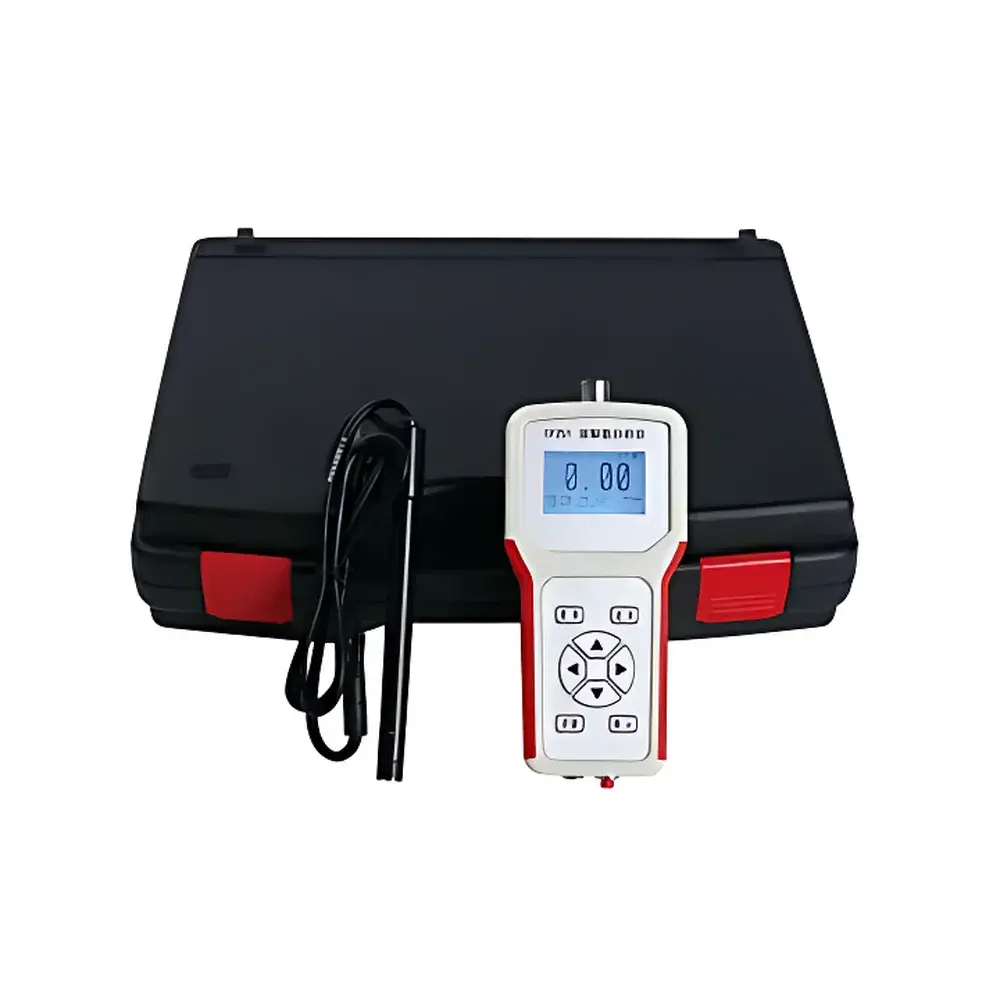
Timepower TP251 Portable Dissolved Oxygen Meter
| Brand | Timepower |
|---|---|
| Origin | Beijing, China |
| Manufacturer Type | Manufacturer |
| Product Category | Domestic |
| Model | TP251 Timepower |
| Instrument Type | Portable |
| Measurement Principle | Fluorescence Quenching Method |
| Measurement Range | 0.00–20.00 mg/L |
| Accuracy | ±0.2 mg/L |
| Repeatability | ≤1% |
| Detection Limit | 2 ppb (typical baseline offset) |
| Resolution | 0.01 mg/L |
| Response Time (T90) | <5 min at 25°C |
| Temperature Compensation Range | 0.0–60.0°C |
| Sample Temperature Range | 5–60°C |
| Operating Ambient Temperature | 5–45°C |
| Relative Humidity | ≤90% RH (non-condensing) |
| Storage/Transport Temperature | −25–55°C (electrode ≥0°C) |
| Display | 128×64 dot-matrix LCD with Chinese interface |
| Power Supply | AC 220±22 V, 50±1 Hz |
| Power Consumption | ≤1 W |
| Battery Life | Up to 8 hours continuous operation |
| Dimensions | 80 × 30 × 175 mm |
| Weight | 0.26 kg |
| Output | 4–20 mA (load <300 Ω) |
| Relay Output | AC 220 V / 3 A or DC 30 V / 3 A |
| Data Storage | Cyclic memory with >10-year data retention after power loss |
| A/D Converter | 24-bit high-precision ADC |
Overview
The Timepower TP251 Portable Dissolved Oxygen Meter is a field-deployable analytical instrument engineered for precise, real-time quantification of dissolved oxygen (DO) in aqueous solutions across environmental, industrial, and municipal water applications. Unlike traditional Clark-type amperometric sensors, the TP251 employs fluorescence quenching technology — a non-consumptive, membrane-based optical method wherein molecular oxygen modulates the lifetime and intensity of a ruthenium-based luminophore immobilized on the sensor tip. This principle eliminates oxygen consumption during measurement, eliminates electrolyte depletion, and provides stable calibration over extended periods without frequent membrane replacement or polarization delay. The instrument is optimized for milligram-per-liter (mg/L) level DO analysis in natural waters, wastewater effluents, boiler feedwater, aquaculture systems, and laboratory process streams — delivering metrological traceability suitable for routine compliance monitoring and QA/QC protocols.
Key Features
- Fluorescence-based sensing architecture ensures zero oxygen consumption, eliminating drift associated with electrochemical polarization and enabling true continuous monitoring.
- Integrated 24-bit analog-to-digital converter delivers high-resolution signal acquisition (0.01 mg/L) and long-term stability (±1% FS/4 h).
- Rugged, handheld form factor (80 × 30 × 175 mm; 0.26 kg) with IP65-rated enclosure supports field deployment in humid, dusty, or splash-prone environments.
- Intuitive Chinese-language graphical user interface on 128×64 dot-matrix LCD simplifies operation for technicians with minimal training requirements.
- Onboard cyclic data storage retains up to 1,000 measurement records with automatic overflow management and non-volatile memory retention exceeding 10 years post-power loss.
- Dual-output capability: isolated 4–20 mA analog output (≤300 Ω load) and programmable relay (AC 220 V / 3 A or DC 30 V / 3 A) for alarm or control integration.
- Extended battery runtime — up to 8 hours of continuous operation on a single charge — facilitates multi-site surveys without external power dependency.
- Automatic temperature compensation (0.0–60.0°C) using integrated NTC thermistor ensures accuracy across variable thermal conditions typical of surface water, cooling towers, and distribution networks.
Sample Compatibility & Compliance
The TP251 is validated for use with low- to medium-conductivity aqueous matrices including freshwater, seawater (with salinity correction), treated wastewater, boiler feedwater (post-cooling), and process rinse solutions. It complies with fundamental performance criteria outlined in ISO 5814:2012 (Water quality — Determination of dissolved oxygen — Electrochemical probe method) and ASTM D888-22 (Standard Test Methods for Dissolved Oxygen in Water), though users must apply appropriate matrix-specific calibration and verification procedures. While not intrinsically certified for hazardous locations, its low-power design (<1 W) and absence of explosive gas pathways support safe operation in Class I, Division 2 environments per NEC guidelines. For regulated facilities operating under GLP or GMP frameworks, the device supports manual audit trails via timestamped data export and permits operator-defined calibration logs — however, it does not implement FDA 21 CFR Part 11 electronic signature or audit trail functionality natively.
Software & Data Management
Data retrieval is performed via manual export through the front-panel interface; the TP251 does not feature USB, Bluetooth, or wireless connectivity. All stored measurements include date/time stamps, DO concentration, temperature reading, and status flags (e.g., “CAL”, “ALARM”). Users may configure relay thresholds and analog output scaling directly from the menu system. Calibration routines support both air-saturation (100% O₂ at local barometric pressure) and zero-oxygen (sodium sulfite solution) points. Each calibration event is recorded with operator ID entry (manual text input), supporting basic traceability in non-automated QA workflows. Firmware updates are performed exclusively by authorized service centers — no field-upgradable software architecture is provided.
Applications
- Environmental monitoring: In-situ DO profiling in rivers, lakes, wetlands, and estuaries for ecological health assessment and regulatory reporting (e.g., EPA Method 360.1 adaptation).
- Municipal wastewater treatment: Aeration basin optimization, secondary clarifier effluent verification, and disinfection contact tank monitoring.
- Power generation: Boiler feedwater and condensate return line surveillance to prevent oxidative corrosion in steam cycles.
- Aquaculture and fisheries: Real-time DO mapping in ponds, raceways, and recirculating aquaculture systems (RAS) to maintain optimal dissolved oxygen tension for species-specific respiration.
- Pharmaceutical water systems: Monitoring purified water (PW) and water-for-injection (WFI) distribution loops where low-level DO may indicate biofilm risk or system integrity breaches.
- Educational laboratories: Teaching core principles of aquatic chemistry, sensor physics, and environmental instrumentation without requiring benchtop infrastructure.
FAQ
Does the TP251 require membrane replacement or electrolyte refilling?
No — unlike amperometric DO sensors, the fluorescence-based optical sensor uses a solid-state luminophore layer and does not rely on liquid electrolyte or gas-permeable membranes subject to drying or fouling.
Can the instrument be used directly in hot boiler feedwater?
No — sample temperature must remain within 5–60°C. Hot water (>60°C) must first be cooled using an inline heat exchanger or bypass cooler to avoid sensor damage and measurement error.
Is the TP251 compliant with FDA 21 CFR Part 11 for electronic records?
No — it lacks electronic signature capability, automated audit trails, or secure user authentication. It is intended for non-GxP field screening or supplementary data collection only.
What is the recommended calibration frequency for routine use?
Daily calibration is advised for critical applications (e.g., wastewater discharge monitoring); weekly calibration suffices for ambient water surveys when instrument stability is verified against reference standards.
How should the sensor be stored during prolonged non-use?
Store the probe upright in its protective cap with a small volume of storage solution (provided with electrode kit) to maintain luminophore hydration. Avoid freezing or exposure to direct sunlight.







