
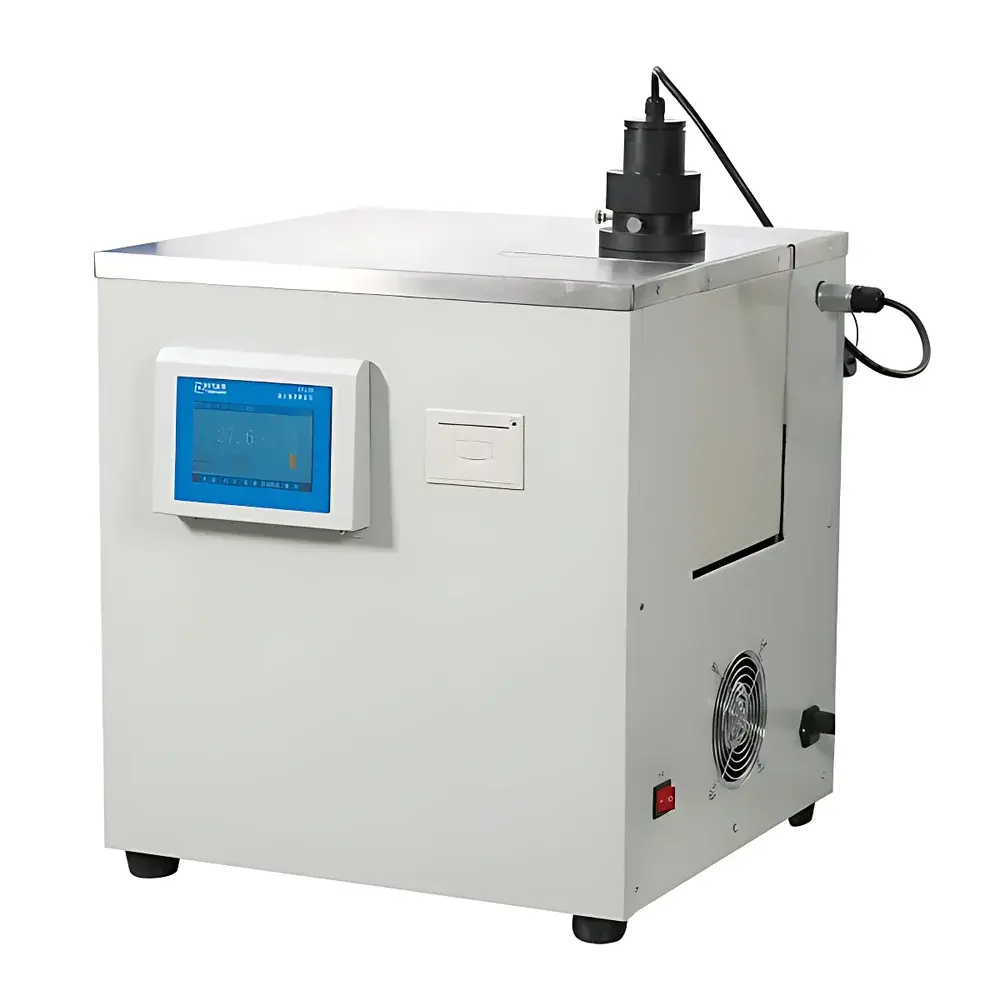
Timepower TP526 Automated Pour Point and Cloud Point Tester
| Brand | Timepower |
|---|---|
| Model | TP526 |
| Origin | Beijing, China |
| Manufacturer | Timepower Measurement & Control Equipment Co., Ltd. |
| Temperature Range | Ambient to –70 °C |
| Accuracy | ±1 °C |
| Resolution | 0.1 °C |
| Cooling Method | High-efficiency compressor-based refrigeration |
| Heating Capability | Up to 50 °C |
| Display | LCD touchscreen interface |
| Printer | Thermal printer (36-character Chinese/English output) |
| Power Supply | AC 220 V ±10%, 50 Hz ±10% |
| Power Consumption | <300 W |
| Dimensions | 460 × 310 × 480 mm |
| Weight | 21.3 kg |
| Compliance Standards | GB/T 510, GB/T 3535, ASTM D2386, ASTM D97 |
| Operating Environment | 5–40 °C, ≤85% RH |
Overview
The Timepower TP526 Automated Pour Point and Cloud Point Tester is a fully integrated, microprocessor-controlled instrument engineered for precise determination of pour point and cloud point in crude oils, lubricants, distillates, and other dark petroleum products. It operates on the principle of controlled cooling followed by sequential visual or automated mechanical detection of flow cessation (pour point) or wax crystal formation (cloud point), in strict accordance with internationally recognized test methods including ASTM D97 (Standard Test Method for Pour Point of Petroleum Products), ASTM D2386 (Standard Test Method for Freezing Point of Aviation Fuels), GB/T 510 (Chinese national standard for pour point), and GB/T 3535 (general method for cloud point of petroleum products). Unlike capillary-based or manual tilt methods, the TP526 employs programmable cooling ramping, real-time temperature monitoring, and automatic sample tilting at defined intervals—ensuring full compliance with standard-defined procedural sequences while eliminating operator-dependent variability.
Key Features
- Wide operational temperature range from ambient to –70 °C, enabled by a high-reliability industrial-grade compressor refrigeration system with optimized thermal insulation and uniform bath circulation.
- Intuitive 7-inch LCD touchscreen interface supporting multilingual menu navigation (English and Chinese), real-time temperature curve visualization, and step-by-step guided operation.
- Automated tilt mechanism synchronized precisely with temperature decrements per ASTM/GB protocols—tilt angle, duration, and frequency are fully configurable to match specific method requirements.
- Dual-mode testing: selectable “Rapid Mode” for preliminary screening (with accelerated cooling and reduced dwell time) and “Standard Mode” for full-compliance reporting required in regulatory or certification contexts.
- Integrated thermal printer with 36-character line capacity, capable of printing test ID, date/time stamp, final result (°C), method reference, and operator code—all in native Chinese or English as configured.
- Onboard diagnostics with fault-code display (e.g., refrigeration timeout, sensor drift, tilt motor stall), enabling rapid troubleshooting without external service tools.
- User-customizable cooling profiles—including ramp rate (°C/min), hold times at critical sub-zero thresholds, and termination logic—facilitating method adaptation for non-standard or proprietary specifications.
Sample Compatibility & Compliance
The TP526 accommodates standard ASTM D97 and GB/T 510 sample tubes (typically 34 mm OD × 125 mm length) and supports viscous and opaque samples without pre-dilution or filtration. Its design eliminates viscosity-related measurement bias, making it suitable for heavy fuel oils, bitumen blends, synthetic lubricants, and bio-derived hydrocarbons. The instrument meets functional requirements for ISO/IEC 17025-accredited laboratories and supports audit-ready documentation for GLP and GMP environments. While not inherently 21 CFR Part 11 compliant out-of-the-box, its firmware architecture allows integration with validated LIMS or ELN systems via RS232/USB serial export of raw temperature-time data and result logs.
Software & Data Management
Data acquisition and storage are handled internally via non-volatile memory, retaining up to 500 test records with timestamps, method parameters, and pass/fail flags. Export options include USB flash drive transfer of CSV-formatted datasets containing full temperature vs. time series, tilt event markers, and final endpoint determination. Optional PC software (Timepower LabLink v3.x) provides graphical overlay of multiple runs, statistical trend analysis (mean, SD, RSD), and customizable report generation aligned with internal QA templates or third-party submission formats (e.g., ASTM-certified PDF reports). All digital outputs include embedded metadata such as instrument ID, calibration due date, and operator login trace.
Applications
This instrument serves critical quality control and formulation development functions across upstream, midstream, and downstream petroleum operations. In refineries, it verifies cold-flow performance of diesel fractions prior to winter-grade blending. In pipeline operations, it assesses pour point depression efficacy of additive packages under simulated transit conditions. Power generation facilities use it to screen turbine oils and insulating fluids for low-temperature operability in arctic substations. Independent testing labs deploy the TP526 for contract analysis supporting ASTM D97 certification, customs clearance (e.g., SGS or BV verification), and API RP 1175 conformance assessments. Research institutions utilize its programmable cooling flexibility to study wax crystallization kinetics and phase transition thermodynamics in unconventional feedstocks.
FAQ
What standards does the TP526 explicitly support?
It is factory-configured and validated for ASTM D97, ASTM D2386, GB/T 510, and GB/T 3535. Custom protocol loading is supported via firmware update.
Can the instrument be used for both pour point and cloud point measurements?
Yes—its dual-sensor architecture (PT100 precision RTD + optical flow detector) and programmable tilt logic enable unambiguous differentiation between cloud formation onset and complete flow arrest.
Is external calibration required before first use?
The unit ships with NIST-traceable temperature calibration certificates for –70 °C to 50 °C; field verification using certified reference fluids (e.g., SRM 1484) is recommended per ISO/IEC 17025 clause 6.5.
How is data integrity maintained during power interruption?
All active test sessions are auto-saved to EEPROM at 30-second intervals; recovery resumes from last stable state upon reboot without data loss.
Does the TP526 require routine refrigerant servicing?
No—the sealed compressor system is maintenance-free for ≥8,000 hours of cumulative operation; annual condenser coil cleaning is advised in dusty environments.





