
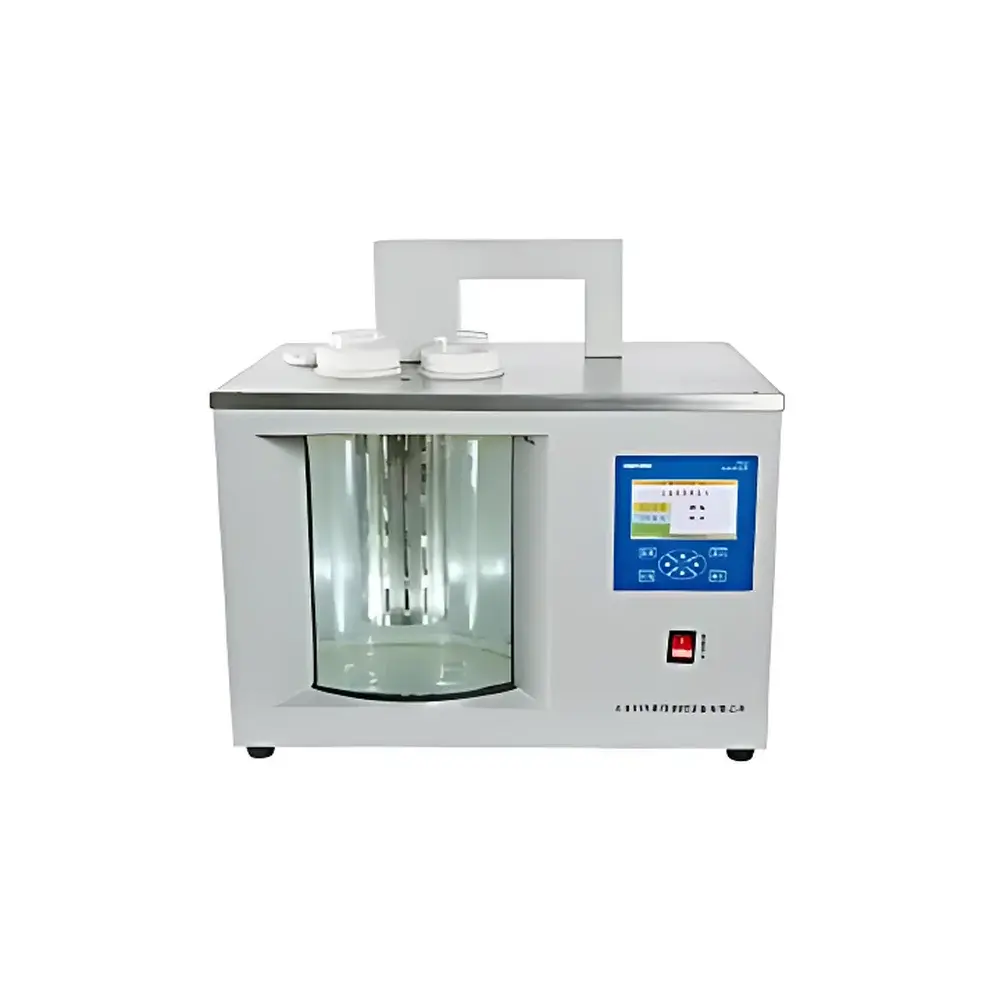
Timepower TP655 Petroleum Density Analyzer
| Brand | Timepower |
|---|---|
| Origin | Beijing, China |
| Manufacturer Type | Direct Manufacturer |
| Country of Origin | China |
| Model | TP655 |
| Pricing | Upon Request |
| Display | 480×272 color LCD, Chinese GUI |
| Control System | Microprocessor-based |
| Temperature Control | PID-regulated |
| Temp Range | 0–100 °C (with optional immersion chiller for sub-ambient operation) |
| Temp Accuracy | ≤ ±0.1 °C |
| Temp Resolution | 0.1 °C |
| Bath Capacity | Dual-sample wells |
| Stirring Speed | 1200 ± 12 rpm |
| Power Supply | AC 220 V ± 10 %, 50 Hz ± 10 % |
| Heating Power | ≤ 1500 W |
| Total Power Consumption | ≤ 1800 W |
| Dimensions | 510 × 365 × 470 mm |
| Weight | 20 kg |
| Ambient Operating Conditions | 5–40 °C, ≤ 85 % RH |
| Compliance | Designed per GB/T 1884–2000 (equivalent to ASTM D1298 and ISO 3675) |
Overview
The Timepower TP655 Petroleum Density Analyzer is a precision laboratory instrument engineered for the gravimetric determination of density in crude oils, refined petroleum products, and petroleum–nonpetroleum blends under standardized thermal equilibrium conditions. It operates on the principle of hydrometric measurement—based on Archimedes’ law—where a calibrated glass petroleum hydrometer floats freely in a temperature-stabilized liquid sample within a water bath. The instrument strictly adheres to the procedural requirements of GB/T 1884–2000, which aligns with international standards including ASTM D1298 (Standard Test Method for Density, Relative Density, or API Gravity of Crude Petroleum and Liquid Petroleum Products by Hydrometer Method) and ISO 3675 (Crude Petroleum and Petroleum Products — Laboratory Determination of Density — Hydrometer Method). Designed for use at atmospheric pressure (101.325 kPa), the TP655 supports density measurements across a broad operational temperature range (0–100 °C), with optional immersion chilling enabling sub-ambient testing down to ambient minus 20 °C. Its dual-bath configuration allows parallel analysis of two independent samples, improving throughput without compromising thermal stability or measurement repeatability.
Key Features
- Microprocessor-controlled PID temperature regulation ensures rapid thermal equilibration and long-term stability within ±0.1 °C—critical for minimizing thermal drift during hydrometer reading.
- Dual independent sample wells accommodate simultaneous analysis while maintaining individual thermal integrity; each well features integrated magnetic stirring (1200 ± 12 rpm) for uniform temperature distribution.
- High-contrast 480×272 color LCD display with full Chinese graphical user interface enables intuitive navigation via unmarked tactile keypad—no language barrier for domestic laboratory personnel.
- Integrated LED illumination system provides consistent, flicker-free backlighting for accurate meniscus reading; optical design minimizes parallax error and glare during visual hydrometer interpolation.
- Robust stainless-steel water bath housing with reinforced acrylic viewing panels ensures structural durability, corrosion resistance, and optical clarity over extended service life.
- Expandable architecture supports optional immersion-type refrigeration module for low-temperature density testing—essential for high-wax crudes or low-volatility distillates requiring sub-ambient stabilization.
Sample Compatibility & Compliance
The TP655 is validated for transparent and translucent liquids with Reid Vapor Pressure (RVP) ≤ 180 kPa, covering a wide spectrum of feedstocks and finished products—including naphthas, diesel fuels, lubricating oils, residual fuel oils, and blended biofuels. It accommodates both low-viscosity fluids (e.g., gasoline fractions) and moderately viscous materials (up to ~150 mm²/s at 40 °C), provided sufficient thermal stabilization time is allowed prior to hydrometer insertion. All operational protocols conform to GLP documentation requirements, with built-in timestamped event logging for audit readiness. While the instrument itself does not generate electronic records compliant with FDA 21 CFR Part 11, its manual measurement workflow is fully compatible with paper-based or LIMS-integrated reporting systems used in ISO/IEC 17025-accredited petroleum testing laboratories.
Software & Data Management
The TP655 operates as a standalone benchtop analyzer with embedded firmware—no external PC or proprietary software required. All system parameters (setpoint temperature, stir speed, runtime, ambient conditions) are stored in non-volatile memory and recalled at power-up. The interface logs start/end timestamps and operator ID (manually entered) for each test cycle. Raw data—hydrometer scale reading and observed sample temperature—are manually recorded by the user; the unit does not perform automatic density correction or API gravity conversion. However, it includes reference lookup tables aligned with ASTM D1250 and ISO 91–1 for manual application of temperature-corrected density values. For digital integration, RS-232 or USB-to-serial adapters may be used to relay status signals (e.g., “temp stable”, “stir active”) to external SCADA or lab automation platforms.
Applications
- Quality control of incoming crude oil batches at refineries, verifying compliance with contractual density/API gravity specifications.
- Intermediate process monitoring of fractionation streams—e.g., stabilizer overheads, kerosene cuts, and vacuum gas oils—where real-time density correlates strongly with hydrocarbon composition.
- Research and development of alternative fuel blends (e.g., ethanol–gasoline, FAME–diesel), where density serves as a primary indicator of homogeneity and phase stability.
- Regulatory testing for environmental agencies assessing fuel adulteration or mislabeling based on deviations from certified density baselines.
- Calibration verification of online densitometers deployed in pipeline custody transfer stations, using TP655 as a traceable reference standard.
FAQ
What standards does the TP655 comply with?
It is designed and validated per GB/T 1884–2000, with methodological equivalence to ASTM D1298 and ISO 3675.
Can the instrument measure samples below ambient temperature?
Yes—when equipped with the optional immersion chiller accessory, it achieves stable operation from 0 °C down to approximately 5 °C below ambient.
Is automatic density calculation included?
No—the TP655 provides stabilized thermal conditions and precise temperature readout; final density correction requires manual application of ASTM D1250 or ISO 91–1 look-up tables.
What safety precautions apply during operation?
Always fill the water bath before powering on; ensure proper grounding; maintain water level below overflow threshold when inserting sample cylinders; never operate without verified stirrer function or thermal sensor feedback.
How often should calibration verification be performed?
Hydrometers must be certified annually per ISO 4787; bath temperature sensors should be verified against a NIST-traceable reference thermometer at least quarterly—or before each critical test series.





