
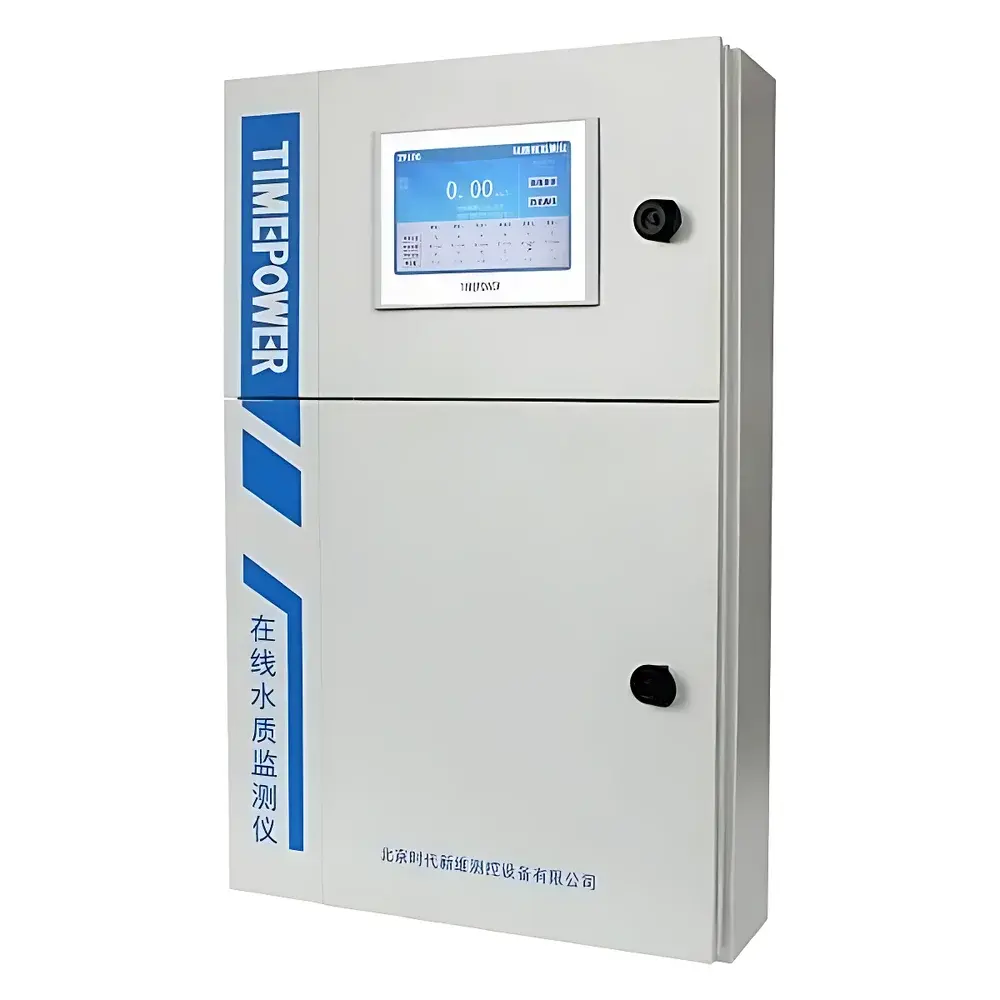
Timepower TP-106 Online Silicate Analyzer
| Brand | Timepower |
|---|---|
| Origin | Beijing, China |
| Manufacturer | Timepower Co., Ltd. |
| Type | Online Analyzer |
| Model | TP-106 |
| Measurement Principle | Molybdenum Blue Photometric Method |
| Display | 7.0-inch Color TFT Touchscreen (Chinese UI) |
| Range Options | 0.0–200.0 µg/L or 0.0–2000 µg/L |
| Accuracy | ±2% F.S. |
| Repeatability | ±1% F.S. |
| Cycle Time | ~12 min per channel |
| Channels | 1–6 configurable |
| Sample Flow Rate | 10–40 L/h |
| Sample Temp. | 5–45 °C |
| Max. Suspended Solids | <5 µm, non-colloidal |
| Ambient Temp. | 5–45 °C |
| Humidity | ≤90% RH (non-condensing) |
| Reagent Consumption | ~2 L/month per reagent (4 reagents total) |
| Digital Output | RS232 / RS485 |
| Analog Output | Isolated 0–20 mA / 4–20 mA / 0–10 mA selectable |
| Alarm Outputs | Independent per channel (sample loss, high/low limit) |
| Power Supply | AC 220 V ±10%, 50 Hz ±10% |
| Power Consumption | ≤100 W |
| Dimensions | 460 × 281 × 720 mm (W×D×H) |
| Panel Cutout | 670 × 410 mm |
| Weight | ~20 kg |
Overview
The Timepower TP-106 Online Silicate Analyzer is a dedicated photometric instrument engineered for continuous, unattended quantification of dissolved silicate (as SiO₂) in aqueous process streams. It operates on the standardized molybdenum blue spectrophotometric method—fully compliant with GB/T 12149–2017, which aligns with internationally recognized wet-chemical principles for silicate determination in industrial water systems. The analyzer integrates sample conditioning, precise reagent dosing, temperature-controlled color development, and optical detection within a single compact chassis. Designed for deployment in demanding environments—including boiler feedwater, condensate, circulating cooling water, and ultrapure water loops—the TP-106 delivers stable, trace-level measurements down to sub-ppb resolution without manual intervention beyond periodic reagent replenishment and calibration verification.
Key Features
- Modular multi-channel architecture supporting 1–6 independent measurement paths—enabling simultaneous monitoring of multiple sampling points while optimizing footprint and operational cost.
- High-reliability solenoid valves with extended service life and sub-microliter dosing precision ensure consistent reagent addition and minimal carryover between cycles.
- Integrated thermostatic reaction chamber maintains optimal color-development temperature (typically 25 °C), minimizing kinetic variability and enhancing inter-laboratory reproducibility.
- 7.0-inch full-color resistive touchscreen interface with intuitive Chinese-language navigation; real-time display of silicate concentration, sample temperature, system status, and elapsed time—all visible simultaneously.
- Onboard data logging stores up to 6,000 timestamped records including measured values, calibration events, fault logs, and maintenance alerts—supporting internal audit trails and basic GLP documentation.
- Robust optical subsystem featuring a long-life monochromatic cold light source (LED-based) and solid-state photodetector, delivering stable absorbance readings over extended operational periods with negligible drift.
Sample Compatibility & Compliance
The TP-106 accepts clarified liquid samples with suspended solids <5 µm and no colloidal silica interference—consistent with typical pretreatment requirements for power plant and semiconductor-grade water systems. It meets mechanical and electrical safety standards applicable to Class I, Division 2 hazardous locations when installed per manufacturer guidelines. While not certified to IEC 61508 or SIL-2, its architecture supports integration into safety-related loops via external logic solvers. Data integrity features—including password-protected configuration access and non-volatile memory retention—facilitate alignment with FDA 21 CFR Part 11 expectations for electronic records in regulated pharmaceutical and biotech applications. All wetted materials (PFA tubing, quartz flow cells, ceramic valve seats) are chemically inert to common water treatment chemicals including hydrazine, ammonia, and low-concentration phosphonates.
Software & Data Management
The embedded firmware provides dual-mode operation: continuous real-time monitoring or programmable interval sampling (e.g., every 15, 30, or 60 minutes). Analog outputs (4–20 mA isolated) are field-configurable per channel and mapped linearly to user-defined concentration ranges—enabling direct interfacing with DCS, PLC, or automatic chemical dosing controllers. Digital communication via RS485 Modbus RTU allows centralized readout of all channels, diagnostic codes, and alarm states using standard SCADA protocols. Internal storage retains full measurement history even during network outages; data export is supported via USB flash drive in CSV format for offline trend analysis. Firmware updates are performed locally via USB without requiring factory service visits.
Applications
- Thermal power plants: Monitoring silica breakthrough in condensate polishers and feedwater trains to prevent turbine blade deposition.
- Chemical & petrochemical facilities: Ensuring silica compliance in high-purity process water used for catalyst preparation and reactor cooling.
- Pharmaceutical manufacturing: Verifying USP and EP 2.2.44 silica limits in Water for Injection (WFI) distribution loops.
- Municipal drinking water treatment: Tracking silica leaching from cementitious pipe linings and ion exchange resins.
- Electronics-grade ultrapure water (UPW) systems: Supporting ISO 3696 Grade 1 water specifications where silica must remain below 10 µg/L.
FAQ
What regulatory standards does the TP-106 comply with?
It conforms to GB/T 12149–2017 for analytical methodology and incorporates design elements aligned with ISO/IEC 17025 general requirements for competence of testing laboratories.
Can the TP-106 be integrated into an existing DCS environment?
Yes—via isolated 4–20 mA analog outputs or RS485 Modbus RTU digital interface, both configurable per channel.
How often does the system require maintenance?
Reagents should be replaced monthly; optical windows require cleaning every 3–6 months depending on sample turbidity; annual verification of photometric linearity and valve timing is recommended.
Is remote diagnostics supported?
No built-in Ethernet or cloud connectivity is provided; however, third-party gateways can bridge RS485 to IP networks for remote monitoring.
Does the analyzer support automatic calibration verification?
It performs scheduled zero/span checks using onboard standards but requires manual introduction of calibration solutions—no auto-dilution or standard reservoir is included.
Related Products







