
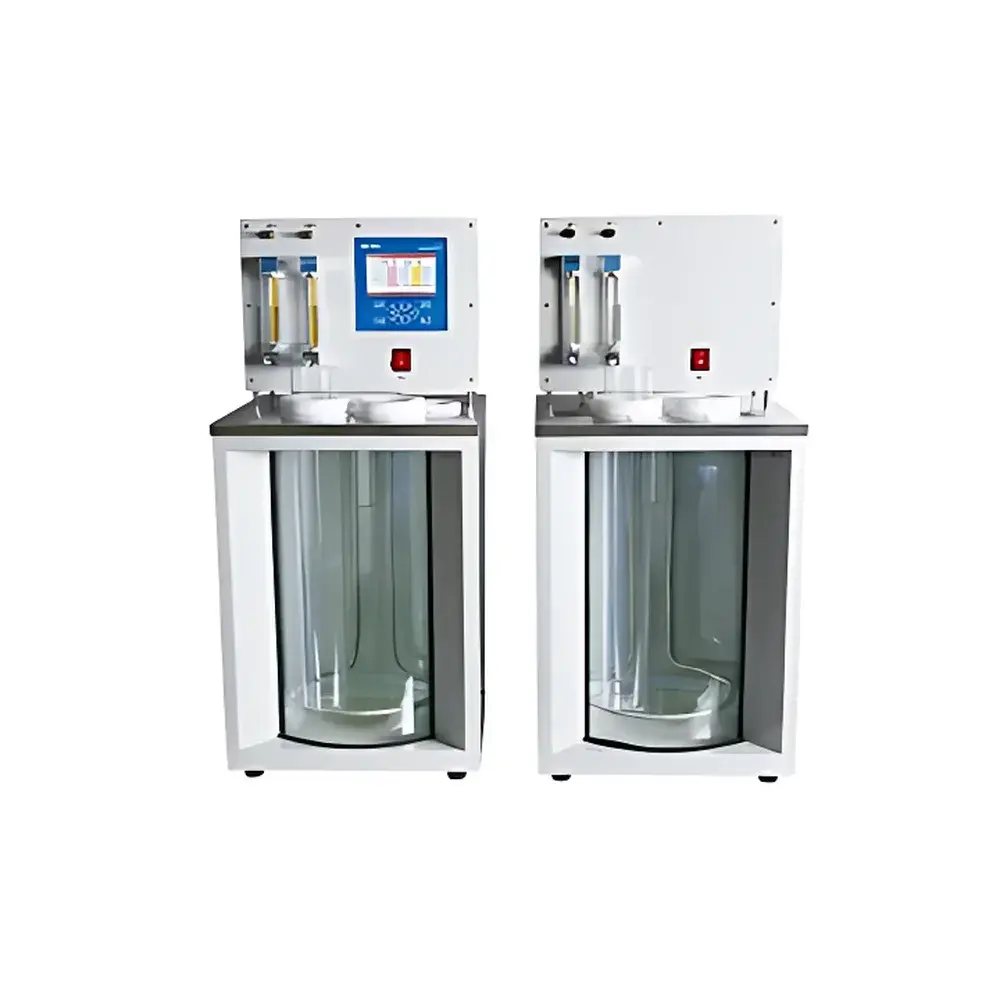
TimePower TP652 Foam Characteristics Analyzer
| Brand | TimePower |
|---|---|
| Origin | Beijing, China |
| Manufacturer Type | Direct Manufacturer |
| Product Origin | Domestic (China) |
| Model | TP652 |
| Temperature Control Range | 0 °C to 100 °C |
| Temperature Accuracy | ±0.5 °C |
| Air Flow Rate | 16–160 mL/min (adjustable via rotameter) |
| Air Source | Integrated silent air pump, 3 L/min output |
| Gas Diffusion Head Capacity | 3000–6000 mL/min at 2.45 kPa |
| Timing Resolution | ±1 s (automated) |
| Display | LCD interface |
| Power Supply | AC 220 V ±10%, 50 Hz ±10% |
| Max. Power Consumption | ≤2300 W |
| Dimensions (W×D×H) | 340 × 340 × 740 mm |
| Net Weight | 23 kg |
| Operating Environment | 5–40 °C, RH ≤85% |
| Compliance | GB/T 12579, ISO 6247, ASTM D892 |
Overview
The TimePower TP652 Foam Characteristics Analyzer is a precision-engineered instrument designed for the standardized evaluation of foam tendency and foam stability in lubricating oils and related petroleum-based fluids. It operates on the principle of controlled air sparging through a calibrated gas diffusion head into a precisely temperature-regulated oil sample, followed by quantitative volumetric measurement of generated foam layers in graduated cylinders. The system implements dual-temperature sequential testing—first at 24 °C (standard ambient condition), then at 93.5 °C (high-temperature condition), with post-thermal recovery retesting at 24 °C—to assess both initial foaming behavior and thermal resilience of foam suppression additives. Its architecture conforms to the hydrodynamic and thermoregulatory requirements defined in GB/T 12579, ISO 6247, and ASTM D892, ensuring traceable, interlaboratory-comparable results essential for quality control in lubricant formulation, refinery QC, and third-party certification laboratories.
Key Features
- PID-based digital temperature control with ±0.5 °C accuracy across a 0–100 °C range; optional immersion chiller enables sub-ambient stabilization when ambient temperature exceeds 24 °C.
- Integrated low-noise air supply delivering consistent 3 L/min output; four independent flow channels support parallel or sequential sample testing.
- Adjustable rotameter-controlled airflow (16–160 mL/min) with fine-tuned regulation for repeatable bubble generation kinetics.
- Microprocessor-driven operation with real-time LCD display of temperature, elapsed time, and flow status; automatic timing sequence synchronized to test protocol phases.
- Dual-bath thermal system: high-temperature bath (up to 100 °C) and auxiliary ambient bath (24 °C), each equipped with circulation and level-sensing safeguards.
- Thermal printer module (36-character dot-matrix, Chinese/English bilingual support) for immediate hardcopy reporting of foam volume, test duration, and temperature logs.
Sample Compatibility & Compliance
The TP652 accommodates standard ASTM/ISO-compliant 100-mL and 200-mL graduated cylinders (included) and accepts all mineral-, synthetic-, and semi-synthetic-based lubricants, hydraulic fluids, turbine oils, and gear oils meeting viscosity grade specifications per ISO VG 10–680. Its mechanical and thermal design ensures full alignment with regulatory expectations for method validation under GLP and GMP frameworks. Data integrity is reinforced by hardware-enforced test sequencing, non-volatile parameter storage, and time-stamped operational logs—features supporting audit readiness for FDA 21 CFR Part 11–aligned environments where electronic records require attributable, legible, and contemporaneous documentation.
Software & Data Management
While the TP652 operates as a standalone embedded system, its firmware supports export-ready data formatting via RS-232 serial interface (optional USB adapter available). All test parameters—including setpoint temperatures, airflow values, start/stop timestamps, and measured foam volumes—are stored in internal memory with timestamped session indexing. The thermal printer provides immediate verification of critical test metadata, reducing transcription errors. For integration into LIMS or centralized QC databases, ASCII-formatted output files can be parsed programmatically using standard delimiter conventions. Firmware updates are delivered via secure offline protocol to maintain system validation status without network exposure.
Applications
This analyzer serves critical roles across multiple technical domains: lubricant R&D teams use it to screen antifoam additive efficacy and synergistic interactions; power generation facilities apply it to monitor in-service turbine oil degradation and contamination-induced foaming; petrochemical QA labs employ it for batch release against OEM specifications (e.g., GEK 32568, Siemens TLV 9013); and independent testing bodies rely on its reproducibility for ASTM D892-certified reports submitted to API, SAE, or ISO certification bodies. Its robustness and adherence to multi-standard protocols make it suitable for routine analysis in ISO/IEC 17025-accredited laboratories.
FAQ
What standards does the TP652 fully support?
It is validated for GB/T 12579 (China), ISO 6247 (International), and ASTM D892 (United States) — all three specify identical test geometry, temperature sequences, airflow rates, and measurement intervals.
Is external air supply required?
No — the unit integrates a maintenance-free, oil-free silent air pump rated at 3 L/min, eliminating dependency on compressed air infrastructure.
How is temperature calibration verified?
Users must cross-check displayed bath temperature against a NIST-traceable mercury or platinum RTD thermometer prior to each test series; deviation correction is performed via front-panel offset adjustment.
What maintenance is required for the gas diffusion head?
After each test, the sintered metal diffusion head must be rinsed with solvent (e.g., n-hexane or toluene), ultrasonically cleaned if fouled, and dried under nitrogen to prevent pore clogging from oxidized oil residues.
Can the instrument operate continuously for extended test campaigns?
Yes — its 2300 W maximum power draw and forced-air-cooled heating elements enable uninterrupted 8-hour operation; thermal cut-off and low-water-level sensors provide redundant safety interlocks.






