
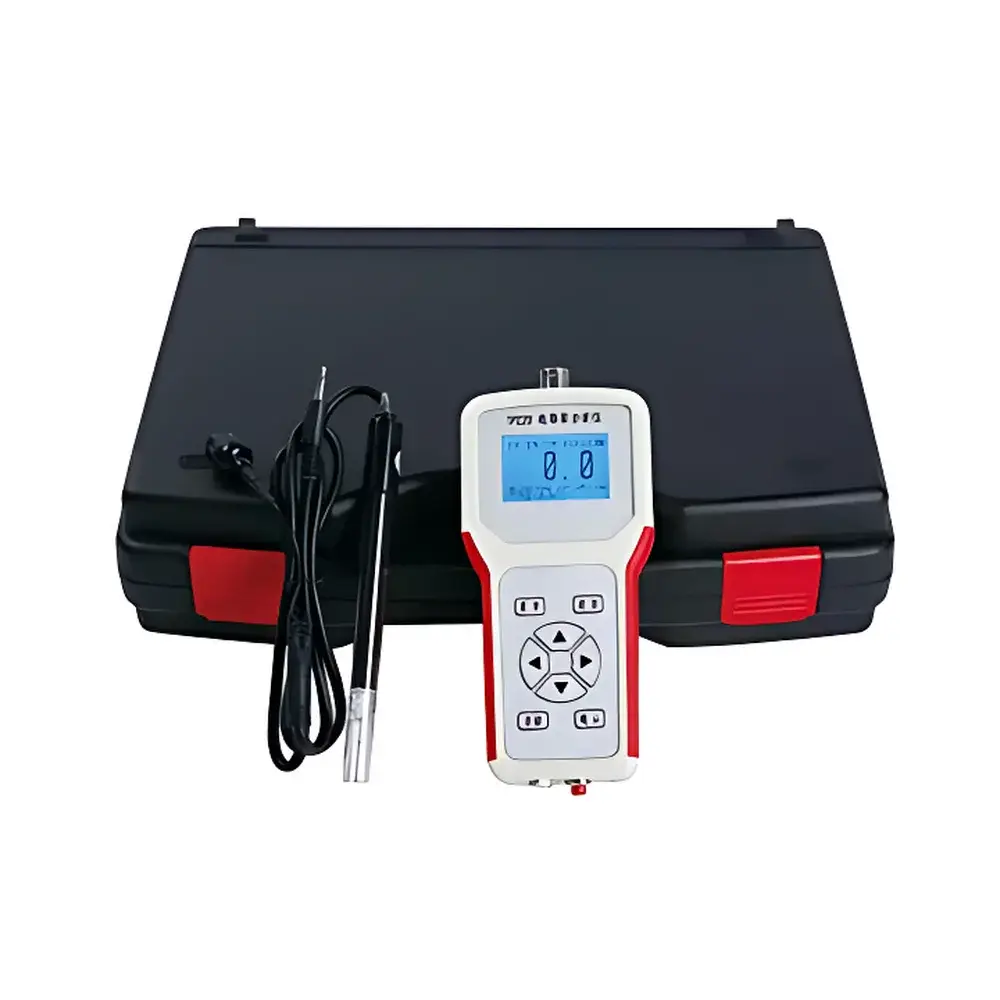
Timepower TP220 Portable Conductivity Meter
| Brand | Timepower |
|---|---|
| Origin | Beijing, China |
| Manufacturer Type | Manufacturer |
| Origin Category | Domestic (China) |
| Model | TP220 |
| Pricing | Upon Request |
| Measurement Principle | Two-electrode AC conductance (1–3 kHz sine wave) |
| Cell Constants Supported | K = 0.01, 0.1, 1.0, 10.0 cm⁻¹ |
| Measurement Range | 0.000–30,000 µS/cm (auto-ranging across four K-values) |
| Resolution | 0.001 µS/cm |
| Accuracy | ±2.5% FS |
| Repeatability | ≤1% |
| Temperature Sensor | Pt1000 RTD |
| Temp Compensation Range | 0–60 °C |
| Sample Temp Range | 5–60 °C |
| Ambient Temp Range | 5–45 °C |
| Ambient Humidity | ≤90% RH (non-condensing) |
| Power Supply | AC 85–265 V, 45–65 Hz |
| Power Consumption | ≤1 W |
| Dimensions | 80 × 30 × 175 mm |
| Weight | 0.26 kg |
| Display | 128×64 dot-matrix LCD, Chinese UI |
| Data Storage | Cyclic memory with >10-year retention after power loss |
| Battery Life | Up to 8 hours (rechargeable internal battery) |
| Backlight | Adjustable LED backlight |
| A/D Converter | 24-bit |
Overview
The Timepower TP220 Portable Conductivity Meter is an engineered solution for field-deployable and laboratory-grade electrical conductivity (EC) measurement in aqueous solutions. It operates on the fundamental principle of two-electrode AC conductance: a stable sinusoidal excitation voltage (1–3 kHz) is applied across a pair of parallel or cylindrical electrodes immersed in the sample, minimizing polarization and electrolytic decomposition. The resulting current is measured and converted into conductivity using the cell constant (K), defined as the ratio of electrode separation (L) to effective surface area (A). This method ensures reliable, non-destructive assessment of ionic strength—directly correlating with total dissolved solids (TDS), salinity, and purity in water-based matrices. Designed for rugged portability without compromising metrological integrity, the TP220 meets the operational demands of environmental monitoring, municipal water utilities, industrial process control, and regulatory compliance workflows where rapid, on-site EC verification is essential.
Key Features
- True portable architecture: Compact form factor (80 × 30 × 175 mm), lightweight (0.26 kg), and integrated rechargeable power system enabling up to 8 hours of continuous field operation.
- Four selectable cell constants (K = 0.01, 0.1, 1.0, 10.0 cm⁻¹) with automatic range switching—enabling precise measurement across ultra-pure water (down to 0.000 µS/cm) to high-conductivity industrial brines (up to 30,000 µS/cm).
- High-fidelity signal acquisition: 24-bit analog-to-digital conversion ensures resolution of 0.001 µS/cm and repeatability ≤1% FS under controlled conditions.
- Pt1000 temperature sensor with full-range automatic temperature compensation (0–60 °C), compliant with standard EC-to-TDS conversion algorithms per ISO 7888 and ASTM D1125.
- Intuitive Chinese-language interface on a 128×64 dot-matrix LCD; adjustable LED backlight for low-light environments; optimized power management to extend battery life and reduce ambient heat generation.
- Robust embedded design: Surface-mount technology (SMT) PCB assembly, single-chip microcontroller architecture, and sealed housing rated for operation at ≤90% RH (non-condensing).
Sample Compatibility & Compliance
The TP220 supports diverse aqueous sample types—including potable water, wastewater effluents, boiler feedwater, cooling tower circulation, pharmaceutical purified water (PW), and process rinse solutions. Electrode selection is critical for accuracy: K = 0.01 cm⁻¹ electrodes are recommended for ultrapure water (100 µS/cm) to maximize signal-to-noise ratio. The instrument adheres to core metrological practices outlined in ISO/IEC 17025 for calibration traceability and supports documentation protocols required under GLP and GMP environments. While not FDA 21 CFR Part 11–certified out-of-the-box, its data storage architecture (cyclic memory with >10-year non-volatile retention) facilitates audit-ready recordkeeping when paired with external validation procedures.
Software & Data Management
Data logging is handled internally via cyclic memory with automatic overwrite of oldest entries upon buffer saturation—eliminating manual file management overhead. All stored records retain timestamp, conductivity value, compensated temperature, and active cell constant. Though the TP220 does not feature USB or Bluetooth connectivity, its internal memory structure enables seamless integration into lab information management systems (LIMS) via periodic manual export using optional PC interface cables (sold separately). The device maintains strict separation between operational firmware and user data partitions, ensuring measurement integrity remains unaffected by firmware updates or configuration changes.
Applications
- Environmental field surveys: Monitoring river, lake, and groundwater conductivity as an indicator of contamination or seasonal ionic load variation.
- Municipal water quality assurance: Verifying compliance with national drinking water standards (e.g., China’s GB 5749-2022, WHO Guidelines) for conductivity limits.
- Power plant chemistry control: Tracking condensate purity and detecting condenser tube leaks via real-time EC spikes in boiler feedwater circuits.
- Pharmaceutical water systems: Routine checks of purified water (PW) and water for injection (WFI) per USP and EP 2.2.38.
- Food & beverage production: Assessing cleaning-in-place (CIP) rinse effectiveness and verifying final rinse water conductivity prior to equipment reuse.
FAQ
What cell constant should I select for measuring deionized water?
For deionized or ultrapure water (<1 µS/cm), use a K = 0.01 cm⁻¹ electrode—preferably within a sealed, air-tight measurement cell to minimize CO₂ absorption and surface contamination effects.
Does the TP220 support linear or non-linear temperature compensation?
It applies linear temperature compensation based on the standard NaCl reference curve (25 °C reference), consistent with ISO 7888 and ASTM D1125 methodologies.
Can the instrument be calibrated with NIST-traceable standards?
Yes—calibration is performed using certified KCl standard solutions (e.g., 84 µS/cm, 1413 µS/cm, 12.88 mS/cm) traceable to NIST or equivalent national metrology institutes.
Is the display readable under direct sunlight?
The monochrome LCD features high contrast and adjustable backlight intensity; however, for prolonged outdoor use in bright ambient light, a shaded viewing position is recommended.
How often should the electrode be cleaned and recalibrated?
Cleaning frequency depends on sample fouling potential—typically before each measurement series in dirty or organic-laden samples. Recalibration is advised daily for critical applications or after electrode cleaning, storage, or physical impact.
Related Products







