
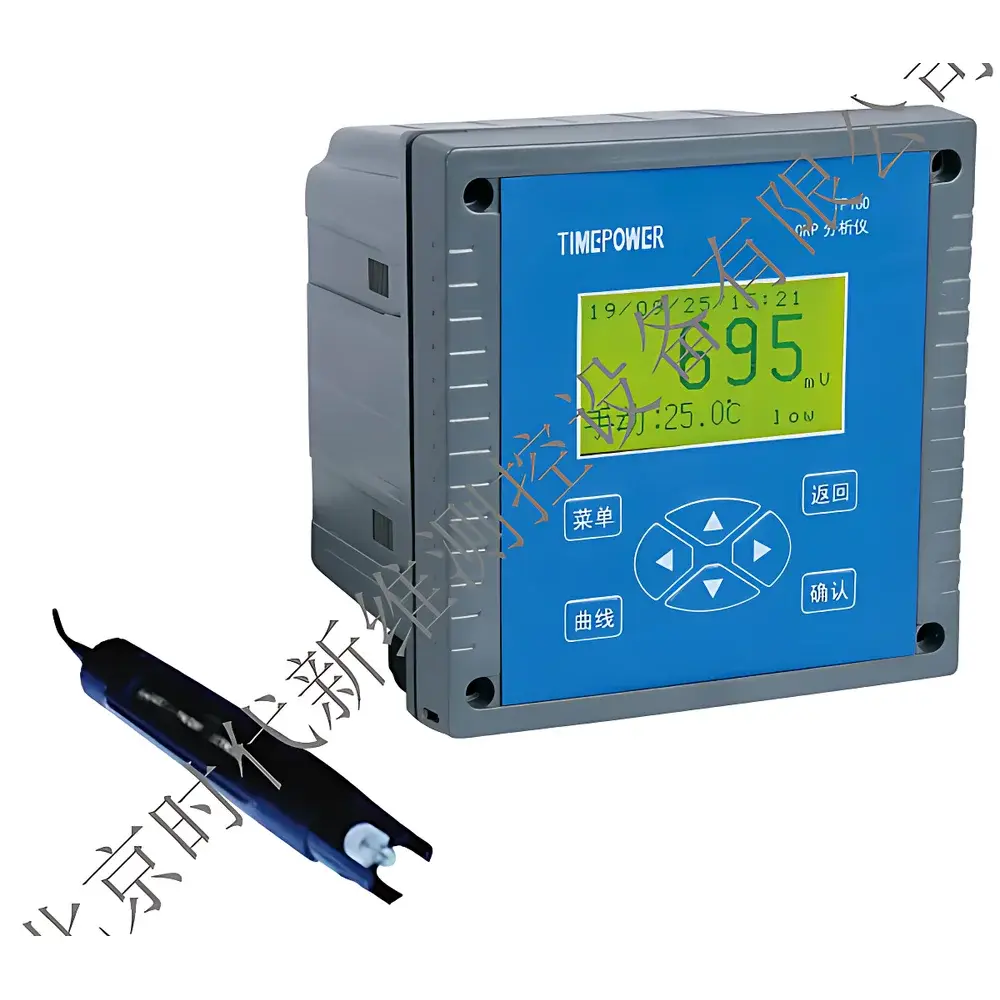
TimePower TP-160 Industrial Online ORP Monitor
| Brand | TimePower |
|---|---|
| Origin | Beijing, China |
| Manufacturer Type | Manufacturer |
| Country of Origin | Domestic (China) |
| Model | TP-160 |
| Instrument Type | Industrial Online ORP Meter |
| Display | 128×64 Dot-Matrix LCD with Chinese Interface |
| Microcontroller Architecture | Embedded MCU with High-Resolution A/D Conversion |
| Circuit Design | SMT Assembly with Integrated Isolation Circuits |
| Output Signals | Configurable Standard Analog Outputs (e.g., 4–20 mA or 0–10 V) |
| Relay Outputs | Two Programmable SPDT Relays for Alarm/Control |
| Data Logging | Cyclic Memory Storage with Auto-Overflow Management |
| Enclosure Rating | IP65 |
Overview
The TimePower TP-160 Industrial Online ORP Monitor is a dedicated electrochemical measurement system engineered for continuous, real-time monitoring of Oxidation-Reduction Potential (ORP) in aqueous process streams. Operating on the fundamental principle of potentiometric measurement, the TP-160 detects the voltage difference between a noble metal sensing electrode (typically platinum or gold) and a stable reference electrode (commonly Ag/AgCl in gel-filled or double-junction configuration), immersed directly in the sample medium. This measured potential—expressed in millivolts (mV) relative to the Standard Hydrogen Electrode (SHE)—quantifies the net tendency of a solution to accept or donate electrons, serving as a critical surrogate indicator for disinfection efficacy, redox-driven reaction progress, corrosion risk, and oxidative stability in industrial water systems. Unlike laboratory-grade benchtop meters, the TP-160 is purpose-built for unattended, long-term deployment in harsh operational environments typical of power generation, chemical processing, municipal wastewater treatment, pharmaceutical water loops, and food & beverage production lines.
Key Features
- Robust IP65-rated enclosure with UV-stabilized polycarbonate housing, certified for outdoor and semi-outdoor installation without additional weatherproofing.
- High-stability analog signal conditioning circuitry incorporating galvanic isolation and SMT-based integrated isolation design, minimizing ground-loop interference and electromagnetic noise in electrically noisy plant environments.
- Dual independent relay outputs configurable for high/low ORP alarms, pump interlock, or chemical dosing control—each with user-defined hysteresis and delay timers to prevent chatter.
- Configurable analog output (4–20 mA or 0–10 V DC) compliant with standard DCS/PLC input modules, supporting linear or segmented scaling across user-specified ORP ranges (e.g., −1000 to +1000 mV).
- Onboard cyclic data storage retains up to 30 days of timestamped ORP readings (at 1-minute intervals), with automatic overwrite functionality ensuring persistent operation without manual maintenance.
- Intuitive 128×64 dot-matrix LCD interface featuring full Chinese-language prompts, menu navigation, calibration status indicators, and real-time graphical trend display for rapid operator assessment.
Sample Compatibility & Compliance
The TP-160 is validated for use in conductive aqueous solutions with conductivity ≥50 µS/cm, including boiler feedwater, cooling tower blowdown, chlorinated effluent, clean-in-place (CIP) rinse water, purified water (PW), and water-for-injection (WFI) distribution loops. It supports both flow-through and submersible probe configurations using industry-standard 3/4″ NPT or DIN 19213 threaded process connections. While not certified to IEC 61508 or SIL-2 for safety instrumented systems, the device conforms to electromagnetic compatibility requirements per IEC 61326-1 (industrial environment) and meets basic electrical safety standards per GB/T 18268.21 (Chinese national equivalent of IEC 61010-1). Its design facilitates alignment with GLP and GMP documentation practices through traceable calibration logs and user-accessible audit trails.
Software & Data Management
The TP-160 operates autonomously without external PC dependency; however, its serial RS-485 Modbus RTU interface enables integration into centralized SCADA or MES platforms for remote parameter configuration, historical data retrieval, and alarm event forwarding. Calibration records—including date, operator ID (manually entered), buffer values used (e.g., +225 mV Zobell’s solution, −200 mV quinhydrone), and post-calibration verification results—are stored locally and exportable via Modbus register mapping. The firmware supports time-stamped event logging for relay actuations, sensor disconnects, and out-of-range conditions—providing essential forensic data for regulatory review under FDA 21 CFR Part 11 when paired with appropriate system-level validation protocols.
Applications
- Power Generation: Continuous ORP monitoring in condensate polishing units and demineralizer effluent to verify oxidative scavenger (e.g., hydrazine, carbohydrazide) residual activity and detect air ingress.
- Chemical Manufacturing: Redox endpoint detection in chlorine dioxide generation, electrochemical synthesis reactors, and wastewater neutralization basins where stoichiometric oxidant demand must be tightly controlled.
- Environmental Engineering: Real-time assessment of advanced oxidation processes (AOPs), such as ozone/H2O2 or UV/H2O2, where ORP correlates with hydroxyl radical yield and contaminant degradation kinetics.
- Pharmaceutical Water Systems: Monitoring of purified water storage tanks and distribution loops to ensure consistent oxidative bioburden control, particularly during sanitization cycles using ozone or hydrogen peroxide.
- Food & Beverage Processing: Verification of sanitizer concentration (e.g., hypochlorite, peracetic acid) in CIP return lines and final rinse water to meet HACCP critical limits and FSMA preventive controls.
FAQ
What reference electrode types are compatible with the TP-160?
The instrument is optimized for use with double-junction Ag/AgCl reference electrodes filled with KCl gel electrolyte, minimizing junction clogging in suspended-solids-laden streams.
Does the TP-160 support automatic temperature compensation (ATC)?
Yes—when paired with an optional integrated Pt100 RTD sensor, the unit applies Nernstian correction to ORP readings based on real-time solution temperature (range: 0–50 °C).
Can the TP-160 be calibrated in the field without specialized equipment?
Field calibration requires only two certified ORP buffer solutions (e.g., Zobell’s at +225 mV and quinhydrone at −200 mV); no proprietary software or service tools are needed.
Is the device suitable for seawater or high-salinity applications?
While functional in saline media, prolonged exposure to chloride concentrations >35,000 ppm may accelerate reference electrode depletion; use of a silver-ion-trapping outer junction is recommended.
How frequently should routine maintenance be performed?
Electrode cleaning and calibration verification are advised every 7–14 days in continuous operation; full electrode replacement intervals range from 6–12 months depending on process fouling severity.





