
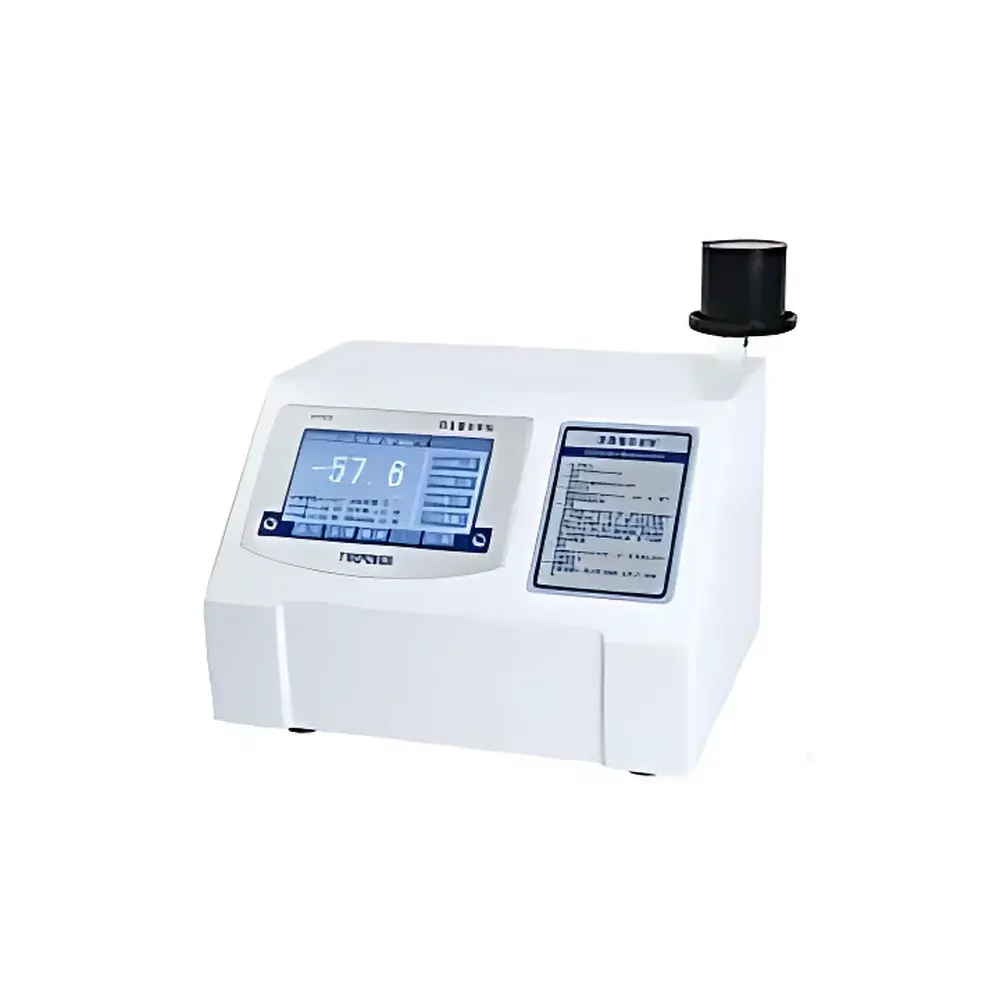
TimePower TP305 Copper Content Analyzer
| Brand | TimePower |
|---|---|
| Origin | Beijing, China |
| Manufacturer Type | Manufacturer |
| Origin Category | Domestic (China) |
| Model | TP305 |
| Price | Upon Request |
| Display | 5.0-inch color touch LCD, Chinese interface |
| Power Supply | AC 85–265 V, 45–65 Hz |
| Power Consumption | ≤30 W |
| Dimensions | 260 × 200 × 180 mm |
| Weight | 3.2 kg |
| Measurement Range | 0.00–200 μg/L |
| Accuracy | ±3% F.S. |
| Resolution | 0.1 μg/L |
| Repeatability | ≤1% |
| Stability | ±1.5% F.S./4 h |
| Operating Temperature | 5–45 °C |
| Relative Humidity | ≤90% RH (non-condensing) |
| Light Source | Imported monochromatic cold light source |
| Calibration | Blank calibration & curve calibration per standard method |
| Compliance Method | National Standard Method using bis-cyclohexanone oxaldihydrazone (BCO) colorimetry |
| Data Storage | Cyclic memory for up to 256 records |
| Timing Function | Automatic countdown timer with alert |
| Optical Principle | Photometric colorimetry based on Lambert-Beer law |
Overview
The TimePower TP305 Copper Content Analyzer is a dedicated benchtop photometric instrument engineered for precise, trace-level quantification of dissolved copper (Cu²⁺) in ultra-pure and process water streams. It operates on the fundamental principle of photometric colorimetry, applying the Lambert-Beer law—where absorbance (A) at a specific wavelength is linearly proportional to the concentration of the colored complex formed between copper ions and the chromogenic reagent, bis-cyclohexanone oxaldihydrazone (BCO). This method is standardized in national regulatory protocols for power plant water chemistry monitoring and aligns with technical requirements outlined in DL/T 938–2019 (Guidelines for Water and Steam Chemistry Supervision in Thermal Power Plants) and ISO 7027-1:2016 (Water quality — Determination of turbidity — Part 1: Quantitative methods). The analyzer delivers reliable performance in environments demanding high reproducibility and minimal operator intervention—particularly where copper contamination poses risk to turbine blade deposition, boiler tube corrosion, or generator stator cooling system integrity.
Key Features
- Optimized optical architecture featuring an imported monochromatic cold light source—ensuring low thermal drift, stable photometric output, and extended service life (>10,000 hours).
- Integrated microcontroller platform based on advanced single-chip technology, delivering low-power operation (<30 W), real-time signal processing, and deterministic response timing.
- 5.0-inch capacitive touch color LCD with intuitive Chinese-language UI—designed for rapid navigation, parameter entry, and on-screen result visualization without external software dependency.
- Automated blank calibration routine that compensates for zero-point drift arising from electronic offset, cuvette variability, and ambient light interference—enhancing baseline stability across multi-shift operation.
- Programmable countdown timer with audible/visual alerts, enabling precise reaction incubation control during BCO complex formation (typically 5–10 min at room temperature).
- Robust mechanical design incorporating surface-mount PCB assembly and modular enclosure—engineered for long-term reliability in industrial laboratories and on-site control rooms with limited climate control.
Sample Compatibility & Compliance
The TP305 is validated for analysis of copper in deionized feedwater, condensate, steam cycle samples, internal-cooling water for hydrogen-cooled generators, boiler drum water, and natural surface waters. Sample introduction uses standard 10 mL quartz or high-transmittance optical-grade plastic cuvettes (10 mm path length). All reagents—including BCO reagent solution, buffer, and copper standard stock solutions—must conform to analytical grade (≥99.9%) purity and be stored in certified polyethylene containers to prevent leaching or adsorption. Instrument operation complies with GLP-aligned workflows: daily blank verification and biweekly calibration curve validation are embedded in operational protocol to satisfy traceability requirements under ISO/IEC 17025:2017 Clause 7.7 (Sampling) and ASTM D1066–22 (Standard Practice for Sampling Steam). While not FDA 21 CFR Part 11–certified out-of-the-box, audit trails (time-stamped calibration logs, measurement records) are retained locally and exportable via USB for integration into validated LIMS environments.
Software & Data Management
The analyzer implements embedded firmware—not PC-based software—with local data handling optimized for field deployment. Up to 256 measurement entries—including date/time stamp, sample ID (user-input), absorbance value, calculated concentration (μg/L), and calibration status—are stored in non-volatile flash memory. Overflow management follows FIFO (first-in, first-out) logic; oldest records auto-delete upon capacity saturation. Data retrieval is performed directly via touchscreen menu navigation—no proprietary drivers or external applications required. Export functionality supports CSV-formatted dumps via standard USB-A port for post-acquisition statistical analysis (e.g., Shewhart X̄-R charts, trend monitoring per IEC 62271-1 Annex J). Firmware updates are delivered via encrypted USB stick with version-controlled checksum verification.
Applications
- Real-time copper surveillance in fossil-fueled and nuclear power plant secondary loops—supporting EPRI TR-102329 guidelines for copper threshold control (<5 μg/L in feedwater, <10 μg/L in condensate).
- Verification of ion exchange resin performance and mixed-bed polisher efficiency in ultrapure water (UPW) systems serving semiconductor front-end fabs.
- Corrosion product tracking in closed-loop HVAC chill water systems where copper alloy piping is present.
- Environmental compliance testing for effluent discharge permits requiring sub-ppb copper reporting per EPA Method 200.7 adaptations.
- Research-grade quantification in electrochemical corrosion studies involving Cu dissolution kinetics under controlled pH and redox conditions.
FAQ
What is the recommended frequency for calibration verification?
Daily blank calibration is mandatory; full multi-point calibration curve verification (using ≥3 certified standards spanning 5–150 μg/L) must be performed every 14 days—or immediately after reagent lot change, lamp replacement, or instrument relocation.
Can the TP305 measure other metal ions?
No. The optical filter set and reagent chemistry are specifically optimized for the Cu²⁺–BCO complex (λmax = 580 nm). Cross-sensitivity to Fe²⁺, Ni²⁺, or Co²⁺ is minimized but not eliminated; simultaneous multi-metal analysis requires ICP-MS or AAS instrumentation.
Is distilled water sufficient for reagent preparation?
No. Only Type I ultrapure water (resistivity ≥18.2 MΩ·cm at 25°C, TOC <5 ppb), generated by a high-efficiency mixed-bed ion exchange system, meets specification requirements for blank integrity and detection limit fidelity.
How does ambient temperature affect measurement stability?
The instrument’s thermal compensation algorithm corrects for minor photodetector drift between 5–45°C; however, sample equilibration to ambient lab temperature (±2°C) prior to analysis is required to avoid condensation-induced scattering errors in low-concentration ranges (<10 μg/L).




