
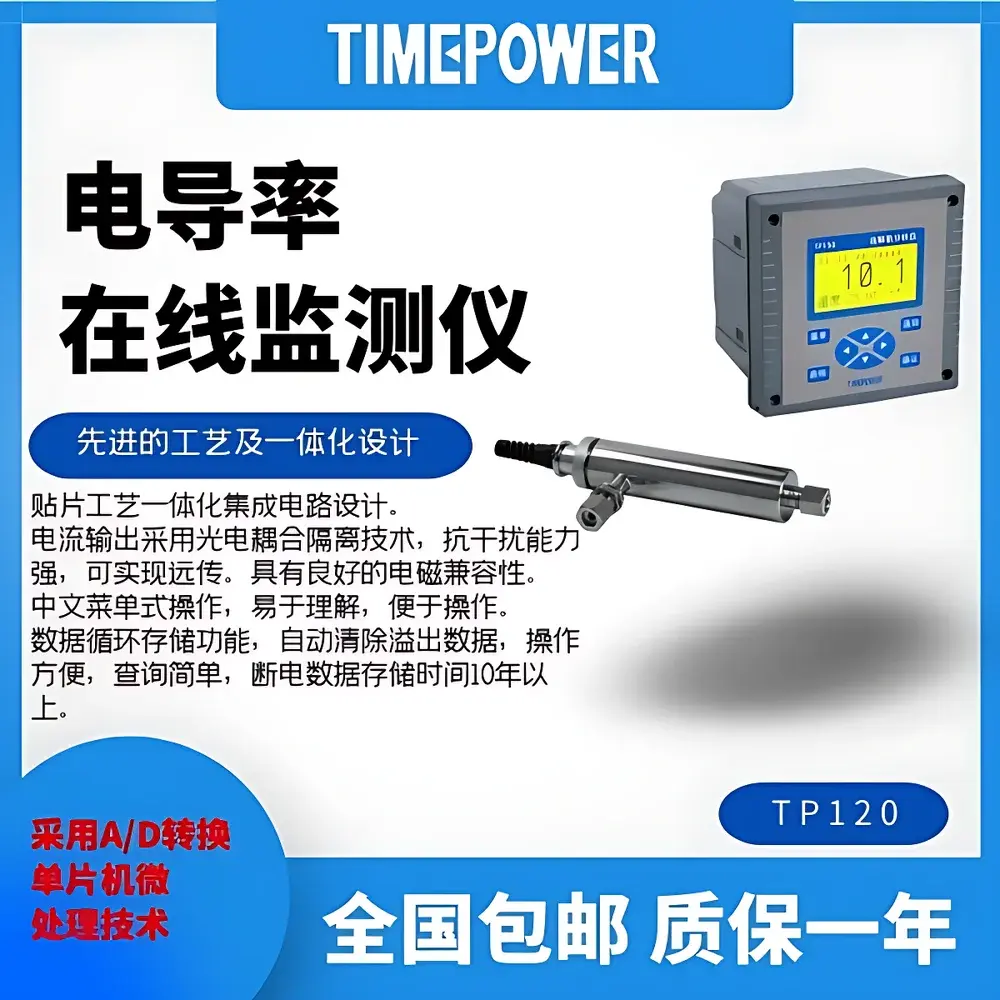
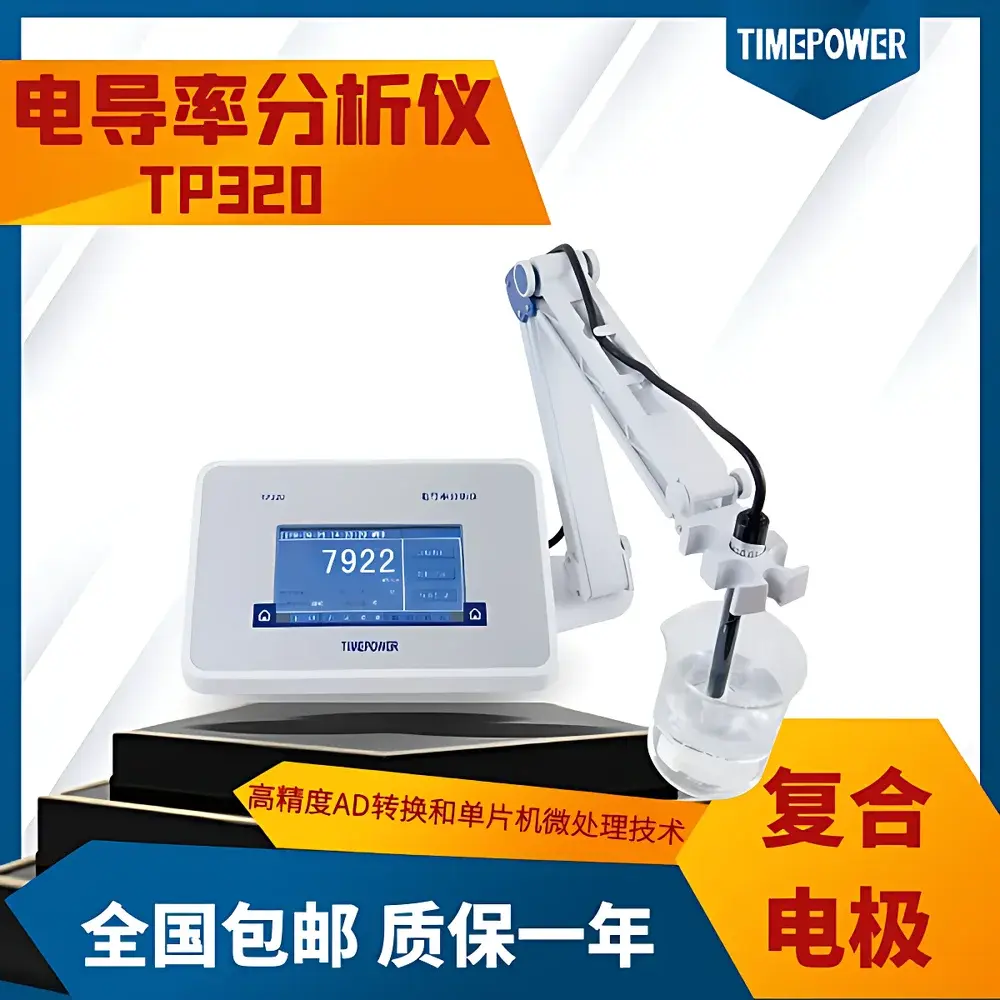
TimePower TP120/121/122 Industrial Online Conductivity Analyzer
| Brand | TimePower |
|---|---|
| Model | TP120 / TP121 / TP122 |
| Origin | Beijing, China |
| Manufacturer Type | Direct Manufacturer |
| Product Origin | Domestic (China) |
| Portability | Portable |
| Application Environment | Industrial Online Process Monitoring |
| Conductivity Measurement Ranges | K=0.01 cm⁻¹: 0.000–3.000 µS/cm and 0.00–30.00 µS/cm |
| K=0.1 cm⁻¹ | 0.00–30.00 µS/cm and 0.0–300.0 µS/cm |
| K=1.0 cm⁻¹ | 0.0–300.0 µS/cm and 0–3000 µS/cm |
| K=10.0 cm⁻¹ | 0–3000 µS/cm and 0–30,000 µS/cm |
| Temperature Range | 0–60 °C |
| Accuracy | ±2.5% of Full Scale (F.S.) |
| Minimum Resolution | 0.001 µS/cm |
Overview
The TimePower TP120/121/122 Industrial Online Conductivity Analyzer is a precision-engineered electrochemical instrument designed for continuous, real-time monitoring of aqueous solution conductivity in demanding industrial process environments. Based on the fundamental principle of two- or four-electrode AC conductometric measurement, the analyzer applies a low-frequency alternating current across a defined cell geometry to minimize polarization effects and electrode fouling—critical for long-term stability in untreated or scaling-prone water streams. Its modular sensor architecture supports interchangeable conductivity cells with standardized cell constants (K = 0.01, 0.1, 1.0, and 10.0 cm⁻¹), enabling accurate quantification across an aggregate dynamic range spanning five decades—from ultrapure water (sub-µS/cm) to high-salinity brines (up to 30,000 µS/cm). Temperature compensation is performed automatically using an integrated Pt1000 RTD sensor (0–60 °C), applying either linear or non-linear (e.g., ASTM D1125-compliant) algorithms to deliver temperature-normalized conductivity values referenced to 25 °C.
Key Features
- Optically isolated signal transmission via high-speed photo-couplers, eliminating ground loops and ensuring robust immunity to EMI/RFI in electrically noisy plant environments (e.g., near VFDs, switchgear, or arc furnaces)
- CE-marked electromagnetic compatibility (EMC) design compliant with IEC 61326-1 for industrial use, validated under conducted/radiated immunity tests up to 10 V/m (80 MHz–2.7 GHz)
- Modular transmitter housing rated IP65 for dust- and water-resistant operation; optional explosion-proof (Ex d IIB T4) variants available for hazardous area deployment
- Configurable analog output (4–20 mA, isolated, HART® 7 compatible) and digital interfaces (RS-485 Modbus RTU, optional Profibus DP-V1) for seamless integration into DCS, SCADA, or PLC-based control systems
- Self-diagnostics including sensor continuity check, temperature plausibility validation, and conductivity cell contamination alert based on conductance drift trend analysis
Sample Compatibility & Compliance
The TP120/121/122 series is validated for continuous operation in clarified, filtered, or coagulated aqueous streams typical of boiler feedwater, condensate polishing, cooling tower blowdown, wastewater effluent, and process rinse water. It is not intended for highly viscous, suspended-solid-laden (>50 mg/L SS), or strongly oxidizing media (e.g., >5 ppm free chlorine without protective coating). Cell materials include 316L stainless steel electrodes and PEEK or PVDF wetted parts, ensuring chemical resistance per NACE MR0175/ISO 15156 for chloride-containing environments. The system supports audit-ready data integrity per FDA 21 CFR Part 11 when paired with TimePower’s certified configuration software, including electronic signatures, change logs, and user-level access controls.
Software & Data Management
The analyzer operates with TimePower’s TPCONFIG v3.2 engineering utility (Windows-based, USB/RS-232 interface), enabling full parameterization—including cell constant entry, temperature compensation mode selection (linear, nonlinear, or user-defined table), alarm thresholds (high/low, rate-of-change), and calibration history logging. All configuration changes are timestamped and attributed to operator ID. Raw conductivity and temperature values are timestamped at 1-second intervals and buffered onboard (16 MB non-volatile memory) for recovery during communication outages. Export formats include CSV and XML, compatible with LIMS and MES platforms. Optional cloud connectivity via MQTT/HTTPS enables remote fleet monitoring and predictive maintenance analytics.
Applications
- Power generation: Continuous monitoring of steam cycle purity (ASTM D4582), demineralizer outlet verification, and condensate leak detection in fossil and nuclear plants
- Chemical & petrochemical: Reaction mixture concentration tracking, scrubber liquor salinity control, and wastewater neutralization endpoint determination
- Pharmaceutical manufacturing: Purified Water (PW) and Water for Injection (WFI) quality surveillance per USP and EU Annex 1 requirements
- Food & beverage: CIP rinse water conductivity validation, syrup dilution control, and desalination brine management
- Municipal & industrial wastewater: Effluent compliance reporting against local discharge permits (e.g., EPA NPDES limits)
FAQ
What cell constant options are supported, and how do I select the appropriate one?
The TP120/121/122 accepts K = 0.01, 0.1, 1.0, and 10.0 cm⁻¹ cells. Selection depends on expected conductivity: K = 0.01 for ultrapure water (≤10 µS/cm), K = 1.0 for municipal drinking water (50–1500 µS/cm), and K = 10.0 for seawater or industrial brines (≥5000 µS/cm).
Does the analyzer support automatic temperature compensation?
Yes—integrated Pt1000 RTD provides continuous temperature measurement (0–60 °C), and compensation follows either linear (α = 2.0 %/°C default) or ASTM D1125 polynomial algorithms, configurable via TPCONFIG.
Is calibration traceable to national standards?
Calibration is performed using NIST-traceable KCl standard solutions (e.g., 1413 µS/cm at 25 °C); certificate of calibration includes uncertainty budget per ISO/IEC 17025 guidelines.
Can the device operate in hazardous locations?
Standard units are rated for general-purpose industrial areas; Class I Div 2 / ATEX Zone 2 configurations with intrinsic safety barriers are available upon request.
What is the recommended maintenance interval for sensor cleaning and verification?
For clean, low-fouling applications: quarterly verification with certified standards; for high-scaling environments (e.g., cooling towers): monthly visual inspection and weekly conductivity drift check.




