
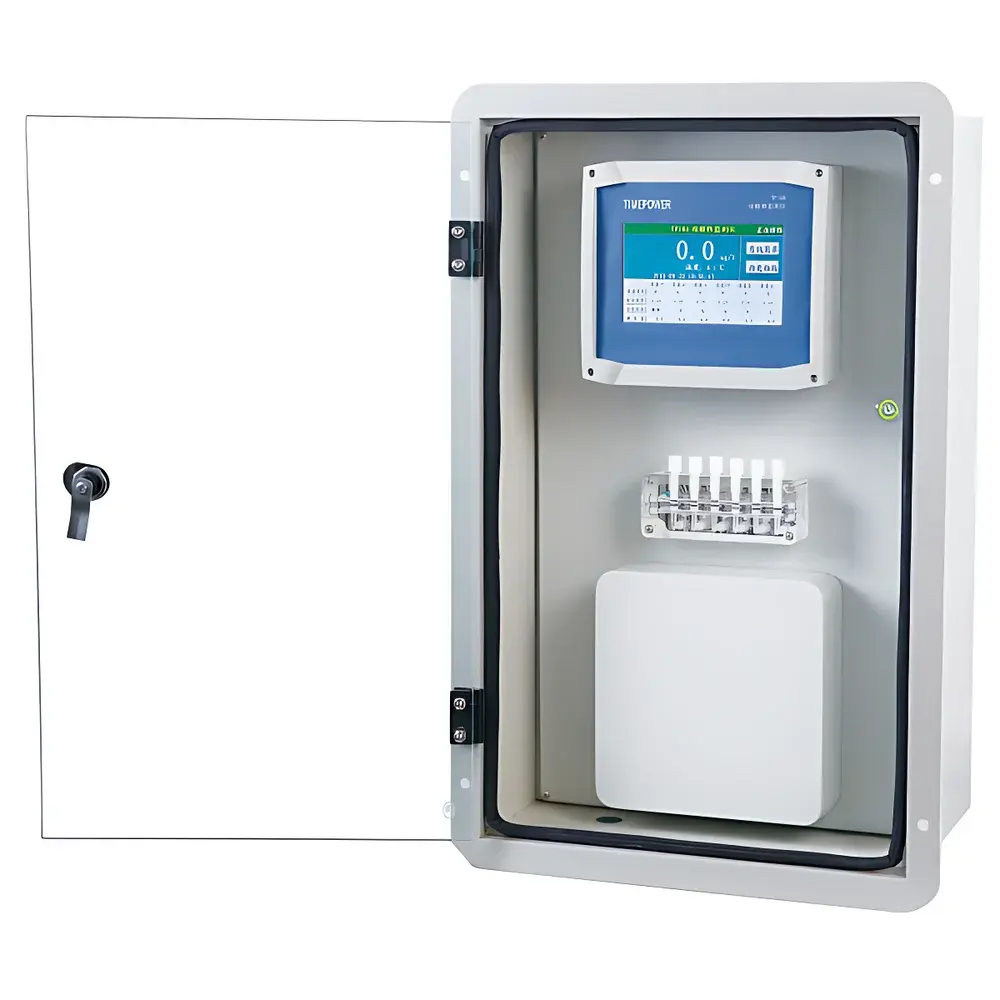
Timepower TP106 Online Silicate Analyzer
| Brand | Timepower |
|---|---|
| Origin | Beijing, China |
| Manufacturer Type | Manufacturer |
| Regional Category | Domestic |
| Model | TP106 |
| Instrument Type | Online Analyzer |
| Pricing | Upon Request |
Overview
The Timepower TP106 Online Silicate Analyzer is a dedicated photometric analyzer engineered for continuous, real-time quantification of soluble silicate (SiO₂ as silicic acid) in aqueous process streams. It operates on the validated molybdenum blue spectrophotometric method—standardized in GB/T 12149–2017 (“Determination of Silicon in Industrial Circulating Cooling Water and Boiler Feed Water”) and aligned with foundational principles of ASTM D859 and ISO 10573. In acidic medium (pH 1.1–1.3), orthosilicic acid reacts with ammonium molybdate to form a yellow heteropoly-molybdosilicic acid complex; subsequent reduction by 1-amino-2-naphthol-4-sulfonic acid (1,2,4-acid) yields an intensely colored blue chromophore—the “silicomolybdenum blue”—whose absorbance at ~815 nm is linearly proportional to silicate concentration per the Beer–Lambert law. This method delivers high selectivity against common interferents (e.g., phosphate, iron, aluminum) when pH and reagent stoichiometry are rigorously controlled—a requirement met by the TP106’s precision fluidic architecture and temperature-stabilized optical path.
Key Features
- Modular multi-channel configuration: Supports 1–6 independent measurement channels within a single cabinet, enabling cost-effective monitoring of multiple sample points without redundant instrumentation.
- High-reliability fluid handling: Utilizes imported solenoid valves with >1 million cycle lifetime; precise metering pumps ensure reproducible reagent dosing (<±0.5% volumetric accuracy) and consistent sample aspiration (10–40 L/h flow range).
- Optical stability: Equipped with a monochromatic cold LED light source (center wavelength ±2 nm tolerance) and solid-state photodetector, delivering 50,000-hour operational lifespan.
- Human-machine interface: 7-inch color TFT-LCD touchscreen with native Chinese UI; simultaneous display of real-time concentration trends, historical curves (up to 30 days stored locally), and system status diagnostics.
- Industrial-grade I/O: Four isolated analog outputs (configurable 0–20 mA / 4–20 mA / 0–10 mA) support seamless integration with DCS, PLC, or automated chemical dosing systems; independent high/low limit and flow-loss alarms per channel.
- Field-serviceable design: Front-access modular cartridge layout; standardized 670 mm × 410 mm panel cutout; weight-optimized chassis (22 kg) for wall-mount or console installation.
Sample Compatibility & Compliance
The TP106 is validated for use with clarified, low-turbidity water samples meeting the following physical specifications: suspended solids <5 µm, absence of colloidal silica or gelatinous precipitates, temperature 5–50 °C, and ambient operating conditions of 5–45 °C / ≤90% RH (non-condensing). It complies with GB/T 12149–2017 for boiler feedwater and industrial cooling water applications. While not certified to IEC 61508 or SIL standards, its architecture supports GLP/GMP-aligned operational practices—including audit-ready event logging, user-access-level password protection, and timestamped calibration records. Reagent consumption is optimized at ~3 L/month per reagent (four reagents total), minimizing maintenance frequency and waste generation.
Software & Data Management
Onboard firmware stores up to 30 days of second-by-second measurement data (concentration, absorbance, temperature, valve status) with automatic timestamping and cyclic overwrite. Data export is supported via USB port (CSV format) for offline trending and regulatory reporting. The system maintains full traceability: each calibration event logs operator ID, standard concentration, date/time, and deviation from reference value. Though lacking native network connectivity (e.g., Modbus TCP, OPC UA), optional RS-485 serial interface enables integration into legacy SCADA environments. All signal outputs meet IEC 61000-4 immunity requirements for industrial electromagnetic environments.
Applications
The TP106 serves critical silicate control functions across thermal power generation (steam-cycle purity assurance), petrochemical refining (catalyst protection), semiconductor ultrapure water (UPW) pretreatment, pharmaceutical WFI distribution loops, municipal drinking water treatment (corrosion inhibitor optimization), and fertilizer production effluent monitoring. Its robustness in high-conductivity, variable-pH feedwaters makes it especially suited for boiler drum blowdown monitoring and reverse osmosis reject stream analysis—where early detection of silica scaling potential directly impacts equipment longevity and outage frequency.
FAQ
What is the minimum detectable silicate concentration?
The instrument achieves a lower detection limit of 0.5 µg/L (0–200.0 µg/L range) with a resolution of 0.1 µg/L.
Does the analyzer require daily manual intervention?
No routine daily intervention is required; scheduled monthly reagent replacement and quarterly optical path cleaning constitute standard maintenance.
Can the TP106 be calibrated using NIST-traceable standards?
Yes—calibration is performed using aqueous silicate standards traceable to NIST SRM 2783 (Silicon in Water) or equivalent national metrology institute references.
Is remote diagnostic capability available?
Remote diagnostics are not embedded but can be enabled via third-party industrial IoT gateways connected to the analog or RS-485 outputs.
How does the system handle sample turbidity or particulate interference?
An inline 5-µm filter (included) is mandatory upstream; for highly variable particulate loads, optional auto-backflush filtration modules may be integrated prior to the analyzer inlet.
Related Products







