
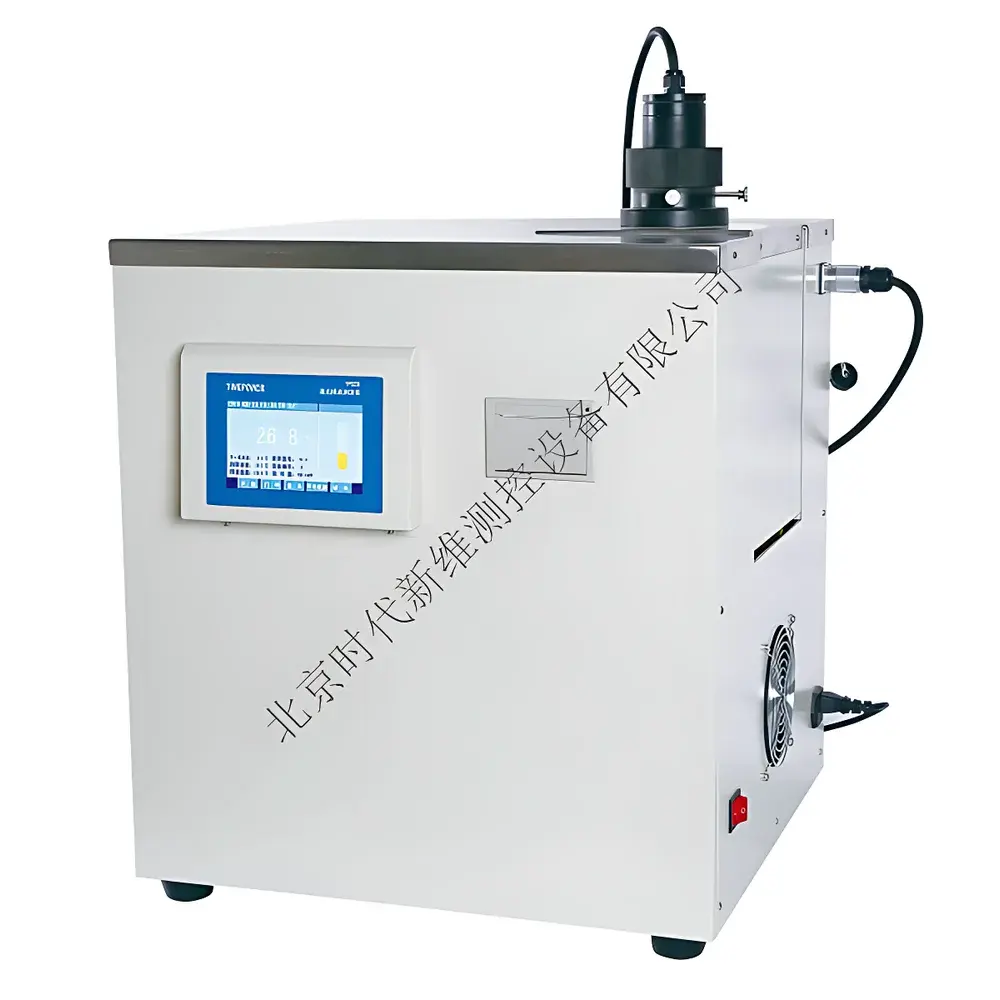
TimePower TP526 Automatic Cloud Point and Pour Point Tester
| Brand | TimePower |
|---|---|
| Model | TP526 |
| Origin | Beijing, China |
| Manufacturer | TimePower Instrument Co., Ltd. |
| Test Range | Ambient to –60 °C |
| Accuracy | ±1 °C |
| Resolution | 0.1 °C |
| Cooling Method | Thermoelectric (Peltier) |
| Display | LCD |
| Printer | Thermal, 36-character Chinese/English output |
| Power Supply | AC 220 V ±10 %, 50 Hz ±10 % |
| Power Consumption | <300 W |
| Dimensions | 475 × 360 × 495 mm |
| Weight | 21.3 kg |
| Environmental Operating Conditions | 10–40 °C, 30–80% RH |
Overview
The TimePower TP526 Automatic Cloud Point and Pour Point Tester is a fully automated, thermoelectric-cooled analytical instrument engineered for precise determination of cloud point (ASTM D2500, ISO 3015, IP 219) and pour point (ASTM D97, ISO 3016, IP 15) in petroleum products—including diesel fuels, lubricating oils, crude oils, and biodiesel blends. Based on standardized cooling ramp protocols and optical detection of wax crystal formation (cloud point) or cessation of flow under gravity (pour point), the TP526 implements dual-CPU microcontroller architecture to ensure synchronized temperature control, real-time sample monitoring, and unattended endpoint recognition. Its Peltier-based cooling system eliminates reliance on hazardous refrigerants or external chillers, enabling stable, stepwise cooling at programmable rates (e.g., 1 °C/min for cloud point, 3 °C/min for pour point per ASTM requirements) across a validated range from ambient temperature down to –60 °C. Designed for routine QC laboratories in refineries, power generation facilities, and third-party testing labs, the instrument complies with fundamental thermal stability and measurement traceability expectations for low-temperature petroleum property analysis.
Key Features
- Dual-CPU embedded control system for independent thermal regulation and optical sensing logic—minimizing cross-interference during critical phase-transition detection.
- High-stability thermoelectric cooling module with active heat dissipation, delivering reproducible cooling profiles without compressor noise, vibration, or maintenance-intensive cryogenic media.
- Automated test sequence execution: sample loading confirmation → controlled cooling → continuous optical turbidity monitoring (cloud point) or tilt-and-hold flow assessment (pour point) → endpoint validation → thermal hold for verification.
- Integrated thermal printer supporting 36-character Chinese/English output; all results include test ID, date/time stamp, sample ID, method standard reference (e.g., “ASTM D2500-22”), raw temperature data, and pass/fail flags against specification limits.
- Self-diagnostic firmware that monitors sensor integrity (PT100 RTD calibration drift), cooling efficiency (ΔT/s slope deviation), optical path contamination, and power supply stability—reporting error codes compliant with IEC 61508 functional safety principles.
- Ergonomic benchtop design (475 × 360 × 495 mm; 21.3 kg) with front-access sample chamber, tool-free vial holder, and reinforced thermal insulation—optimized for daily use in ISO/IEC 17025-accredited environments.
Sample Compatibility & Compliance
The TP526 accepts standard ASTM D2500/D97 sample vials (35–45 mL capacity, 16 mm OD glass tubes) and supports both clear and dyed hydrocarbon liquids. It is validated for use with Group I–III base oils, ultra-low-sulfur diesel (ULSD), aviation turbine fuel (Jet A-1), and FAME biodiesel blends up to B20. Instrument performance meets repeatability requirements of ≤1.0 °C (within-lab, same operator, same instrument) and reproducibility targets of ≤2.0 °C (inter-laboratory, per ASTM precision statements). The system’s temperature measurement chain is traceable to NIST-certified RTD standards, and its software architecture supports audit-ready operation under GLP and GMP frameworks—including electronic signature capability, user access levels (admin/operator/auditor), and immutable test record storage.
Software & Data Management
While the TP526 operates as a standalone unit with local LCD interface and thermal printout, it features an RS-232 serial port for optional integration into LIMS or centralized QC data platforms. All test records—including raw temperature vs. time arrays, optical transmittance curves, endpoint derivation logic flags, and environmental condition logs—are timestamped and stored internally for ≥1,000 tests. Exported data conforms to ASTM E1382-compliant ASCII format (.csv), enabling direct import into statistical process control (SPC) tools such as Minitab or JMP. Firmware updates are performed via USB flash drive with cryptographic signature verification to maintain data integrity per FDA 21 CFR Part 11 Annex 11 expectations.
Applications
- Quality release testing of winter-grade diesel fuels against regional specifications (e.g., EN 590 Class F, GB 19147–2016).
- Monitoring wax inhibition efficacy in pipeline transport of waxy crudes.
- Formulation development of low-temperature lubricants for wind turbine gearboxes (IEC 61400-4).
- Contract laboratory reporting for customs clearance of imported petroleum products (e.g., under U.S. EPA or EU REACH regulatory submissions).
- Research-scale screening of cold flow improver (CFI) additives using comparative pour point depression assays.
FAQ
Does the TP526 require external refrigerant or coolant circulation?
No—the instrument uses solid-state Peltier elements for cooling and does not require liquid nitrogen, dry ice, or chiller units.
Can it perform cloud point and pour point tests simultaneously on two separate samples?
No; the TP526 processes one sample per test cycle but supports sequential unattended operation with manual vial exchange between runs.
Is the optical detection system calibrated for colored or opaque samples?
The turbidity sensor is optimized for ASTM-transparent petroleum distillates; highly pigmented or asphaltene-rich samples may require method adaptation per ASTM D5254 guidance.
What is the minimum required sample volume?
35 mL in standard ASTM glass vials—consistent with D2500 and D97 procedural requirements.
How often must the RTD temperature sensor be recalibrated?
Annual calibration against a NIST-traceable reference bath is recommended; the instrument stores calibration offset values and supports user-initiated two-point adjustment.






