
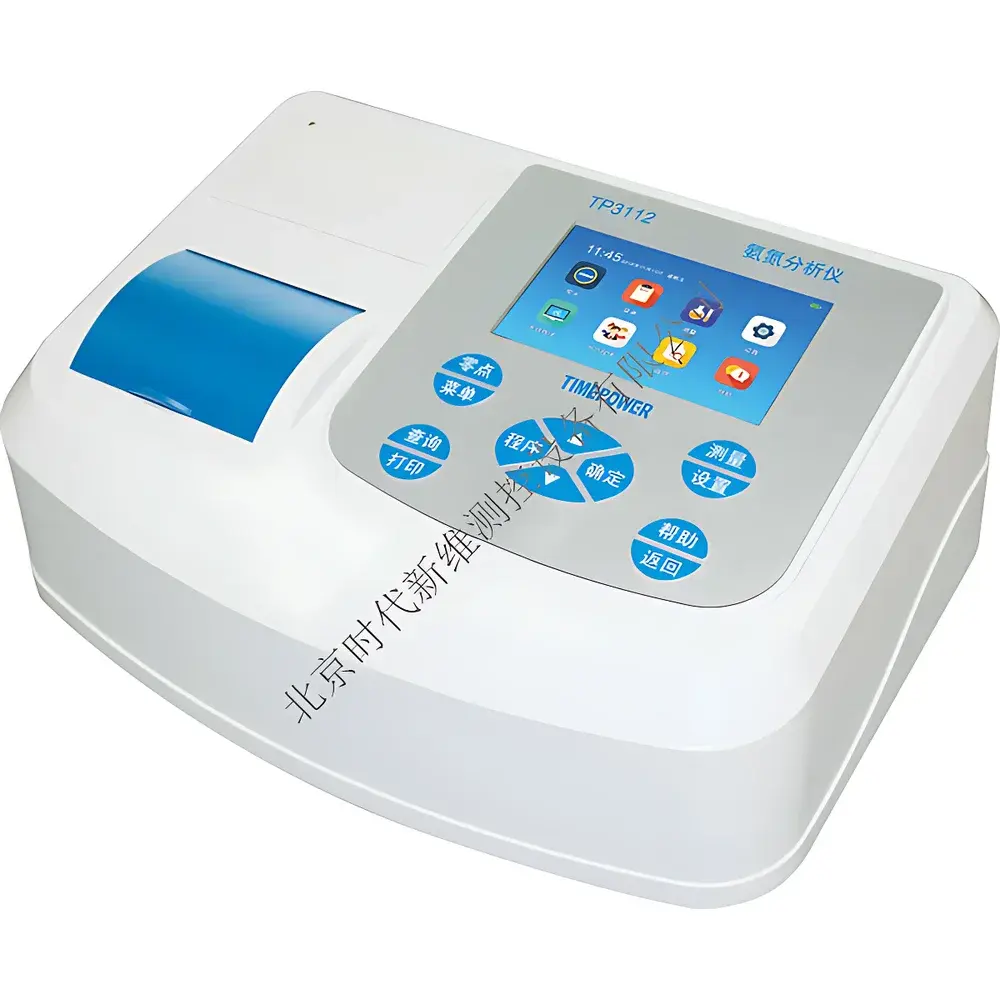
Timepower TP3112 Benchtop Ammonia Nitrogen Analyzer
| Brand | Timepower |
|---|---|
| Origin | Beijing, China |
| Manufacturer Type | Direct Manufacturer |
| Instrument Type | Laboratory Benchtop Analyzer |
| Model | TP 3112 |
| Measurement Principle | Colorimetric Method (Nessler’s Reagent Spectrophotometry) |
| Range | 0.01–50 mg/L (multi-range segmented calibration) |
| Accuracy | ≤ ±5% FS |
| Detection Limit | 0.01 mg/L |
| Analysis Time | 10–15 minutes per batch |
| Batch Capacity | 10 water samples |
| Light Source | Imported cold LED (100,000 h lifetime) |
| Display | 5.0″ color LCD (Chinese/English switchable) |
| Data Storage | 30,000 records + 96 customizable calibration curves |
| Interface | USB 2.0, RJ45 Ethernet |
| Printer | Built-in thermal printer |
| Power | AC 220 V ±10%, 50 Hz, 5 W |
| Dimensions | 348 × 250 × 145 mm |
| Weight | 2.6 kg (main unit) |
| Compliance | HJ/T 535–2009 |
Overview
The Timepower TP3112 Benchtop Ammonia Nitrogen Analyzer is a precision laboratory instrument engineered for reliable, standardized quantification of ammonia nitrogen (NH₃–N) in aqueous matrices. It operates on the Nessler’s reagent spectrophotometric method—fully compliant with China’s national standard HJ/T 535–2009, “Water Quality – Determination of Ammonia Nitrogen.” This method relies on the formation of a yellow-brown colloidal complex between ammonia and alkaline mercuric potassium iodide under controlled pH conditions, with absorbance measured at 420 nm. The analyzer employs a stable, temperature-compensated LED light source and high-fidelity optical path design to ensure long-term photometric reproducibility. Its benchtop form factor, low power consumption (5 W), and compact footprint (348 × 250 × 145 mm) make it suitable for routine QC labs, environmental monitoring stations, and field-deployable mobile laboratories where space and energy efficiency are constrained.
Key Features
- Segmented multi-range calibration (0.01–50 mg/L) enables high-resolution detection across trace and elevated concentrations without manual dilution.
- Imported cold LED light source delivers spectral stability and >100,000-hour operational lifetime—eliminating lamp replacement cycles and intensity drift.
- 5.0-inch full-color LCD interface supports dual-language operation (English/Chinese), intuitive icon-based navigation, and real-time graphical display of calibration curves.
- Built-in thermal printer provides immediate hardcopy output of current results, historical records, and calibration reports—supporting GLP-compliant documentation workflows.
- Onboard data management system stores up to 30,000 test records and accommodates 96 user-defined calibration curves—facilitating method validation, matrix-matched calibration, and multi-analyte expansion.
- Dual measurement modes: Standard single-point mode for regulatory compliance testing; continuous kinetic mode for reaction monitoring or method development.
- Robust electrical architecture includes EEPROM-based parameter retention and battery-backed memory—ensuring data integrity during unexpected power interruption.
Sample Compatibility & Compliance
The TP3112 is validated for use with surface water, groundwater, municipal wastewater, industrial effluents (e.g., from pharmaceutical, food processing, textile dyeing, and chemical synthesis facilities), and hospital discharge streams. Sample turbidity and color interference are mitigated via integrated blank correction and optional pre-filtration protocols. All hardware and firmware comply with electromagnetic compatibility (EMC) requirements per GB/T 18268.1–2010 (IEC 61326-1). While not certified to ISO/IEC 17025 as a standalone system, the instrument supports audit-ready data generation when operated within a documented quality management framework aligned with ISO/IEC 17025:2017 Clause 7.7 (Reporting of Results) and US FDA 21 CFR Part 11 (electronic records & signatures) when paired with Timepower’s optional secure data export software.
Software & Data Management
Data transfer is supported via USB 2.0 and 10/100 Mbps Ethernet (RJ45), enabling seamless integration with LIMS environments or centralized QA/QC databases. Raw absorbance values, concentration outputs, timestamps, operator IDs, and curve metadata are exported in CSV format—preserving traceability for internal audits or regulatory submissions. Firmware updates are delivered via encrypted USB stick, maintaining version control and change-log integrity. All stored calibration curves retain full metadata (date, analyst, standard lot number, R² value), satisfying GLP requirement for method traceability. No cloud dependency or proprietary binary formats are used—ensuring long-term data accessibility and interoperability.
Applications
The TP3112 serves critical roles in wastewater treatment plant process control (influent/effluent monitoring), environmental protection agency (EPA) contract laboratories performing routine compliance testing, pharmaceutical facility environmental monitoring programs (EMPs), and academic research investigating nitrogen cycling in aquatic ecosystems. Its rapid 10–15 minute turnaround supports emergency response scenarios—such as accidental ammonium release incidents—where timely decision-making depends on field-deployable lab-grade accuracy. Universities and technical colleges utilize its modular architecture for teaching analytical chemistry fundamentals, including Beer–Lambert law validation, calibration strategy design, and interferences assessment.
FAQ
What regulatory standards does the TP3112 meet?
It fully implements HJ/T 535–2009 and is functionally compatible with ASTM D1426–15 (Standard Test Methods for Nitrogen in Water) and ISO 7150-1:1984 (Water quality — Determination of ammonia — Part 1: Manual spectrometric method).
Can the instrument be used for saline or high-TDS samples?
Yes—when paired with matrix-matched calibration standards and optional sample pretreatment (e.g., distillation per HJ 537–2009), it maintains accuracy in brackish or industrial effluent matrices.
Is third-party calibration verification supported?
Yes—users may import external reference standards and generate audit trails documenting calibration verification against NIST-traceable ammonia standards.
How is reagent stability ensured?
Timepower supplies Nessler’s reagents in air-tight, light-protected vials with lot-specific expiration dates and stability data per ICH Q5C guidelines.
Does the system support remote diagnostics?
No—remote access is intentionally excluded to preserve data security and prevent unauthorized configuration changes in regulated environments.
Related Products







