
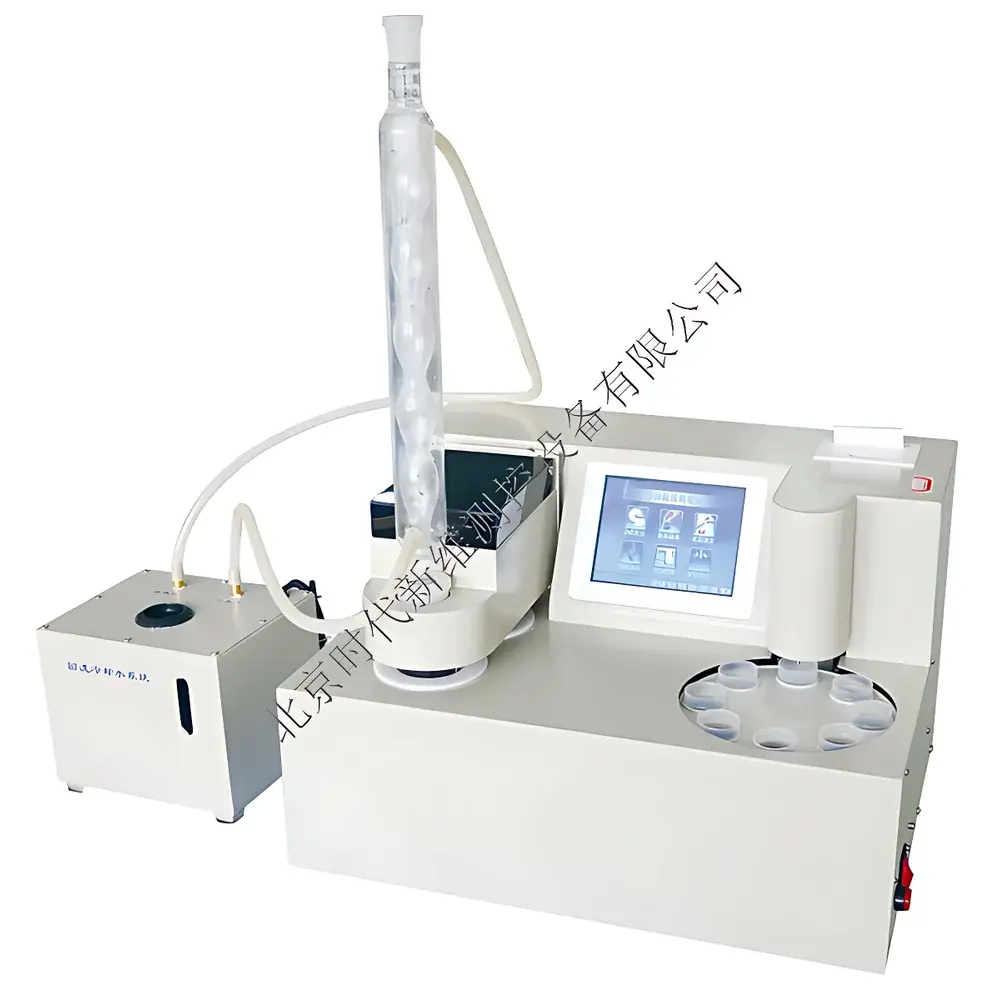
Timepower TP5321 Automatic Acid Number Analyzer
| Brand | Timepower |
|---|---|
| Origin | Beijing, China |
| Manufacturer Type | Manufacturer |
| Origin Category | Domestic (China) |
| Model | TP5321 |
| Price | Upon Request |
Overview
The Timepower TP5321 Automatic Acid Number Analyzer is a fully automated benchtop instrument engineered for precise, reproducible determination of acid number (AN) in insulating oils used in power generation and transmission systems—including transformer oil, turbine oil, and phosphate ester-based anti-wear hydraulic fluids (e.g., fire-resistant turbine oils). It operates on the potentiometric titration principle per GB/T 7599–1987, with full compliance to the electrochemical measurement framework defined in DL/T 846.7–2004, DL 429.9–1991, and GB/T 507–2002 (for dielectric strength correlation context). Unlike manual titration or semi-automated systems, the TP5321 integrates gravimetric sample introduction, temperature-controlled reflux, real-time endpoint detection via pH-sensitive electrode pair, and automatic baseline correction—eliminating operator-dependent variability in endpoint judgment and reagent delivery. Its design prioritizes laboratory safety by minimizing direct handling of corrosive reagents (e.g., alcoholic potassium hydroxide titrant) and volatile solvents (e.g., 95% ethanol/toluene mixtures), while maintaining traceable, auditable measurement conditions required under GLP-compliant oil testing workflows.
Key Features
- Integrated high-precision analytical balance (0.1 mg resolution) eliminates manual weighing—sample mass is auto-recorded upon cup placement.
- Automated heating and reflux cycle: programmable temperature ramp and dwell time ensure complete dissolution of acidic degradation products prior to titration.
- Dynamic background subtraction: real-time compensation for ethanol solvent blank and indicator (e.g., p-naphtholbenzein or phenolphthalein) baseline drift during titration.
- Onboard standardization module: includes dedicated calibration routine and certified reference standard acid solution (e.g., potassium hydrogen phthalate in ethanol), enabling user-performed verification of titrant molarity at any time—critical for long-term stability monitoring of KOH-in-ethanol solutions.
- Simplified single-sample workflow: one-button initiation triggers full sequence—reflux, titration, calculation, and result display—without intermediate manual intervention.
- Robust mechanical architecture: corrosion-resistant fluidic path, chemically inert PTFE pump tubing, and sealed electrode compartment prevent cross-contamination and extend service life.
Sample Compatibility & Compliance
The TP5321 is validated for use with mineral-based transformer oils (naphthenic and paraffinic), synthetic ester dielectric fluids, and phosphate ester anti-wear turbine oils meeting IEC 60296 and ASTM D3487 specifications. It supports sample volumes from 10 to 50 g, accommodating viscosity ranges up to 100 cSt at 40 °C. All operational parameters—including reflux temperature (78–82 °C), titrant addition rate (0.02–0.1 mL/s), and endpoint threshold (ΔpH ≥ 0.3 within 3 s)—are preconfigured to satisfy repeatability requirements of GB/T 7599–1987 (RSD ≤ 2% for AN < 0.1 mg KOH/g). The system meets electromagnetic compatibility (EMC) Class B per GB/T 18268.1–2010 and electrical safety standards GB 4793.1–2007, making it suitable for routine deployment in substation laboratories and ISO/IEC 17025-accredited testing facilities.
Software & Data Management
The embedded control interface provides alphanumeric LCD display with soft-key navigation and real-time titration curve visualization. Measurement data—including sample ID, mass, titrant volume, calculated acid number, date/time stamp, and operator ID—are stored internally (≥500 records) and exportable via USB to CSV format. Audit trail functionality logs all critical events: balance zeroing, standardization execution, parameter modifications, and result finalization—supporting traceability requirements aligned with CNAS-CL01:2018 and power industry internal QA protocols. While not FDA 21 CFR Part 11-certified (as it lacks electronic signature capability), its data integrity framework satisfies GLP documentation expectations for non-regulated utility maintenance labs.
Applications
- Condition monitoring of in-service transformer oil in 110 kV–1000 kV substations to assess oxidation-induced carboxylic acid accumulation.
- Acceptance testing of new turbine oils per DL/T 571–2014 before commissioning into steam or gas turbine lube systems.
- Root-cause analysis of rapid acid number rise correlated with overheating, cellulose insulation degradation, or catalytic metal particle contamination.
- Verification of oil reclamation efficacy following clay treatment or vacuum dehydration processes.
- Supporting predictive maintenance programs integrated with DGA (dissolved gas analysis) and interfacial tension data.
FAQ
What is the recommended maintenance interval for the peristaltic pump tubing?
Replace PTFE pump tubing every 6 months under continuous operation; inspect weekly for cracking or flattening. Always release pump arm pressure after each use to preserve elasticity.
Can the TP5321 be used for biodiesel (FAME) acid number testing?
No—it is optimized for low-polarity insulating oils per GB/T 7599. Biodiesel requires higher-polarity solvent systems (e.g., isopropanol/toluene) and different electrode conditioning, per ASTM D664.
Is external PC connectivity supported?
No native Ethernet or RS-232 port is provided; data transfer is USB-host only. Third-party integration requires manual CSV parsing.
How often should standardization be performed?
Perform before first use each day, after reagent replacement, and at minimum every 72 hours during active testing—per DL/T 846.7–2004 guidance.
Does the instrument comply with ISO 6618 for acid number determination?
It does not implement ISO 6618 (which specifies manual titration); however, its algorithmic endpoint detection and gravimetric dosing yield equivalent metrological uncertainty to ISO 6618 when validated against certified reference materials.





