
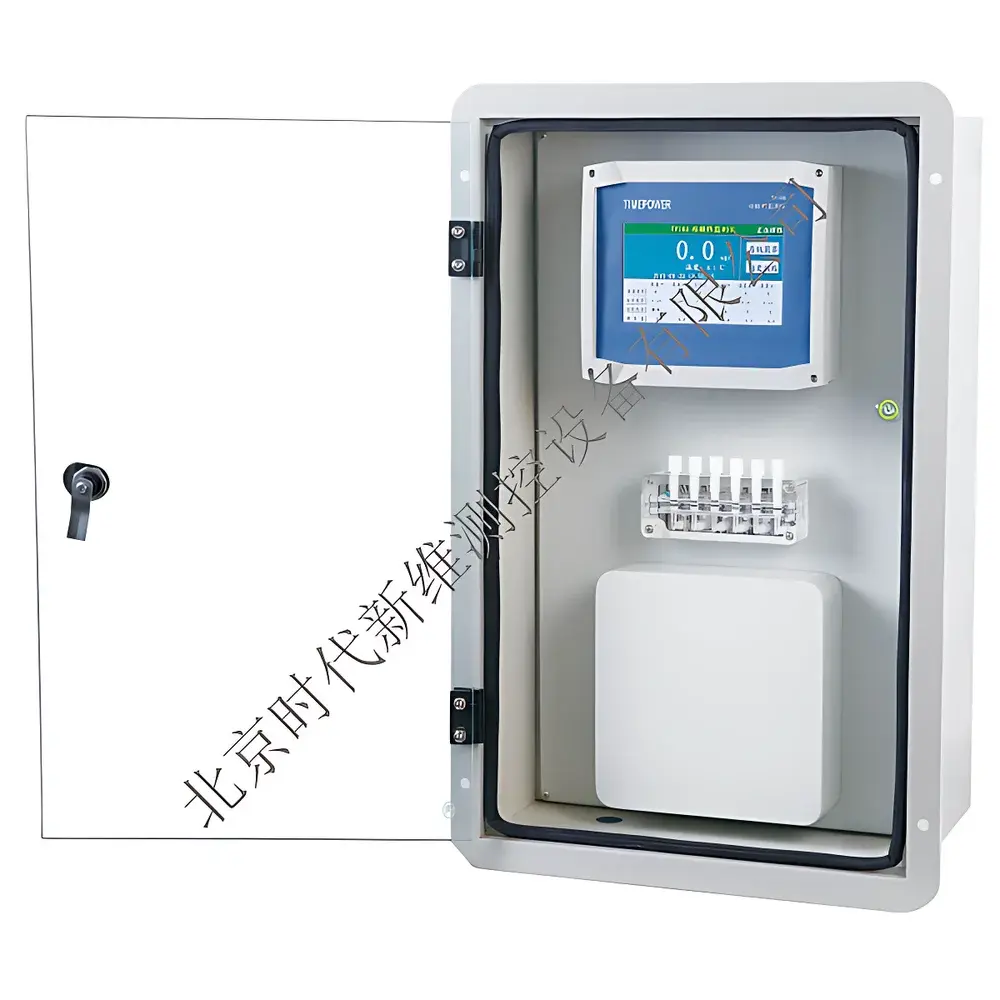
TimePower TP106 Online Silica Analyzer (Silicon Dioxide Monitor)
| Brand | TimePower |
|---|---|
| Model | TP106 |
| Origin | Beijing, China |
| Manufacturer | TimePower Instruments Co., Ltd. |
| Measurement Principle | Molybdenum Blue Photometric Method |
| Measurement Range | 0.0–200.0 μg/L or 0.0–2000 μg/L (selectable) |
| Accuracy | ±2% F.S. |
| Repeatability | ≤±1% F.S. |
| Drift | <±1% F.S./24 h |
| Response Time | <10 min |
| Cycle Time | ~10 min per channel |
| Sample Flow Rate | 10–40 L/h |
| Sample Temperature | 5–50 °C |
| Sample Particulate Limit | <5 µm, non-colloidal |
| Light Source | Monochromatic cold LED |
| Display | 7.0-inch color TFT touchscreen (Chinese UI) |
| Channels | 1–6 configurable |
| Reagent Consumption | ~3 L/month per reagent (4 reagents total) |
| Output Signals | Isolated 0–20 mA / 4–20 mA / 0–10 mA (programmable) |
| Alarm Outputs | Independent per channel — high/low limit, flow interruption |
| Power Supply | AC 85–265 V, 45–65 Hz |
| Power Consumption | ≤100 W |
| Dimensions (W×H×D) | 460×720×280 mm |
| Panel Cutout | 670×410 mm |
| Weight | 22 kg |
| Operating Environment | 5–45 °C, ≤90% RH (non-condensing) |
Overview
The TimePower TP106 Online Silica Analyzer is an industrial-grade photometric instrument engineered for continuous, real-time monitoring of dissolved silica (as SiO₂) in ultrapure and process water streams. It operates on the well-established molybdenum blue method: under controlled acidic conditions (pH 1.1–1.3), soluble silicate reacts with ammonium molybdate to form a yellow heteropoly acid complex; subsequent reduction by 1-amino-2-naphthol-4-sulfonic acid (1-2-4 acid) yields a stable, intensely colored silicon-molybdenum blue complex. Absorbance at 630–650 nm is quantified via dual-beam photometry using a monochromatic cold LED light source—ensuring long-term optical stability and minimal thermal drift. Designed for integration into critical water quality control loops, the TP106 meets the stringent demands of power generation (especially boiler feedwater and condensate monitoring), semiconductor-grade ultrapure water (UPW) systems, pharmaceutical water-for-injection (WFI) circuits, and chemical process streams where sub-ppb to low-ppb silica detection is essential for corrosion prevention and equipment longevity.
Key Features
- Modular multi-channel architecture supporting 1 to 6 independent measurement channels—enabling simultaneous monitoring of multiple sample points without hardware duplication.
- High-precision peristaltic and solenoid valve manifold with imported electromagnetic valves, delivering reproducible reagent dosing, accurate sample aspiration, and >500,000-cycle actuation life.
- 7.0-inch full-color TFT touchscreen interface with intuitive Chinese-language navigation, real-time trend visualization, and overlay-capable channel curves (live + historical).
- Robust optical design featuring temperature-stabilized LED light source and matched photodetector pair—eliminating lamp aging effects and enabling <±1% F.S./24 h baseline stability.
- Integrated data logging with onboard memory retaining 30 days of timestamped measurements (including absorbance values, calculated silica concentration, alarm status, and system diagnostics) at user-defined intervals.
- Flexible I/O architecture: four isolated analog outputs (0–20 mA / 4–20 mA / 0–10 mA configurable per channel), relay-based discrete alarms (high/low limit, flow fault), and RS485 Modbus RTU support for DCS/SCADA integration.
Sample Compatibility & Compliance
The TP106 accepts liquid samples within 5–50 °C and requires pre-filtration to remove suspended solids <5 µm; colloidal silica must be absent to avoid interference with colorimetric reaction kinetics. It complies with ASTM D859 (Standard Test Method for Silica in Water) and aligns with ISO 15301 (Water quality — Determination of silica — Molybdenum blue spectrophotometric method). For regulated environments—including pharmaceutical manufacturing (FDA 21 CFR Part 11-ready configuration available), power plant chemistry monitoring (EPRI guidelines), and municipal drinking water treatment—the analyzer supports audit-trail-enabled operation, user-level access control, and electronic signature capability when paired with TimePower’s optional GLP/GMP-compliant software suite.
Software & Data Management
Data acquisition and remote supervision are facilitated through TimePower’s proprietary TPCloud Connect platform (Windows/Linux compatible), offering secure web-based access to live readings, historical trends, calibration logs, reagent consumption tracking, and predictive maintenance alerts. All measurement events—including manual calibrations, zero/span adjustments, and alarm triggers—are time-stamped and stored with operator ID. The system supports CSV export, automated report generation (daily/weekly/monthly), and seamless integration into enterprise LIMS or MES via OPC UA or RESTful API. Firmware updates are delivered over-the-air with cryptographic signature verification to ensure integrity and traceability.
Applications
- Thermal power plants: Continuous monitoring of silica in boiler feedwater, condensate polishing effluent, and steam cycle make-up water to prevent turbine blade deposition and heat exchanger scaling.
- Semiconductor fabs: Ultrapure water (UPW) loop surveillance at sub-20 μg/L levels to meet SEMI F63 specifications for particle and ionic contaminant control.
- Pharmaceutical facilities: Monitoring of purified water (PW) and water-for-injection (WFI) per USP and EU Annex 1 requirements for non-volatile residue and silica-related endotoxin risk mitigation.
- Chemical & petrochemical plants: Catalyst protection in hydroprocessing units and silica fouling prevention in cooling tower blowdown control.
- Municipal utilities: Raw water intake assessment and post-treatment verification in advanced oxidation or membrane filtration plants.
FAQ
What is the minimum detectable silica concentration?
The lower limit of quantification (LLOQ) is 0.5 μg/L in the 0.0–200.0 μg/L range, validated per ICH Q2(R2) principles using signal-to-noise ≥10.
Can the TP106 measure colloidal silica?
No—colloidal or particulate silica must be removed prior to analysis via 0.45 µm membrane filtration; only truly dissolved monosilicic acid [Si(OH)₄] is measured.
How often does the system require calibration?
Factory-calibrated with NIST-traceable silica standards; field verification recommended every 7 days or after reagent replacement, with automatic zero/span validation supported.
Is remote diagnostic support available?
Yes—embedded Ethernet and optional 4G LTE module enable secure remote troubleshooting, firmware updates, and real-time parameter adjustment via authenticated cloud portal.
Does the analyzer comply with cybersecurity standards for industrial control systems?
It implements TLS 1.2 encryption for web interface, role-based authentication, disabled default credentials, and configurable password policies—aligned with ISA/IEC 62443-3-3 Level 1 requirements.





