
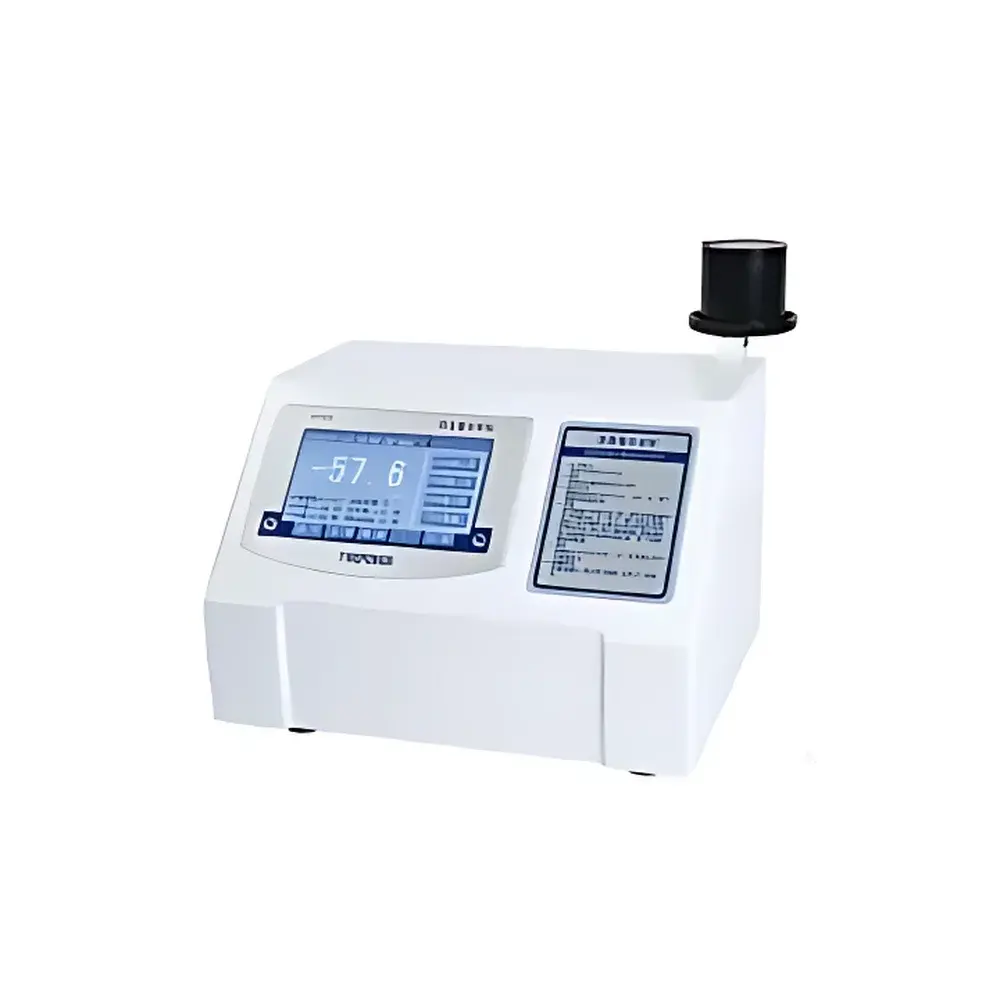
TimePower TP305 Copper Ion Analyzer
| Brand | TimePower |
|---|---|
| Origin | Beijing, China |
| Manufacturer Type | Manufacturer |
| Region of Origin | Domestic (China) |
| Model | TP305 |
| Pricing | Upon Request |
| Display | 5.0-inch color touchscreen LCD (Chinese interface) |
| Measurement Principle | Photometric colorimetry based on Lambert-Beer law |
| Analytical Method | National standard method using bis-cyclohexanone oxalyldihydrazone (BCO) reagent |
| Measurement Range | 0.00–200 μg/L |
| Accuracy | ±3% of full scale (F.S.) |
| Resolution | 0.1 μg/L |
| Repeatability | ≤1% |
| Stability | ±1.5% F.S. / 4 h |
| Operating Temperature | 5–45 °C |
| Relative Humidity | ≤90% RH (non-condensing) |
| Power Supply | AC 85–265 V, 45–65 Hz |
| Power Consumption | ≤30 W |
| Dimensions | 260 × 200 × 180 mm |
| Weight | 3.2 kg |
| Data Storage | Cyclic memory for up to 256 measurements |
| Calibration | Blank calibration and curve calibration supported |
| Light Source | Imported monochromatic cold-light LED source |
| Circuit Design | High-integration SMT PCB architecture |
| Microcontroller | Advanced low-power single-chip microcontroller |
| Timing Function | Automatic countdown timer with audible/visual alert |
| Compliance | Aligns with Chinese national standard GB/T 12149–2019 (Industrial circulating cooling water — Determination of copper ion content by spectrophotometry) |
Overview
The TimePower TP305 Copper Ion Analyzer is a dedicated photometric instrument engineered for trace-level quantification of dissolved copper ions (Cu²⁺) in ultra-pure and process water streams. It operates on the fundamental principle of spectrophotometric colorimetry, applying the Lambert-Beer law to correlate absorbance at a defined wavelength (typically ~550 nm) with copper concentration in solution. The analyzer employs the nationally standardized bis-cyclohexanone oxalyldihydrazone (BCO) method—recognized in GB/T 12149–2019—which forms a stable, intensely colored chelate complex with Cu²⁺ under controlled pH and temperature conditions. Designed specifically for power generation facilities, the TP305 delivers reliable, field-deployable analysis of boiler feedwater, condensate, steam cycle samples, generator stator cooling water, drum boiler water, and natural surface waters where copper contamination poses corrosion or deposition risks.
Key Features
- High-stability optical system featuring an imported monochromatic cold-light LED source—ensuring minimal thermal drift, low power draw (10,000 h).
- Integrated 5.0-inch capacitive touchscreen LCD with native Chinese GUI—enabling intuitive navigation, real-time parameter display, and on-device data review without external software.
- Robust embedded architecture built with advanced surface-mount technology (SMT) and a low-power, high-reliability microcontroller—optimized for continuous operation in industrial control rooms and mobile lab environments.
- Automated timing module with programmable countdown alerts—supporting standardized reaction incubation periods per GB/T 12149–2019, reducing operator dependency and procedural variability.
- Dual-stage calibration protocol: zero-point blank calibration eliminates electronic and optical baseline drift; periodic multi-point curve calibration compensates for reagent aging, cuvette fouling, and ambient temperature fluctuations.
- Cyclic non-volatile memory storing up to 256 measurement records—including timestamp, sample ID (user-input), concentration value, and calibration status—with automatic overwrite logic to prevent data loss.
Sample Compatibility & Compliance
The TP305 is validated for use with deionized water matrices meeting ASTM D1193 Type II or higher purity specifications. Sample introduction is performed manually via supplied polypropylene sample cups; no integrated autosampler or fluidic manifold is included. All reagents—including BCO chromogenic reagent, buffer solutions, and copper standard stock solutions—must be prepared using high-purity reagents (≥analytical grade) stored in certified polyethylene containers to prevent leaching. Instrument performance aligns with GB/T 12149–2019 requirements for precision (repeatability ≤1%), accuracy (±3% F.S.), and short-term stability (±1.5% F.S./4 h). While not inherently 21 CFR Part 11 compliant, audit-ready operation is achievable through documented SOPs, manual calibration logs, and exported CSV data files.
Software & Data Management
The TP305 operates as a standalone embedded system with no proprietary PC software dependency. All configuration, calibration, and measurement functions are executed locally via the touchscreen interface. Measurement data—including date/time stamp, user-entered sample identifier, raw absorbance, calculated concentration (μg/L), and pass/fail status against user-defined limits—can be reviewed on-screen or exported via USB flash drive in plain-text CSV format. No cloud connectivity, remote diagnostics, or database integration is provided. For regulated environments, laboratories must implement supplementary documentation controls (e.g., paper-based calibration logs, version-controlled SOPs) to satisfy GLP or internal QA requirements.
Applications
- Monitoring copper breakthrough in mixed-bed demineralizers and condensate polisher effluents.
- Verifying compliance with ASME PTC 19.11 and EPRI guidelines for <5 μg/L Cu in turbine feedwater.
- Diagnosing copper corrosion in closed-loop generator cooling systems (stator and rotor circuits).
- Supporting root-cause analysis during steam purity excursions in fossil and nuclear power plants.
- Field verification of copper removal efficiency in membrane filtration or electrochemical treatment units.
- Environmental surveillance of copper discharge limits in plant wastewater per local regulatory frameworks (e.g., China’s GB 8978–1996).
FAQ
What is the recommended frequency for blank and curve calibration?
Blank calibration should be performed daily before first use; full multi-point curve calibration is required every two weeks—or immediately after reagent batch change, optical component cleaning, or environmental temperature shifts exceeding ±5 °C.
Can the TP305 analyze samples containing interfering ions such as iron or nickel?
The BCO method exhibits moderate selectivity for Cu²⁺. Samples with Fe³⁺ > 100 μg/L or Ni²⁺ > 500 μg/L may require pre-treatment (e.g., masking with ammonium citrate or selective extraction) per GB/T 12149–2019 Annex B.
Is the instrument suitable for outdoor or unconditioned laboratory use?
Operation is limited to ambient temperatures between 5–45 °C and relative humidity ≤90% RH (non-condensing); prolonged exposure to direct sunlight or vibration sources is not recommended.
How is traceability maintained for copper standard solutions?
Users must prepare standards from NIST-traceable Cu stock solutions (e.g., CertiPUR® or equivalent) and document preparation dates, dilution factors, and storage conditions per ISO/IEC 17025 clause 7.7.
Does the TP305 support export of raw absorbance values for third-party regression analysis?
Yes—CSV exports include both concentration (μg/L) and corresponding absorbance readings at the measurement wavelength, enabling offline method validation or custom calibration model development.





