
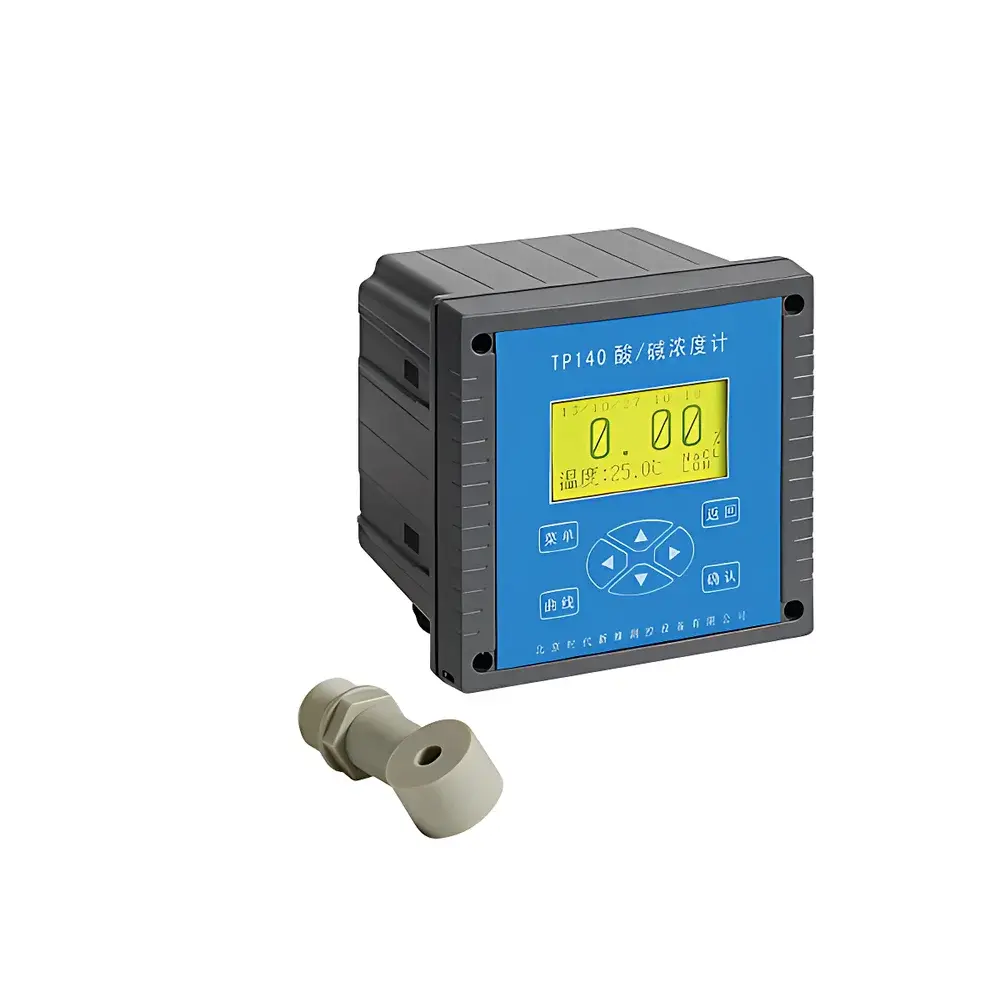
TimePower TP140 Online Acid Concentration Analyzer
| Brand | TimePower |
|---|---|
| Origin | Beijing, China |
| Manufacturer | TimePower Measurement & Control Equipment Co., Ltd. |
| Model | TP140 |
| Measurement Principle | Conductivity-based concentration determination |
| Measurable Media | HCl (0–10.00%), NaOH (0–10.00%), H₂SO₄ (0–20.00%), NaCl (0–20.00%), HNO₃ (0–15.00%), Na₂CO₃ (0–10.00%) |
| Accuracy | ±2% FS |
| Resolution | 0.01% |
| Repeatability | ≤1% |
| Temperature Sensor | Pt1000 |
| Temp. Measurement Range | 0.0–99.9 °C |
| Temp. Compensation Range | 0.1–60.0 °C |
| Sample Temp. Range | 5–60 °C |
| Ambient Temp. Range | 5–45 °C |
| Humidity Limit | ≤90% RH (non-condensing) |
| Power Supply | AC 220 V ±10%, 50 Hz ±1 Hz |
| Power Consumption | <5 W |
| Enclosure Rating | IP65 |
| Dimensions (L×W×H) | 142 mm × 125 mm × 155 mm |
| Panel Cutout | 138 mm × 138 mm |
| Weight | 1.6 kg |
| Output Signals | 0–10 mA / 0–20 mA / 4–20 mA (selectable) |
| Relay Outputs | 2 SPST, AC220 V / 3 A or DC30 V / 3 A |
| Data Storage | Cyclic non-volatile memory, >10 years retention after power loss |
| Mounting Options | Panel-mount (standard), wall-mount, rack-mount |
| Electrode Mounting | Flow-through, immersion, flanged, or inline pipe mount |
| Display | 128×64 dot-matrix LCD, full Chinese interface |
Overview
The TimePower TP140 Online Acid Concentration Analyzer is a microprocessor-controlled, conductivity-based process analyzer engineered for continuous, real-time monitoring of acid and alkali concentrations in industrial aqueous solutions. It operates on the fundamental principle that electrolytic conductivity correlates linearly with ionic concentration within defined temperature and composition ranges—enabling precise, non-invasive quantification of common process chemicals including hydrochloric acid (HCl), sulfuric acid (H₂SO₄), nitric acid (HNO₃), sodium hydroxide (NaOH), sodium chloride (NaCl), and sodium carbonate (Na₂CO₃). Designed for integration into high-purity water regeneration systems—particularly ion exchange resin regeneration cycles—and boiler/pipe chemical cleaning operations, the TP140 delivers stable, drift-resistant measurements under dynamic flow conditions. Its measurement architecture employs 24-bit analog-to-digital conversion and automatic temperature compensation via integrated Pt1000 sensing, ensuring metrological integrity across operating temperatures from 5 °C to 60 °C. The instrument conforms to general-purpose industrial instrumentation requirements for reliability, electromagnetic compatibility (IEC 61326-1), and functional safety in non-hazardous areas.
Key Features
- High-stability, corrosion-resistant conductivity electrode (model 140-001) optimized for aggressive acidic and alkaline media
- Multi-range programmable configuration: supports six standard chemistries with pre-calibrated concentration spans (e.g., H₂SO₄: 0–20.00%, HNO₃: 0–15.00%)
- Full Chinese graphical user interface with intuitive menu navigation—no language barrier for on-site operators
- Robust embedded design using advanced SMT manufacturing and high-integration circuitry for long-term operational stability
- Temperature-compensated conductivity measurement with Pt1000 sensor (0.0–99.9 °C range; compensation active from 0.1–60.0 °C)
- Selectable current output (4–20 mA standard, also 0–10 mA or 0–20 mA) with galvanic isolation for noise immunity in industrial control environments
- Dual programmable relay outputs (SPST, 3 A rating) configurable for high/low concentration alarms or system interlock signaling
- Cyclic non-volatile memory with >10-year data retention after power failure—supports audit-ready historical trend logging without external storage
- IP65-rated enclosure suitable for panel mounting in control rooms or wall/rack installation in equipment cabinets
Sample Compatibility & Compliance
The TP140 is validated for use with clean, low-turbidity aqueous streams containing no suspended solids, oils, or precipitates that could foul the conductivity cell. It is not intended for viscous, emulsified, or highly contaminated effluents. Electrode configurations include flow-through cells for pressurized pipelines, immersion probes for open tanks, flanged assemblies for ASME B16.5-compliant vessels, and direct pipe-thread mounts. While the analyzer itself does not carry CE, UKCA, or ATEX certification, its electrical design meets IEC 61000-6-2 (immunity) and IEC 61000-6-4 (emission) standards for industrial environments. For regulated applications—including pharmaceutical water systems or power plant chemistry monitoring—the device supports traceable calibration documentation and can be incorporated into GLP/GMP workflows when paired with documented procedures and periodic verification per ASTM D1125 (Standard Test Methods for Electrical Conductivity of Water).
Software & Data Management
The TP140 operates autonomously without external software dependencies. All configuration, calibration, and alarm thresholds are managed locally via the front-panel keypad and LCD interface. Calibration is performed using two-point conductivity standards traceable to NIST or equivalent national metrology institutes. The instrument stores up to 32 calibration events with timestamps and operator IDs (entered manually), satisfying basic data integrity requirements. While it lacks native Ethernet or Modbus TCP connectivity, the 4–20 mA analog output enables seamless integration into DCS, PLC, or SCADA systems for centralized trending and alarm aggregation. Optional third-party data loggers may acquire output signals for long-term archiving compliant with FDA 21 CFR Part 11 if accompanied by appropriate procedural controls (e.g., access restrictions, electronic signature protocols).
Applications
- Continuous monitoring of HCl or NaOH concentration during ion exchange resin regeneration in ultrapure water (UPW) production systems
- Real-time dosing control of acid cleaning solutions in thermal power plant boiler tube descaling processes
- Concentration verification of pickling baths in metal surface treatment lines (e.g., stainless steel passivation)
- Quality assurance of reagent-grade NaCl or Na₂CO₃ solutions in chemical synthesis pilot plants
- Process validation support for ISO 9001-certified manufacturing where solution strength directly impacts product specifications
FAQ
What calibration standards are recommended for H₂SO₄ measurement?
Standard potassium chloride (KCl) solutions at known concentrations (e.g., 0.01 mol/L and 0.1 mol/L) are used for primary conductivity calibration; secondary verification against certified H₂SO₄ reference solutions (traceable to NIST SRM 3109a) is advised for critical applications.
Can the TP140 measure mixed-acid solutions?
No—the instrument assumes single-solute electrochemical behavior. Accurate quantification requires homogeneous, binary aqueous systems (acid + water or base + water); mixed acids introduce non-linear conductivity interactions and require lab-based titration or HPLC validation.
Is temperature compensation mandatory?
Yes—conductivity varies significantly with temperature (typically ~2%/°C for strong electrolytes). The built-in Pt1000 sensor and automatic compensation algorithm are essential for maintaining ±2% FS accuracy across the 5–60 °C sample range.
How often should the electrode be cleaned or replaced?
Cleaning frequency depends on fouling potential: weekly for clean UPW regeneration loops; daily for high-solids or organic-laden streams. Electrode lifetime averages 12–24 months under proper maintenance; performance degradation is indicated by rising zero drift or reduced sensitivity during calibration.
Does the device support remote configuration via digital communication?
No—the TP140 relies exclusively on local keypad operation. Digital fieldbus options (e.g., Modbus RTU over RS-485) are not available in this model variant; consider the TP140-RS series for protocol-enabled versions.





