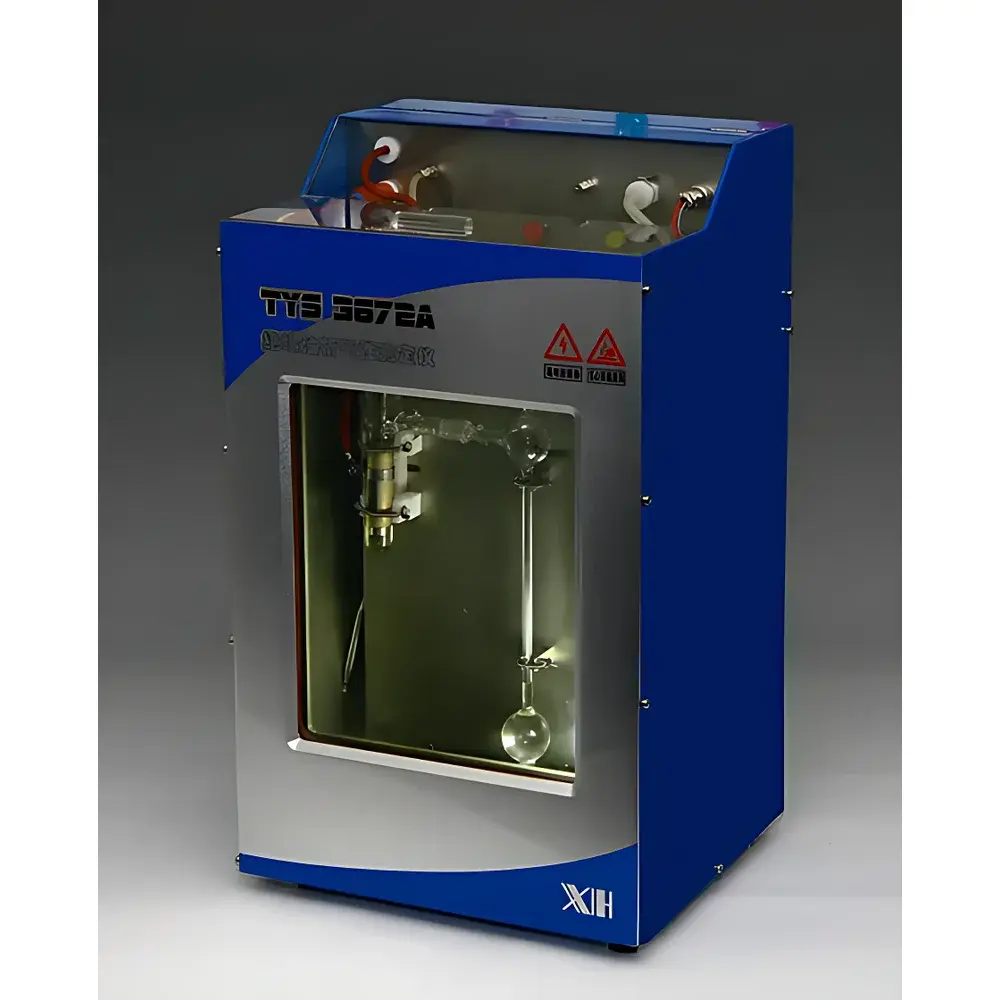
TYS-3672A Insulating Oil Gassing Tendency Tester
| Origin | Beijing, China |
|---|---|
| Manufacturer Type | Authorized Distributor |
| Regional Origin | Domestic (China) |
| Model | TYS-3672A |
| Pricing | Upon Request |
Overview
The TYS-3672A Insulating Oil Gassing Tendency Tester is a precision-engineered laboratory instrument designed to quantitatively evaluate the gassing behavior of electrical insulating oils under controlled thermal and high-voltage stress conditions. Based on the fundamental principle of electrochemical gas evolution in dielectric liquids, the system simulates service-relevant operating environments—specifically elevated temperature (up to 120 °C) and sustained AC high voltage (10 kV or 12 kV, ±2% accuracy)—to induce and measure net gas volume change within a sealed test cell. This volumetric measurement reflects the net balance between gas absorption and liberation (e.g., hydrogen, methane, ethane) resulting from oil decomposition and recombination reactions at electrode interfaces. The instrument complies with internationally recognized test methodologies including ASTM D2300 (Standard Test Method for Gassing Tendency of Electrical Insulating Oils), IEC 60628 (Mineral insulating oils for electrical equipment – Specifications), and GB/T 11142 (Test method for gassing tendency of insulating oil). Its design supports routine quality control in transformer oil manufacturing, condition monitoring of in-service oils, and R&D validation of antioxidant and inhibitor formulations.
Key Features
- Full-color capacitive touchscreen HMI with intuitive icon-driven navigation and multilingual UI support (English default)
- Automated end-to-end test sequencing: temperature ramping, voltage application, gas collection timing, and data logging—all programmable and repeatable
- Integrated self-diagnostic subsystem with real-time status feedback and audible/visual fault alerts (e.g., overtemperature, voltage instability, seal integrity loss)
- High-capacity oil bath heating system with rapid thermal response and uniformity (<±0.2 °C stability across working range: ambient to 120 °C)
- Magnetically coupled gear pump circulation ensures laminar, vibration-free oil flow—critical for minimizing thermal stratification and accelerating bath equilibration
- Front-access transparent quartz viewport with integrated LED illumination enables direct visual verification of meniscus position in the calibrated gas burette and sample chamber integrity
- Stainless-steel oil bath liner (316L grade) provides corrosion resistance, mechanical durability, and compliance with electrical safety standards for high-voltage immersion
- Modular gassing cell assembly allows tool-free disassembly, cleaning, and rapid sample exchange—reducing turnaround time between tests
Sample Compatibility & Compliance
The TYS-3672A accommodates standard 100 mL glass gassing cells conforming to ASTM D2300 geometry specifications. It supports both new and reclaimed mineral-based insulating oils, naphthenic and paraffinic formulations, and select synthetic ester fluids—provided they exhibit sufficient dielectric strength (>30 kV/2.5 mm per ASTM D877) and thermal stability under test conditions. All operational parameters—including temperature setpoint, voltage level (10 kV or 12 kV selectable), exposure duration (1–120 min), and gas collection interval—are fully configurable via the HMI. The instrument meets electromagnetic compatibility (EMC) requirements per IEC 61326-1 and is designed for use in ISO/IEC 17025-accredited laboratories. Data output conforms to GLP documentation standards, with timestamped records traceable to system clock and operator ID.
Software & Data Management
The embedded firmware supports storage of up to 1,000 complete test records, each containing raw gas volume readings, temperature/voltage profiles, timestamps, operator annotations, and pass/fail flags relative to user-defined limits. Data export is available via USB 2.0 interface in CSV format for integration into LIMS or statistical process control platforms. Built-in thermal printout capability provides immediate hardcopy reports compliant with internal QA protocols. Audit trail functionality logs all configuration changes, calibration events, and user logins—supporting FDA 21 CFR Part 11 readiness when deployed in regulated environments requiring electronic record integrity.
Applications
- Quality assurance testing of virgin transformer oils prior to filling
- Evaluation of gassing inhibition performance of additives (e.g., DBPC, passivators)
- Assessment of oil aging kinetics under accelerated electrical-thermal stress
- Comparative analysis of alternative base stocks (e.g., highly refined naphthenics vs. Group II/III hydroprocessed oils)
- Root-cause investigation of abnormal gas generation in field-failed units (correlated with DGA trends)
- Validation of reclamation process efficacy in removing gassing precursors
FAQ
What voltage options are supported, and how is output accuracy maintained?
The TYS-3672A offers two factory-configured high-voltage outputs: 10 kV ±2% and 12 kV ±2%, both delivered as 50 Hz sinusoidal waveforms with total harmonic distortion <5%. Voltage calibration is traceable to national metrology institutes via internal HV divider verification.
Is the instrument suitable for use with non-mineral insulating fluids?
Yes—provided the fluid meets minimum dielectric strength and thermal stability thresholds. Validation per ASTM D2300 Annex A is recommended for ester- or silicone-based oils.
How is temperature uniformity verified across the oil bath?
Three independent PT100 sensors monitor spatial gradients; firmware enforces a maximum allowable differential of ±0.3 °C between zones before initiating voltage application.
Can test methods be exported or shared between instruments?
Method templates (including temperature ramp rates, voltage dwell times, and gas sampling intervals) are stored as encrypted .MTH files and transferable via USB drive.
Does the system support remote monitoring or network connectivity?
No Ethernet or Wi-Fi interface is included; however, RS-232 serial output is available for integration with building SCADA or centralized lab automation systems.