
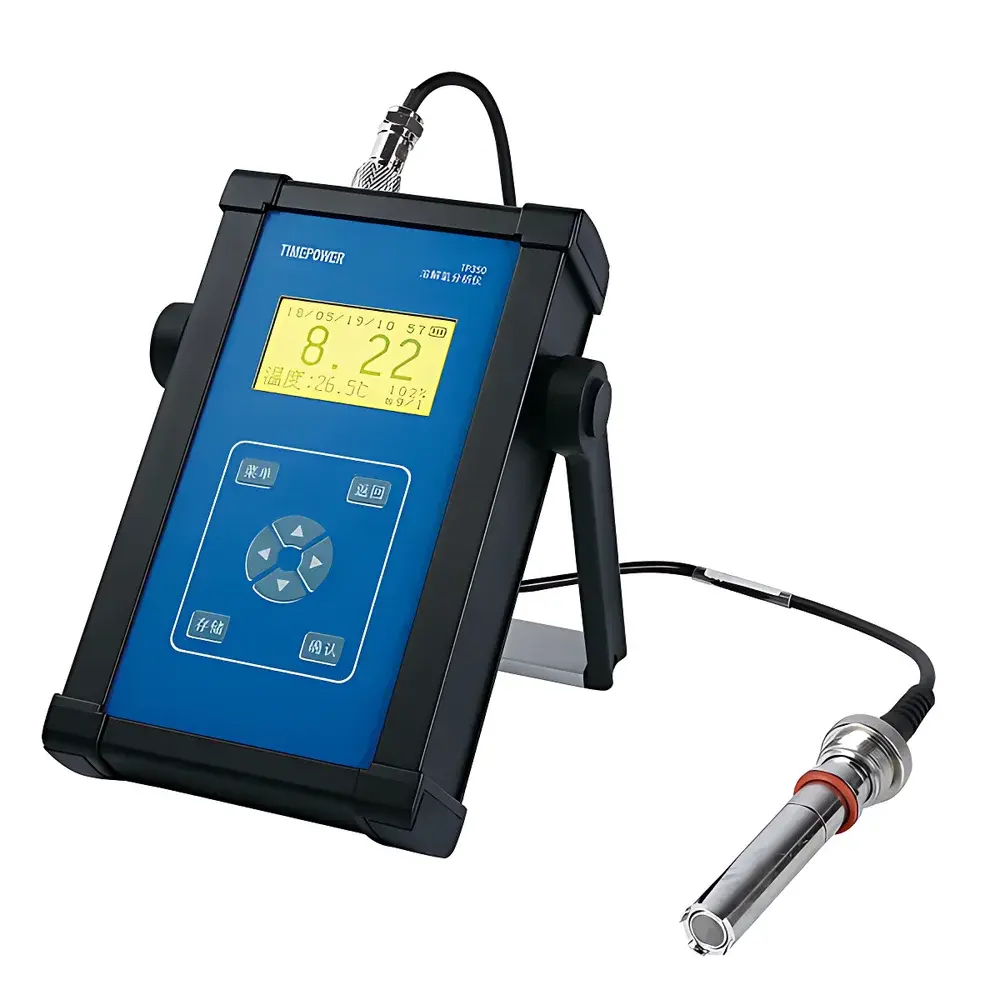
Timepower TP350 Portable Microgram-Level Dissolved Oxygen Analyzer
| Brand | Timepower |
|---|---|
| Origin | Beijing, China |
| Manufacturer Type | Manufacturer |
| Model | TP350 |
| Measurement Principle | Clark-type Membrane Electrode (Galvanic or Polarographic, Configurable) |
| Detection Range | 0.0–100 μg/L, 100–1000 μg/L, 1.00–20.00 mg/L (Auto-ranging) |
| Resolution | 0.1 μg/L (≤100 μg/L), 1.0 μg/L (100–1000 μg/L), 0.01 mg/L (1.00–20.00 mg/L) |
| Accuracy | ±1.0% FS |
| Repeatability | ≤1% |
| Response Time (T90) | <5 min at 25 °C |
| Temperature Compensation | Pt1000 sensor, 0–60.0 °C |
| Sample Temp. Range | 5–45 °C |
| Operating Ambient | 5–45 °C, ≤90% RH (non-condensing) |
| Power Supply | AC 85–265 V, 45–65 Hz |
| Power Consumption | ≤1 W |
| Display | 128×64 dot-matrix LCD, Chinese interface |
| Data Storage | Cyclic memory with >10-year data retention after power loss |
| Battery Life | Up to 8 hours continuous operation (internal rechargeable battery) |
| Enclosure Rating | IP65 |
| Dimensions | 285 × 60 × 255 mm |
| Weight | 2.28 kg |
| Electrode Configuration | Integrated galvanic DO sensor with PTFE/PE composite membrane, Pt cathode, Pb/Al anode, aqueous electrolyte |
Overview
The Timepower TP350 Portable Microgram-Level Dissolved Oxygen Analyzer is a field-deployable, high-stability instrument engineered for trace-level dissolved oxygen (DO) quantification in ultra-pure water systems, pharmaceutical process streams, boiler feedwater, semiconductor rinse water, and laboratory-grade aqueous solutions. It employs the electrochemical Clark-type membrane electrode principle—specifically a galvanic (self-polarizing) configuration—where molecular oxygen diffuses through a selective hydrophobic membrane (PTFE/polyethylene composite) and undergoes reduction at a platinum cathode in the presence of an internal electrolyte. The resulting diffusion-limited current is linearly proportional to the partial pressure of dissolved O₂, enabling precise microgram-per-liter (μg/L) measurement without external polarization voltage. This principle ensures long-term stability, low maintenance, and immunity to redox interferences common in complex matrices—critical for compliance with USP , ASTM D888, ISO 5814, and pharmacopeial water purity specifications.
Key Features
- Triple-range auto-switching detection: 0.0–100 μg/L (for ultrapure water), 100–1000 μg/L (for deaerated process water), and 1.00–20.00 mg/L (for ambient or wastewater applications)—all resolved with appropriate digit precision per range.
- High-fidelity signal acquisition: 24-bit analog-to-digital conversion ensures minimal quantization error and superior signal-to-noise ratio across full dynamic range.
- Integrated Pt1000 temperature sensor with automatic compensation (0–60.0 °C), eliminating manual correction and minimizing thermal drift errors.
- Ruggedized portable architecture: IP65-rated enclosure withstands dust ingress and water splashing; compact form factor (285 × 60 × 255 mm) and 2.28 kg weight support benchtop, mobile cart, or handheld deployment.
- Low-power embedded design: Advanced SMT-based circuitry and optimized firmware deliver ≤1 W power draw and up to 8 hours of continuous operation on internal rechargeable battery.
- Regulatory-ready data handling: Non-volatile memory retains ≥10 years of timestamped measurements post-power-loss; supports GLP-compliant audit trails when paired with optional PC software.
Sample Compatibility & Compliance
The TP350 is validated for use with low-conductivity (<5 µS/cm), low-ionic-strength aqueous media typical of power plant condensate, pharmaceutical purified water (PW), water-for-injection (WFI), and microelectronics rinse water. Its galvanic sensor eliminates the need for polarizing voltage, reducing sensitivity to flow rate fluctuations and minimizing zero drift in stagnant or low-flow conditions. The instrument complies with key international standards including ASTM D888-22 (Standard Test Methods for Dissolved Oxygen in Water), ISO 5814:2012 (Water quality — Determination of dissolved oxygen — Electrochemical probe method), and supports alignment with FDA 21 CFR Part 11 requirements when used with validated data export protocols. For GMP environments, the device’s calibration log, electrode history tracking, and user-accessible diagnostic codes facilitate routine IQ/OQ documentation.
Software & Data Management
While the TP350 operates autonomously via its intuitive Chinese-language menu system, optional Windows-compatible software enables bidirectional communication via USB or RS232. This software provides real-time graphing, customizable report generation (PDF/CSV), batch calibration logging, and firmware updates. All stored measurements include date/time stamps, temperature readings, and range identifiers. Data export conforms to LIMS-ready formats and supports integration into centralized SCADA or MES platforms. Audit trail functionality—including operator ID, calibration event timestamps, and parameter modification history—is configurable to meet GLP/GMP documentation rigor.
Applications
- Power generation: Monitoring dissolved oxygen in turbine condensate and boiler feedwater to prevent corrosion under deposits (CUD) and stress corrosion cracking (SCC).
- Pharmaceutical manufacturing: In-process verification of DO levels in PW/WFI distribution loops per USP and EU Annex 1.
- Semiconductor fabrication: Ensuring sub-10 μg/L DO in ultrapure rinse water to avoid oxidation of copper interconnects during wafer processing.
- Research laboratories: Kinetic studies of oxygen consumption in bioreactors, enzymatic assays, and environmental water column profiling.
- Environmental monitoring: Field validation of low-oxygen zones in groundwater remediation sites or anaerobic digester influents.
FAQ
What electrode technology does the TP350 use?
It uses a galvanic-type Clark electrode with a PTFE/PE composite membrane, Pt cathode, and Pb/Al anode—requiring no external polarization voltage and offering inherent stability in low-flow applications.
How often must the membrane and electrolyte be replaced?
Typical service intervals are 3–6 months under continuous operation; however, replacement is required immediately if response time exceeds 5 min (T90), zero drift increases, or physical membrane damage is observed.
Is temperature compensation automatic?
Yes—the integrated Pt1000 sensor continuously measures sample temperature and applies Nernst-based compensation across the full 0–60.0 °C range.
Can the TP350 be used in flowing stream applications?
Yes—when mounted in a flow-through cell (included in accessory kit), it supports flow rates of 100–500 mL/min; hard-wall tubing (e.g., PFA or stainless steel) is recommended for sub-50 μg/L measurements to prevent atmospheric O₂ permeation.
Does the instrument support regulatory audit trails?
Local storage includes time-stamped calibration records and measurement logs; full 21 CFR Part 11 compliance requires use of validated PC software with electronic signature and role-based access control.
Related Products





