
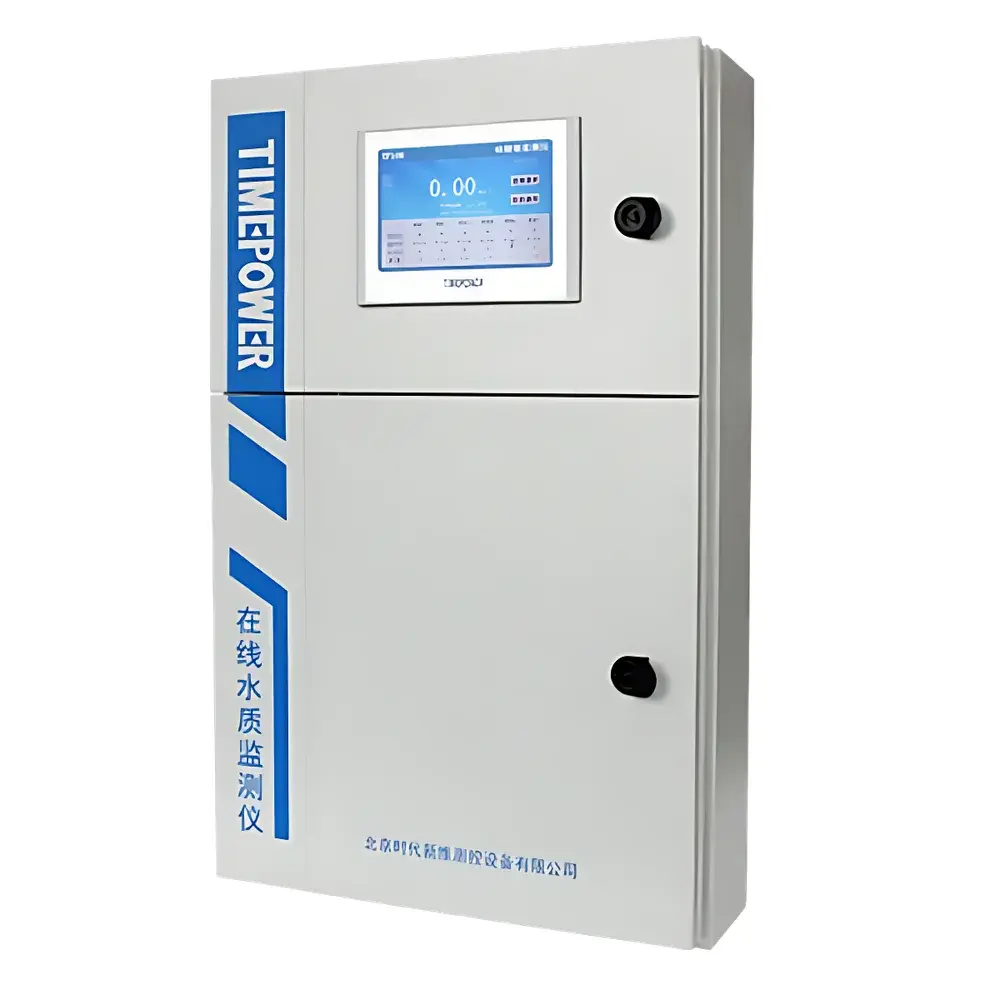
TimePower TP106 Online Silicate Analyzer
| Brand | TimePower |
|---|---|
| Origin | Beijing, China |
| Manufacturer Type | Manufacturer |
| Origin Category | Domestic |
| Model | TP106 |
| Instrument Type | Online Analyzer |
| Measurement Principle | Molybdenum Blue Photometric Method (Silicomolybdate Reduction with 1-Amino-2-Naphthol-4-Sulfonic Acid) |
| Display | 7.0-inch Color TFT Touchscreen (Chinese Interface) |
| Measurement Range | 0.0–200.0 µg/L or 0.0–2000 µg/L (Selectable) |
| Accuracy | ±2% F.S. |
| Repeatability | ≤±1% F.S. |
| Drift | <±1% F.S./24 h |
| Response Time | <10 min |
| Cycle Time | ~10 min per channel |
| Sample Flow Rate | 10–40 L/h |
| Sample Temperature | 5–50 °C |
| Suspended Solids | <5 µm, non-colloidal |
| Ambient Temperature | 5–45 °C |
| Ambient Humidity | ≤90% RH (non-condensing) |
| Reagent Consumption | ~3 L/month per reagent (4 reagents total) |
| Output Signal | Isolated 0–20 mA / 4–20 mA / 0–10 mA (configurable) |
| Alarm Outputs | Independent per channel (flow failure, upper/lower limit) |
| Power Supply | AC 85–265 V, 45–65 Hz |
| Power Consumption | ≤100 W |
| Dimensions (W×H×D) | 460 × 720 × 280 mm |
| Panel Cutout | 670 × 410 mm |
| Weight | 22 kg |
Overview
The TimePower TP106 Online Silicate Analyzer is a dedicated photometric process analyzer engineered for continuous, real-time quantification of dissolved silicate (as SiO₂) in ultra-pure and industrial water streams. It operates on the standardized molybdenum blue method—fully compliant with GB/T 12149–2017, which aligns with internationally recognized colorimetric principles equivalent to ASTM D859 and ISO 15341 for soluble silica determination. In acidic medium (pH 1.1–1.3), orthosilicic acid reacts with ammonium molybdate to form a yellow heteropolyacid complex (silicomolybdic acid), subsequently reduced by 1-amino-2-naphthol-4-sulfonic acid (1-2-4 acid) to yield an intensely colored blue chromophore—silicomolybdenum blue. Absorbance at 815 nm is measured using a stable monochromatic cold LED light source and high-precision photodiode detection. The instrument’s optical path is temperature-compensated and sealed against ambient interference, ensuring long-term photometric stability essential for boiler feedwater, condensate, and demineralized water monitoring where sub-ppb-level silica control prevents turbine blade deposition and heat exchanger scaling.
Key Features
- Modular multi-channel architecture supporting 1–6 independent measurement channels—enabling cost-effective consolidation of multiple sampling points into a single analyzer cabinet.
- High-reliability imported solenoid valves with >500,000 cycle lifetime, calibrated for precise metering of sample, reagents, and purge solutions—critical for maintaining stoichiometric accuracy across extended unattended operation.
- 7.0-inch full-color TFT touchscreen with intuitive Chinese GUI; simultaneous display of real-time concentration trends, historical curves (up to 30 days), and system status diagnostics per channel.
- Four-reagent chemilization system (ammonium molybdate, 1-2-4 acid, sulfuric acid, and reducing buffer) housed in leak-resistant, UV-shielded reservoirs with level sensors and low-volume consumption design (~3 L/month per reagent).
- Robust mechanical construction with front-panel cutout mounting (670 × 410 mm), IP54-rated enclosure, and integrated thermal management—optimized for deployment in power plant control rooms, chemical process skids, and water treatment galleries.
- Isolated analog outputs (0–20 mA / 4–20 mA / 0–10 mA, user-selectable) with HART-compatible configuration; discrete relay alarms for flow interruption, calibration timeout, out-of-range, and reagent depletion.
Sample Compatibility & Compliance
The TP106 accepts aqueous samples with suspended solids <5 µm and no colloidal silica—requiring pre-filtration (e.g., 5-µm cartridge or inline membrane filter, supplied separately). It is validated for use with boiler feedwater, condensate, makeup water, and recirculating cooling water per IAPWS RP-19, EPRI TR-102522, and DL/T 912–2018 guidelines. While designed for Chinese regulatory alignment (GB/T 12149–2017), its photometric methodology satisfies the technical basis of USP , ASTM D859–21, and ISO 15341:2022 for trace silica analysis. The analyzer supports GLP-compliant data integrity via time-stamped event logs and non-volatile memory retention—though native 21 CFR Part 11 compliance requires external audit-trail middleware integration.
Software & Data Management
Onboard firmware stores up to 30 days of second-by-second channel data (concentration, absorbance, valve actuation timestamps, temperature, pressure) in internal flash memory. Historical records are exportable via USB port in CSV format for traceability and root-cause analysis. The touch interface provides guided calibration workflows—including zero/span verification, reagent blank correction, and slope validation—with password-protected administrator access levels. Remote monitoring is enabled through optional RS-485 Modbus RTU communication, allowing seamless integration into DCS, SCADA, or centralized water chemistry management platforms without proprietary drivers.
Applications
- Thermal power plants: Continuous monitoring of silica in boiler feedwater and steam condensate to prevent silica carryover and turbine fouling.
- Petrochemical & refinery utilities: Control of silica ingress in high-pressure steam systems and hydrogen production purge streams.
- Pharmaceutical water systems: Verification of silica removal efficiency in purified water (PW) and water-for-injection (WFI) generation loops.
- Microelectronics ultrapure water (UPW) distribution: Early detection of silica breakthrough from mixed-bed ion exchange or EDI units.
- Municipal drinking water treatment: Regulatory compliance tracking for silica in finished water where geological leaching is a concern.
- Fertilizer and agrochemical manufacturing: Process water quality assurance for silica-sensitive crystallization and formulation steps.
FAQ
What is the minimum detectable silica concentration?
The lower limit of quantitation (LLOQ) is 0.5 µg/L at the 0.0–200.0 µg/L range setting, based on signal-to-noise ratio ≥10 under typical operating conditions.
Can the TP106 be configured for remote calibration verification?
Yes—via programmable timed auto-zero and span checks using certified reference standards; results are logged with metadata and accessible via USB export.
Does the analyzer require daily maintenance?
No routine daily intervention is required; scheduled monthly reagent replacement and quarterly optical window cleaning constitute standard preventive maintenance.
Is the 1-2-4 acid reagent stable over time?
When stored at 4–25 °C in opaque, nitrogen-purged containers, the 1-2-4 acid solution maintains reactivity for ≥6 months—batch-specific expiration dates are provided with each reagent kit.
How does the TP106 handle variable sample temperature?
An integrated Pt100 sensor monitors sample line temperature in real time; absorbance readings are automatically compensated using empirically derived thermal correction coefficients embedded in firmware.
Related Products







