
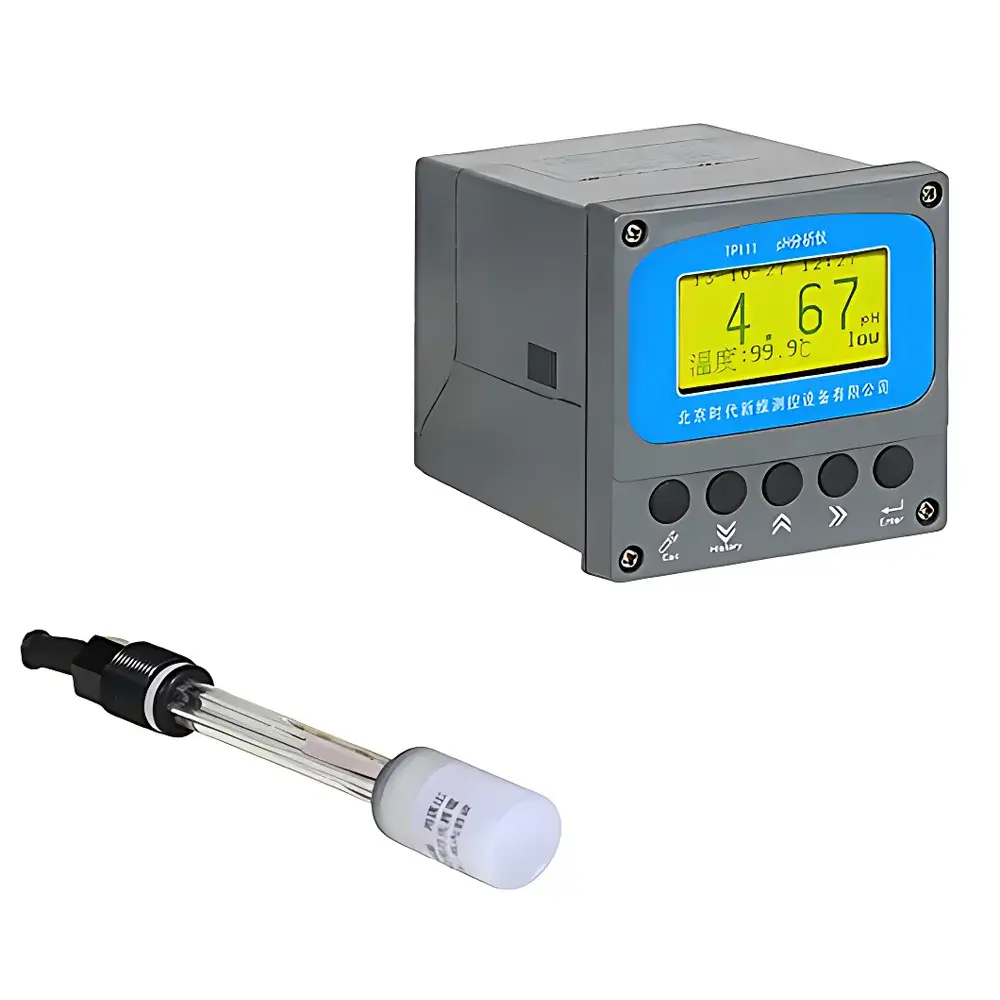
Timepower Model 111 Industrial Online pH Analyzer
| Brand | Timepower |
|---|---|
| Origin | Beijing, China |
| Manufacturer Type | Manufacturer |
| Country of Origin | Domestic (China) |
| Model | 111 |
| Price | Upon Request |
Overview
The Timepower Model 111 Industrial Online pH Analyzer is a robust, microprocessor-based process instrumentation system engineered for continuous, high-stability pH monitoring in demanding industrial water and wastewater applications. It operates on the potentiometric principle: measuring the electromotive force (EMF) generated across an electrochemical cell composed of a pH-sensitive glass indicator electrode and a stable reference electrode immersed in the sample stream. This EMF—directly related to hydrogen ion activity via the Nernst equation—is converted into a calibrated pH reading with traceable accuracy. Designed for unattended operation in harsh environments, the analyzer integrates precision analog signal conditioning, digital temperature compensation, and fail-safe diagnostics to ensure long-term reliability in power generation, pharmaceutical water systems, food & beverage processing, chemical manufacturing, and municipal or industrial wastewater treatment plants.
Key Features
- High-input-impedance (>1 × 10¹² Ω) measurement circuitry minimizes loading errors and ensures stability with high-resistance electrodes and low-conductivity samples (e.g., ultrapure water, boiler feedwater).
- Triple-combination pH electrode compatibility—including specialized variants for pure water, wastewater, flat-surface mounting, high-temperature sterilization (up to 121°C), and flow-through or submersible installations—enables application-specific sensor selection.
- Automatic and manual temperature compensation using integrated Pt1000 RTD sensing (0–60 °C range), supporting accurate pH correction per ISO 7888 and ASTM D1293 standards.
- Configurable analog current outputs (0–10 mA, 0–20 mA, or 4–20 mA; load < 300 Ω) with galvanic isolation for noise immunity in electrically noisy plant environments.
- Dual programmable relay outputs (AC 220 V / 3 A or DC 30 V / 3 A), each configurable as high/low alarm, pump control, or cleaning cycle trigger.
- Onboard data logging with non-volatile memory retention (>10 years without power), enabling storage of timestamped pH values and trend history for compliance review and process troubleshooting.
- Backlit 128 × 64 dot-matrix LCD display with bilingual (English/Chinese) menu navigation, real-time curve plotting of pH trends, and intuitive parameter configuration.
- IP65-rated enclosure, surface-mount or panel-mount housing (94 × 94 mm cutout), and wide operating ambient range (5–45 °C, ≤90% RH non-condensing) support deployment in control rooms, outdoor cabinets, and wet process areas.
Sample Compatibility & Compliance
The Model 111 is validated for continuous measurement in aqueous media with conductivity ≥20 µS/cm and temperature between 5–60 °C. Electrode selection determines suitability for specific matrices: standard triple-junction electrodes for general-purpose use; low-conductivity optimized electrodes for purified water systems (e.g., USP compliant pharmaceutical water); clog-resistant flow-cell configurations for suspended solids-laden wastewater; and autoclavable electrodes for biopharmaceutical CIP/SIP validation. The instrument supports GLP/GMP-aligned operational practices through user-accessible calibration logs, password-protected configuration, and timestamped event records. While not pre-certified to IEC 61508 or SIL-2, its architecture meets functional safety prerequisites for Category B equipment per IEC 61511 when deployed with appropriate system-level risk assessment.
Software & Data Management
Data acquisition and visualization are handled locally via the embedded firmware—no external PC required for routine operation. Historical pH traces (up to 30 days at 1-minute intervals) are viewable directly on the display as scrollable time-series plots. All calibration events, relay state changes, and error codes are stored with date/time stamps and retained through power cycles. For integration into central SCADA or DCS platforms, the 4–20 mA output provides seamless analog interfacing; optional Modbus RTU (RS-485) communication can be enabled via firmware update for digital parameter readout and remote setpoint adjustment. Audit trails comply with basic FDA 21 CFR Part 11 expectations for electronic records when paired with documented procedural controls.
Applications
- Power industry: Continuous pH monitoring of condensate, demineralized water, and cooling tower make-up to prevent corrosion and scaling.
- Pharmaceutical manufacturing: USP -aligned monitoring of purified water (PW) and water for injection (WFI) distribution loops.
- Food & beverage: In-line pH control during fermentation, pasteurization, and cleaning-in-place (CIP) rinse validation.
- Chemical processing: Reaction endpoint detection, neutralization control, and effluent compliance verification prior to discharge.
- Municipal and industrial wastewater: Real-time pH supervision in equalization basins, biological reactors, and final effluent streams to meet local regulatory limits (e.g., EPA 40 CFR Part 136).
- Electroplating and metal finishing: Bath chemistry stabilization and rinse water quality assurance.
FAQ
What electrode types are supported?
The Model 111 accepts all standard BNC-terminated triple-combination pH electrodes, including variants optimized for pure water, wastewater, flat-surface mounting, high-temperature sterilization, and flow-through or submersible installation.
Does it support automatic calibration?
No—calibration is manual using two-point (pH 4.01 and 7.00, or 7.00 and 10.01) buffer solutions. Automatic calibration is not implemented due to regulatory preference for operator-verified, documented procedures in regulated industries.
Can historical data be exported?
Raw trend data is viewable on-device but not exportable via USB or network interface. For archival, users must manually record timestamps and values or integrate the 4–20 mA output with a third-party data logger.
Is the unit suitable for explosive atmospheres?
No—the Model 111 is not ATEX, IECEx, or UL Class I Div 1 certified. It is rated for general-purpose industrial use only.
What is the recommended maintenance interval?
Electrode performance should be verified weekly via two-point calibration; full electrode replacement is typically required every 6–12 months depending on sample fouling and thermal cycling exposure.
Related Products






