
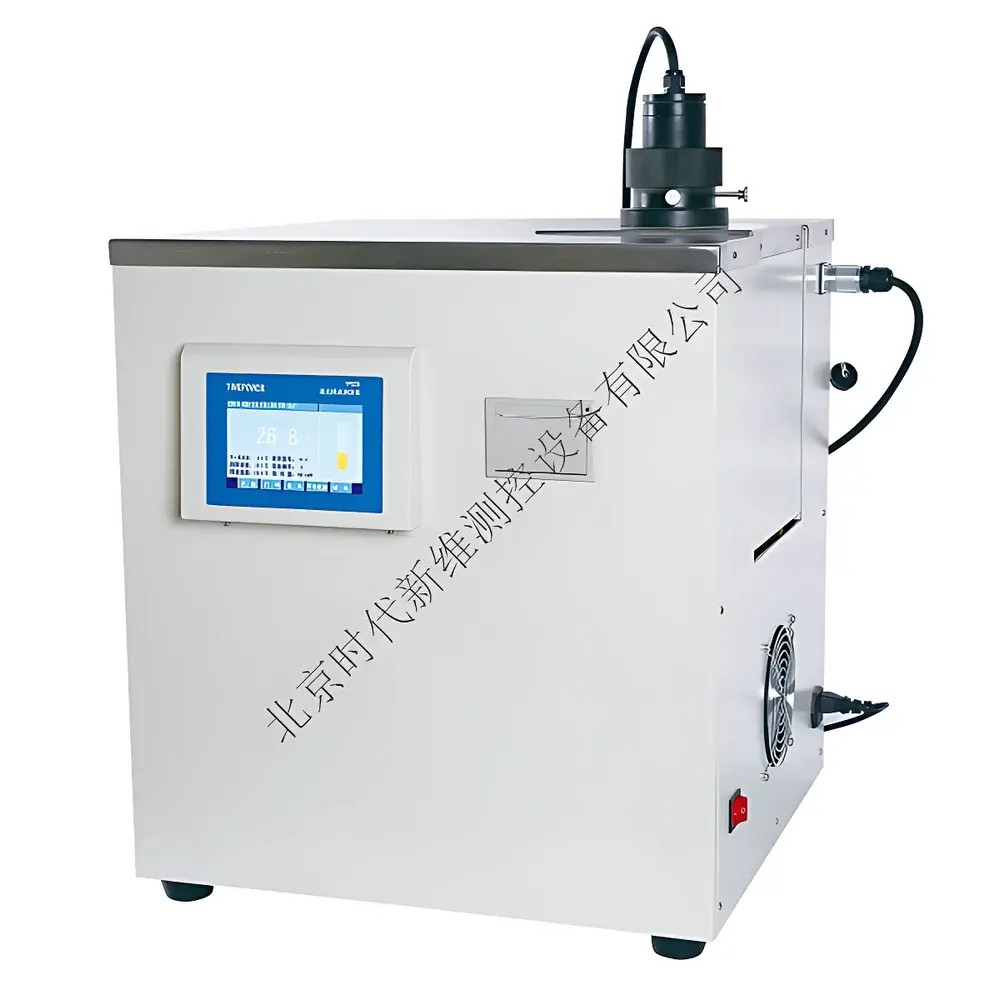
Timepower TP526 Automatic Cloud and Pour Point Tester
| Brand | Timepower |
|---|---|
| Origin | Beijing, China |
| Manufacturer | Timepower Measurement & Control Co., Ltd. |
| Model | TP526 |
| Test Range | Ambient Temperature to –60 °C |
| Accuracy | ±1 °C |
| Resolution | 0.1 °C |
| Display | LCD |
| Cooling Method | Semiconductor-based Peltier |
| Printer | Thermal, 36-character Chinese/English support |
| Ambient Operating Conditions | 10–40 °C, 30–80% RH |
| Power Supply | AC 220 V ±10%, 50 Hz ±10% |
| Power Consumption | <300 W |
| Dimensions (W×D×H) | 475 × 360 × 495 mm |
| Weight | 21.3 kg |
| Compliance | Designed per GB/T 510 (Petroleum Products—Determination of Cloud Point) and GB/T 3535 (Petroleum Products—Determination of Pour Point) |
Overview
The Timepower TP526 Automatic Cloud and Pour Point Tester is a microprocessor-controlled analytical instrument engineered for the precise and repeatable determination of cloud point and pour point in low-viscosity, light-colored petroleum products—including diesel fuels, kerosene, jet fuel, naphthas, and lubricating oil base stocks. It operates on the principle of controlled cooling combined with real-time optical detection and pressure-sensing methodology, enabling automated identification of the temperature at which wax crystals first appear (cloud point) and the lowest temperature at which the sample remains flowable under standardized gravity conditions (pour point). The system adheres to the thermodynamic and procedural foundations outlined in GB/T 510 and GB/T 3535, while its hardware architecture supports method alignment with international equivalents such as ASTM D2500 (Cloud Point) and ASTM D97 (Pour Point), facilitating cross-laboratory comparability in quality control and regulatory testing environments.
Key Features
- Dual-CPU embedded control architecture ensures deterministic timing, thermal ramp stability, and robust error handling during extended cooling cycles.
- High-efficiency semiconductor (Peltier) cooling module delivers consistent, vibration-free temperature descent from ambient to –60 °C without refrigerants or compressors—reducing maintenance overhead and environmental impact.
- Integrated pressure transducer and optical sensor array continuously monitor sample fluidity and phase transition onset, eliminating subjective visual interpretation and minimizing operator bias.
- Automated test sequence includes pre-cooling stabilization, programmable cooling rate (default: 1.0 °C/min per GB/T 510), hold-and-inspect intervals, and endpoint confirmation—all executed without manual intervention.
- Self-diagnostic firmware performs real-time validation of sensor calibration, cooling performance, thermal uniformity across the bath, and printer readiness prior to and during each assay.
- LCD interface supports bilingual (Chinese/English) menu navigation, real-time temperature logging, and on-screen pass/fail status indication aligned with specification limits.
Sample Compatibility & Compliance
The TP526 is validated for use with transparent, low-to-medium volatility petroleum distillates having kinematic viscosity below 100 mm²/s at 40 °C. It is not intended for heavy fuel oils, bitumens, or highly aromatic solvents where wax crystallization kinetics deviate significantly from standard reference behavior. Instrument design conforms to electrical safety requirements per GB 4793.1 (IEC 61010-1) and electromagnetic compatibility per GB/T 18268.1. Data integrity protocols support audit-ready operation under GLP and ISO/IEC 17025-accredited laboratories; optional firmware upgrade enables time-stamped, user-logged test records compatible with 21 CFR Part 11-compliant data management systems when integrated via RS232 or USB.
Software & Data Management
While the TP526 operates as a standalone benchtop unit with local thermal printout capability, its serial interface permits connection to external laboratory information management systems (LIMS) or custom QC databases. The thermal printer outputs include test ID, sample identifier, start/end timestamps, measured cloud/pour points, ambient conditions, operator code, and instrument serial number—formatted to meet internal traceability requirements. Firmware supports configurable report templates and allows storage of up to 100 recent test results in non-volatile memory. No proprietary PC software is required; ASCII-formatted data streams are fully parseable by common spreadsheet or statistical analysis tools.
Applications
- Quality assurance in refinery off-gas condensate and middle-distillate blending operations.
- Specification conformance testing for aviation turbine fuel (Jet A-1) per DEF STAN 91-91 and ASTM D1655.
- Monitoring cold-flow properties during winter-grade diesel formulation (EN 590, ASTM D975).
- R&D evaluation of wax inhibitors and cold-flow improver additives.
- Third-party inspection and customs clearance testing for imported/exported petroleum products under CIQ or SGS protocols.
- Academic and government metrology labs conducting interlaboratory comparison studies on cloud/pour point reproducibility.
FAQ
What standards does the TP526 comply with?
It is designed and verified for compliance with GB/T 510 and GB/T 3535, with operational parameters aligned to ASTM D2500 and ASTM D97 for method transferability.
Can the instrument measure both cloud point and pour point in a single run?
Yes—the TP526 executes sequential cloud and pour point determinations within one automated cycle, following the prescribed temperature hold and tilt protocols defined in applicable standards.
Is calibration traceable to national standards?
The unit accepts NIST-traceable PT100 reference probes; factory calibration certificates include uncertainty budgets referenced to CNAS-accredited primary standards.
What maintenance is required for the semiconductor cooling system?
No consumables or periodic refrigerant recharging are needed; routine maintenance consists of cleaning the heat sink fins and verifying ambient airflow clearance every 6 months.
Does the instrument support multi-language reporting beyond Chinese and English?
Firmware currently supports only Chinese and English UI and print output; additional language packs are not available but may be developed under OEM agreement.




