
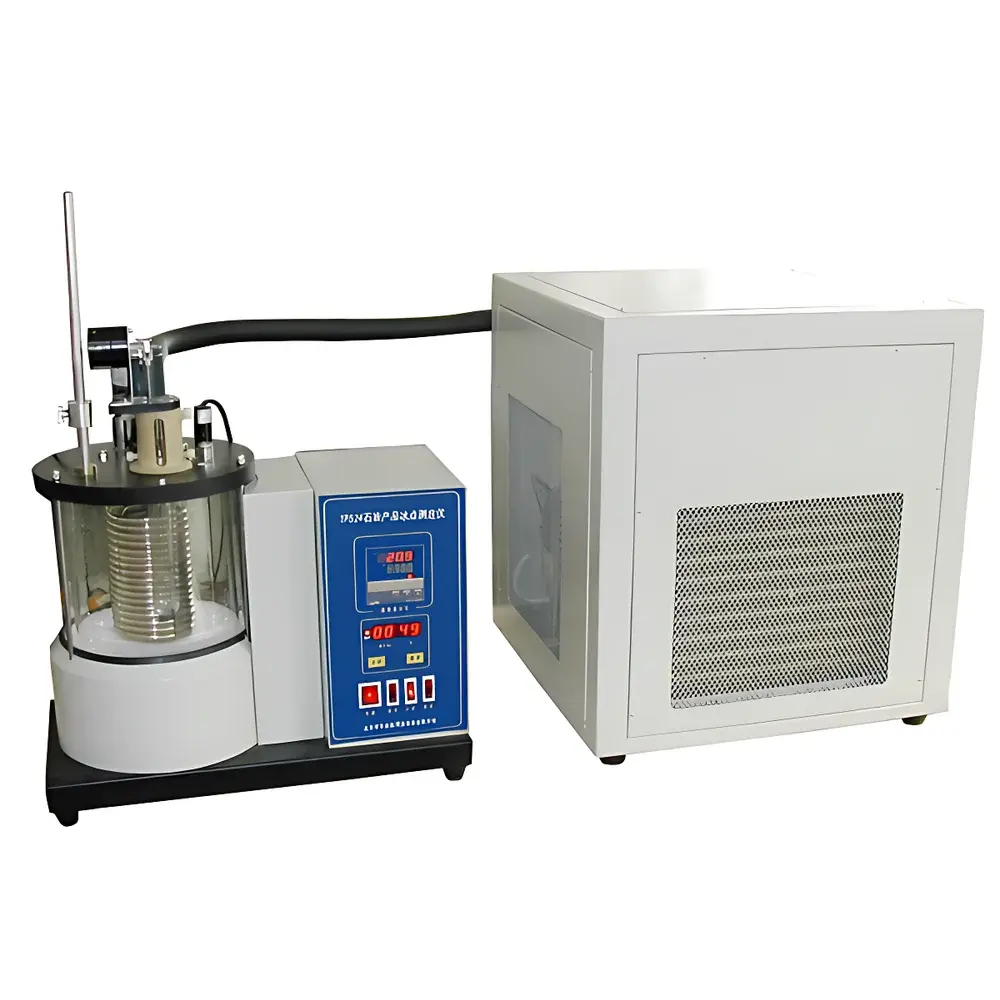
Timepower TP524 Liquid Freezing Point Analyzer
| Brand | Timepower |
|---|---|
| Origin | Beijing, China |
| Manufacturer Type | Direct Manufacturer |
| Country of Origin | China |
| Model | TP524 |
| Pricing | Upon Request |
| Power Supply | AC 220 V ±10%, 50 Hz ±10% |
| Cold Bath Dimensions | Ø210 × 280 mm |
| Temperature Control Range | +20 °C to −70 °C |
| Temperature Stability | ±0.1 °C |
| Bath Agitation | Motor-driven, 6 W, 1200 rpm |
| Refrigeration System | Dual-compressor cascade cooling |
| Sample Stirring | Electromagnetic, 0–120 strokes/min, continuously adjustable |
| Ambient Operating Conditions | 5–40 °C, ≤85% RH |
| Total Power Consumption | ≤2000 W |
| Standard Accessories | (1) Dual-compressor refrigerated main unit, (2) Freezing point test tube, (3) Freezing point stirrer assembly, (4) Calibrated thermometer (−80 to +20 °C, ±0.5 °C), (5) Two blind caps, (6) Two 15 A fuses, (7) User manual, (8) Certificate of Conformance |
Overview
The Timepower TP524 Liquid Freezing Point Analyzer is a precision laboratory instrument engineered for the accurate and repeatable determination of freezing points in low-viscosity, non-aqueous, and partially miscible liquid systems—specifically formulated for aviation turbine fuels (e.g., Jet A-1, JP-8), engine coolant concentrates, and ethylene glycol/water-based antifreeze solutions. It operates on the principle of dynamic thermal arrest detection: as the sample is cooled under controlled conditions, the onset of solid-phase nucleation induces a measurable thermal plateau—the freezing point—detected via high-stability platinum resistance thermometry and verified through real-time crystallization observation in a transparent glass bath. Designed in strict compliance with ASTM D2386 (Standard Test Method for Freezing Point of Aviation Fuels), SH/T 0090 (Chinese standard for engine coolant freezing point), and GB/T 2430 (Chinese national standard for jet fuel freezing point), the TP524 delivers metrologically traceable results suitable for quality control laboratories operating under ISO/IEC 17025, ASTM-certified testing protocols, and OEM technical specifications.
Key Features
- Dual-compressor cascade refrigeration system enabling stable, uninterrupted operation down to −70 °C—critical for detecting sub-zero freezing transitions in high-purity hydrocarbon blends and low-freezing-point coolants.
- Optically clear cylindrical glass bath (Ø210 × 280 mm) with integrated LED illumination, permitting unobstructed visual confirmation of crystal formation and phase separation during freezing curve acquisition.
- Microcontroller-based timing and stirring logic: electromagnetic sample agitation is precisely synchronized with temperature ramping, ensuring uniform supercooling suppression and minimizing metastable delay artifacts.
- High-resolution temperature control architecture with ±0.1 °C stability across the full operational range (+20 to −70 °C), achieved via PID-regulated refrigerant flow and dual-stage thermal feedback loops.
- Modular accessory set—including NIST-traceable calibrated thermometer (−80 to +20 °C, ±0.5 °C), standardized freezing point test tube, and blind caps—ensures method reproducibility between operators and labs.
Sample Compatibility & Compliance
The TP524 is validated for use with transparent, low-suspended-particulate liquids exhibiting freezing points between −65 °C and +10 °C. It accommodates standard 15–20 mL sample volumes per test and supports both neat fluids and pre-diluted coolant formulations. All measurement procedures align with regulatory and industry reference methods: ASTM D2386 (for aviation fuels), SH/T 0090 (for automotive antifreeze), and GB/T 2430 (for civil aviation fuel certification). The instrument’s mechanical design, thermal calibration protocol, and documentation package support audit readiness for GLP environments and internal QA/QC programs requiring documented traceability to national standards.
Software & Data Management
While the TP524 operates as a standalone benchtop analyzer with embedded microcontroller logic (no PC dependency required), its analog temperature output (0–5 V or 4–20 mA optional) enables integration with external data acquisition systems compliant with FDA 21 CFR Part 11 when paired with validated third-party software. All manual measurements are recorded in accordance with laboratory notebook best practices; the included user manual specifies calibration frequency (before each analytical batch), verification steps (using certified reference materials such as n-decane, −29.7 °C), and maintenance intervals for refrigerant charge integrity and stirrer coil performance.
Applications
- Quality assurance testing of jet fuel batches prior to aircraft refueling—verifying compliance with maximum allowable freezing point limits (e.g., −47 °C for Jet A-1).
- Formulation development and batch release testing of ethylene glycol–based engine coolants, where freezing point depression correlates directly with concentration and inhibitor package stability.
- Research into cryoprotectant behavior in specialty lubricants and synthetic ester-based hydraulic fluids.
- Educational laboratories conducting thermodynamic phase transition experiments in physical chemistry and petroleum engineering curricula.
FAQ
What standards does the TP524 comply with?
ASTM D2386, SH/T 0090, and GB/T 2430—covering aviation fuel, engine coolant, and national jet fuel specifications.
Is the instrument suitable for aqueous solutions?
No—it is optimized for non-aqueous, low-water-content hydrocarbons and glycol-based mixtures; water-rich samples may cause ice morphology interference and inaccurate thermal arrest detection.
Does the TP524 include automated data logging?
No—data recording is manual or externally interfaced; the unit provides analog output for integration with validated DAQ systems supporting 21 CFR Part 11 compliance.
What maintenance is required for long-term reliability?
Biannual inspection of refrigerant pressure levels, annual verification of thermometer calibration against certified references, and quarterly cleaning of the glass bath and stirrer shaft to prevent residue buildup.
Can the TP524 be used for cloud point or pour point determination?
No—its hardware, algorithm, and optical design are purpose-built exclusively for freezing point measurement via thermal arrest detection, not for turbidity-based cloud point or flow-based pour point analysis.






