
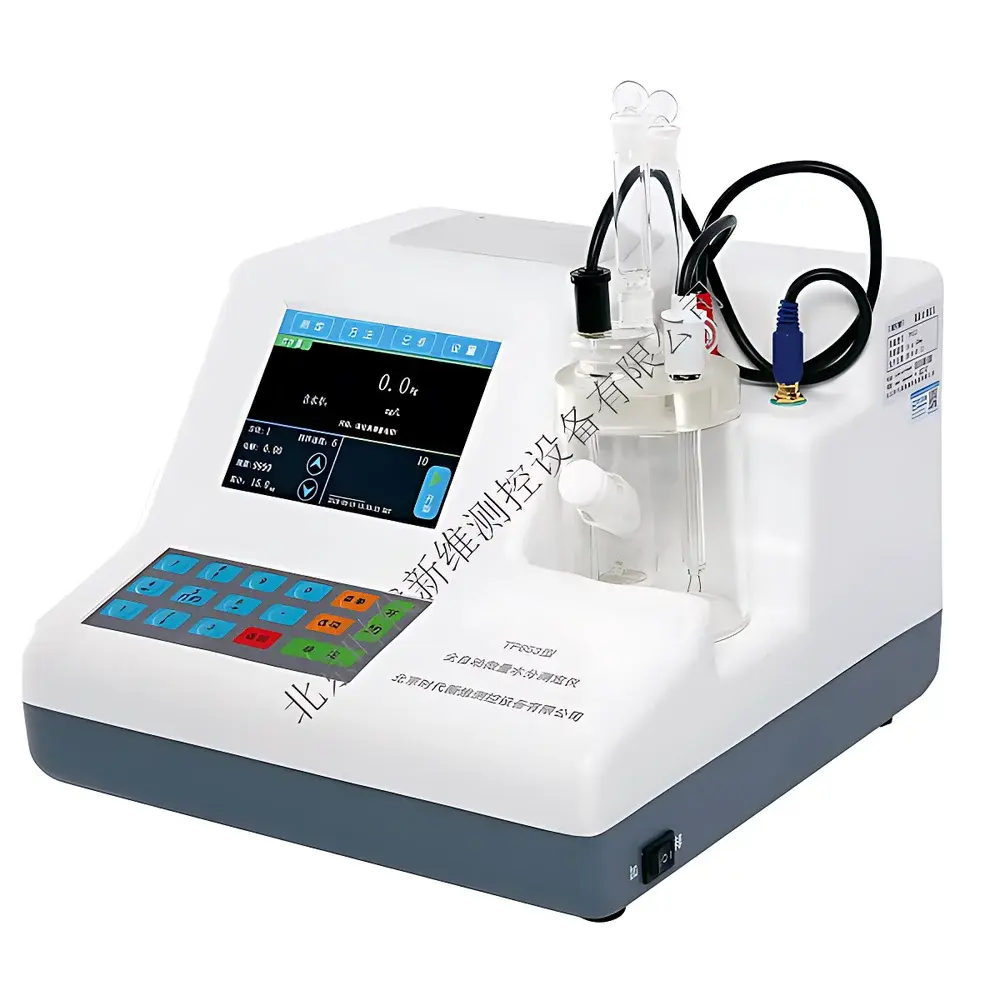
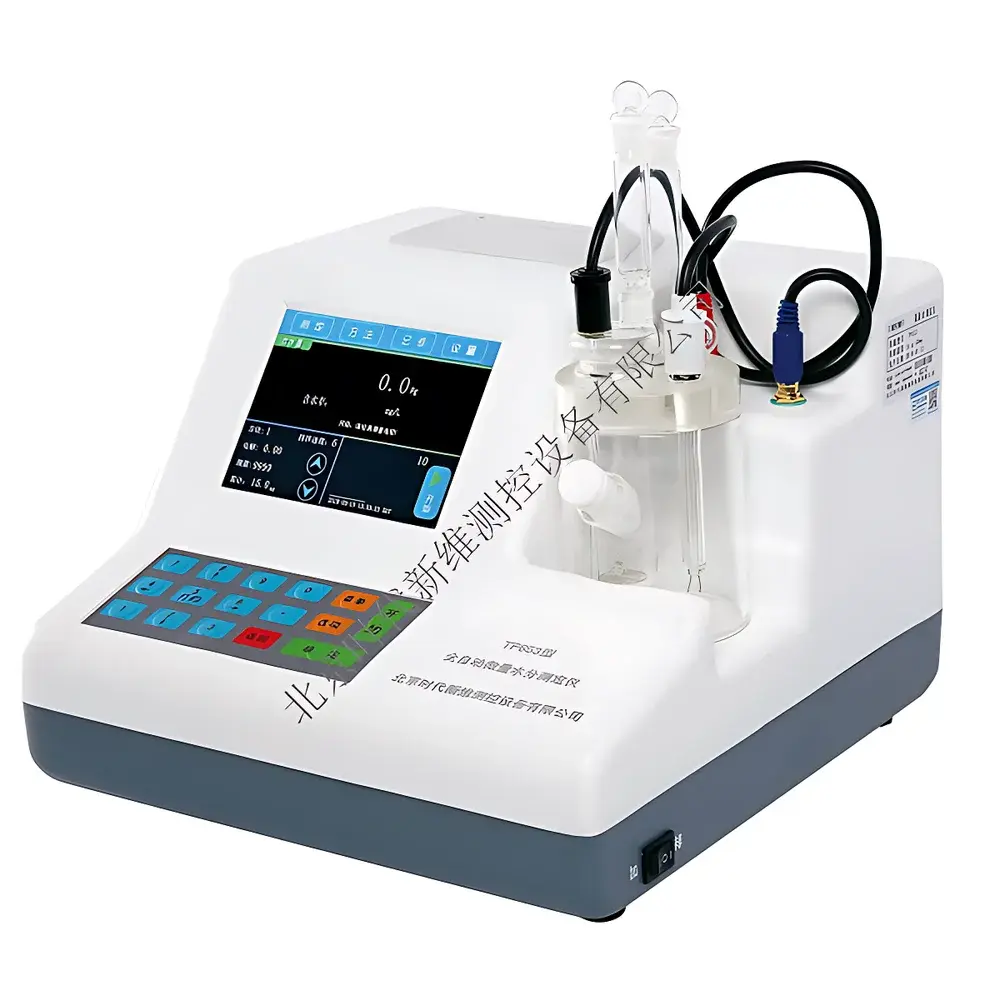
Timepower TP653 Automated Coulometric Karl Fischer Moisture Analyzer
| Brand | Timepower |
|---|---|
| Origin | Beijing, China |
| Manufacturer | Timepower Measurement & Control Co., Ltd. |
| Model | TP653 |
| Titration Method | Automated Coulometric Titration |
| Instrument Type | Coulometric Karl Fischer Moisture Analyzer |
| Measurement Resolution | 0.1 µg |
| Water Content Range | 3 µg – 100 mg (H₂O) |
| Accuracy | ±20% at 3 µg, ±10% at 10 µg, ±5% at 100 µg, ±0.5% above 100 µg (excluding sampling error) |
| Minimum Dispensing Increment | 1/2000 |
| Titration Control Precision | 3 µg – 100 mg (H₂O) |
| Electrolysis Current | 0–400 mA |
| Display | Chinese LCD (not applicable for international UI) |
| Printer | Thermal, 36-character, Chinese character support (not exported) |
| Operating Temperature | 5–40 °C |
| Power Supply | AC 220 V ±10%, 50 Hz ±10% |
| Power Consumption | <40 W |
| Dimensions | 300 × 290 × 200 mm |
| Weight | 3.7 kg |
Overview
The Timepower TP653 Automated Coulometric Karl Fischer Moisture Analyzer is an engineered solution for trace water quantification in liquid and soluble solid samples using the coulometric Karl Fischer (KF) titration principle. Unlike volumetric KF systems, the TP653 generates iodine electrochemically within the titration cell via controlled current application—enabling ultra-sensitive detection down to 0.1 µg of water with high reproducibility and minimal reagent consumption. This method complies with fundamental electrochemical stoichiometry (1 mole of electrons ≡ ½ mole of I₂ ≡ 1 mole of H₂O), ensuring inherent accuracy when calibrated against certified water standards. Designed for laboratories requiring stringent moisture control—such as QC labs in pharmaceutical API synthesis, transformer oil testing per ASTM D1533, or solvent purity verification in fine chemical manufacturing—the TP653 delivers rapid, operator-independent analysis without manual burette handling or endpoint visual interpretation.
Key Features
- 32-bit embedded microprocessor with real-time operating system for deterministic control loop execution and stable baseline compensation
- Dual-circuit balanced electrolysis design minimizes drift and improves signal-to-noise ratio during low-level water detection
- Hermetically sealed, moisture-resistant electrolytic cell with optimized electrode geometry reduces equilibration time and extends reagent lifetime (>300 tests per 100 mL anolyte)
- Integrated auto-fill and auto-drain fluid management system eliminates manual syringe handling and reduces exposure to hygroscopic KF reagents
- Real-time amperometric curve visualization on integrated display supports diagnostic assessment of cell health and reagent exhaustion
- Six programmable calculation formulas accommodate industry-specific reporting formats—including % w/w, ppm, and absolute µg H₂O—with customizable unit conversion
- Robust engineering plastic chassis provides corrosion resistance against KF reagents and organic solvents while maintaining mechanical stability during extended operation
- Onboard non-volatile memory stores ≥10,000 measurement records with timestamp, sample ID, operator code, and raw current/time data for audit readiness
Sample Compatibility & Compliance
The TP653 is validated for use with a broad spectrum of KF-compatible matrices including alcohols (e.g., methanol, ethanol), hydrocarbons (e.g., toluene, xylene), chlorinated solvents (e.g., chloroform, dichloromethane), esters, ethers, and polar aprotic media such as DMF and acetonitrile. It meets methodological requirements of multiple national and international standards: GB/T 7600 (insulating oils), GB/T 11133 (liquid petroleum products), SH/T 0246 (light distillates), ASTM D6304 (coulometric KF standard practice), and ISO 760 (determination of water by KF titration). While not pre-certified for 21 CFR Part 11 compliance, its audit trail functionality—including immutable timestamps, user authentication prompts, and full data logging—supports GLP/GMP-aligned validation protocols when deployed with documented SOPs and electronic signature workflows.
Software & Data Management
Data export is supported via RS-232 serial interface (standard) or optional USB-to-serial adapter for connection to LIMS or laboratory informatics platforms. Raw measurement files (.CSV) include all critical metadata: date/time stamp, sample identifier, operator ID, cell current profile, endpoint determination logic flag, and final water mass result. The internal database permits chronological or alphanumeric search, batch recall, and statistical summary (mean, SD, RSD) generation. For regulated environments, users may implement external validation packages to establish electronic record integrity per ALCOA+ principles—ensuring attributable, legible, contemporaneous, original, and accurate data capture.
Applications
- Pharmaceutical: Quantification of residual moisture in lyophilized APIs and excipients per USP <921>, supporting stability-indicating assay development
- Energy: Trace water analysis in turbine oils, insulating oils, and biodiesel blends where water >10 ppm accelerates oxidation and corrosion
- Chemical Manufacturing: In-process verification of solvent dryness prior to Grignard or lithium aluminum hydride reactions
- Polymer Industry: Moisture monitoring in PET, nylon, and polycarbonate resin pellets to prevent hydrolytic degradation during extrusion
- Agrochemicals: Water content verification in pesticide formulations and technical-grade active ingredients per CIPAC MT 30.1
- Electronics: Detection of adsorbed moisture in photoresist solvents and etchant carriers where sub-10 ppm levels impact lithographic fidelity
FAQ
What sample types are incompatible with the TP653?
Strong reducing agents (e.g., sodium borohydride), aldehydes/ketones (which undergo side reactions with KF reagents), and highly viscous or non-dissolving solids require pretreatment (e.g., oven drying + Karl Fischer oven coupling) or alternative methods such as loss-on-drying.
Does the TP653 support automated sample changers?
No native autosampler integration is provided; however, the RS-232 command set enables third-party robotic liquid handlers to trigger start/stop sequences and retrieve results via ASCII protocol.
How often must the electrolyte be replaced?
Typical anolyte service life exceeds 300 analyses under routine use with proper cell maintenance; replacement is indicated by prolonged endpoint stabilization (>120 s) or deviation from calibration slope exceeding ±3% over three consecutive checks.
Is method validation documentation available?
Timepower supplies instrument qualification templates (IQ/OQ) and a basic performance verification procedure aligned with ASTM D6304 Annex A1; full method validation (including specificity, linearity, LOD/LOQ) remains the responsibility of the end-user laboratory per ICH Q2(R2).
Can the TP653 be used for solid samples?
Yes—when combined with a dedicated oven evaporator module (sold separately), enabling indirect coulometric determination of water released thermally from solids such as powders, tablets, or polymers.





