
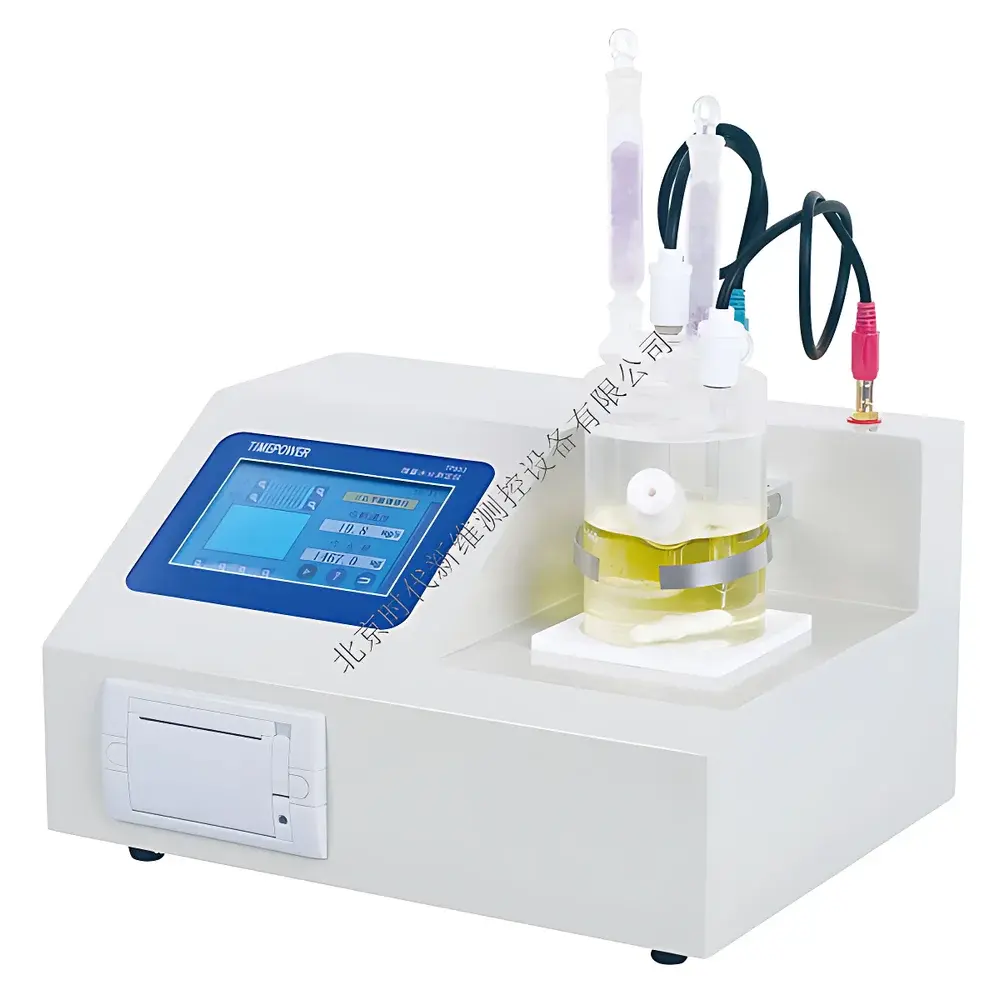
TimePower TP553 Automated Karl Fischer Coulometric Moisture Analyzer
| Brand | TimePower |
|---|---|
| Origin | Beijing, China |
| Manufacturer Type | Direct Manufacturer |
| Instrument Type | Coulometric Karl Fischer Moisture Analyzer |
| Water Content Range | 3 µg – 100 mg |
| Measurement Accuracy | ±0.3% (for samples >1000 µg water) / ±3 µg (for samples 10–1000 µg water) |
| Resolution | 0.1 µg |
| Titration Control Precision | 0.1 µg |
| Minimum Dispensing Increment | 1/1000 |
| Electrolysis Current Range | 0–400 mA |
| Power Supply | AC 220 V ±25 V, 50 Hz ±2.5 Hz |
| Operating Temperature | 5–40 °C |
| Relative Humidity | ≤85% RH |
| Display | 128×64 dot-matrix LCD |
| Standby Power Consumption | 4 W |
| Dimensions (W×D×H) | 325×245×180 mm |
| Weight | 4.14 kg |
| Compliance Standards | GB/T 1600, GB 7600, GB/T 6283, GB/T 11133, SH/T 0246, SH/T 0255 |
Overview
The TimePower TP553 Automated Karl Fischer Coulometric Moisture Analyzer is a precision laboratory instrument engineered for trace-level water quantification in non-aqueous matrices using the coulometric Karl Fischer titration principle. Unlike volumetric KF systems, the TP553 generates iodine electrochemically at the anode via controlled current application—enabling direct, stoichiometric measurement of water content with no reagent dispensing errors. This method delivers exceptional sensitivity and reproducibility for samples containing 3 µg to 100 mg of water, making it ideal for quality control in pharmaceutical excipients, high-purity solvents, lithium battery electrolytes, and active pharmaceutical ingredients (APIs), where residual moisture directly impacts stability, reactivity, and regulatory compliance.
Key Features
- Coulometric detection architecture with real-time electrolysis current regulation (0–400 mA), ensuring rapid equilibrium attainment and minimized analysis cycle time.
- High-resolution 128×64 dot-matrix LCD display with Chinese-language interface prompts—optimized for operator efficiency in multilingual lab environments without compromising technical clarity.
- Integrated blank current compensation and endpoint drift correction algorithms, dynamically adjusting for background electrolyte consumption and environmental humidity fluctuations.
- Hermetically sealed dual-chamber KF cell featuring advanced hydrophobic barrier design—reducing equilibration time by up to 40% and extending electrolyte service life beyond 300 analyses under standard operating conditions.
- Non-volatile memory storage supporting up to 255 test records with timestamping; data retention guaranteed for ≥10 years without power supply.
- Low-power standby mode (4 W) and intelligent LCD screen-saver function, enhancing device longevity and energy efficiency in 24/7 QC laboratories.
Sample Compatibility & Compliance
The TP553 is validated for use with a broad spectrum of organic and inorganic materials, including but not limited to alcohols, hydrocarbons, esters, ethers, ketones, amines, chlorinated solvents, pesticides, polymer precursors, and lyophilized biopharmaceuticals. Its methodology conforms to internationally recognized standard test procedures, including GB/T 1600 (pesticide moisture), GB 7600 (transformer oil), GB/T 6283 (general chemical products), GB/T 11133 (hydrocarbon solvents), SH/T 0246 (light petroleum products), and SH/T 0255 (additive-containing lubricants). While not pre-certified to ISO 8533 or ASTM E203, its operational parameters align with the measurement uncertainty requirements specified in these standards for coulometric KF applications. The system supports GLP-compliant documentation when paired with external audit-ready data export protocols.
Software & Data Management
The TP553 operates autonomously without PC dependency, relying on embedded firmware for method execution, calibration management, and result calculation. All measurement parameters—including titration curve slope, endpoint threshold, current ramp profile, and blank subtraction values—are user-configurable via on-device menu navigation. Test results are displayed in µg water, % w/w, or ppm, with automatic unit conversion based on sample mass input. Data export is supported via RS-232 serial interface for integration into LIMS or ELN platforms. Though the instrument does not feature native 21 CFR Part 11 electronic signature capability, its deterministic algorithmic processing, immutable timestamped record storage, and manual calibration log functionality provide foundational traceability required for GMP-aligned workflows.
Applications
- Pharmaceutical manufacturing: Residual moisture verification in APIs, excipients, and sterile lyophilized products per USP <921> and EP 2.5.12.
- Petrochemical QA/QC: Water quantification in jet fuels, transformer oils, and synthetic lubricants to prevent corrosion and dielectric failure.
- Electrochemical materials: Moisture screening in Li-ion battery cathode/anode slurries and electrolyte formulations, where H₂O content <10 ppm critically affects SEI formation.
- Agrochemical R&D: Stability assessment of wettable powders and emulsifiable concentrates per FAO/WHO guidelines.
- Paints & coatings: Detection of trace hydration in polyurethane prepolymers and epoxy resins prior to curing.
FAQ
What is the difference between coulometric and volumetric Karl Fischer titration on the TP553?
The TP553 exclusively uses coulometric KF—iodine is generated electrochemically in situ, eliminating burette-related variability. It is optimized for low-water-content samples (<100 mg), whereas volumetric systems require standardized reagent addition and are better suited for higher moisture levels.
Does the TP553 support automated sample changers or external dosing units?
No—the TP553 is a benchtop standalone analyzer with manual sample injection via syringe. It does not integrate with robotic autosamplers, but its compact footprint and rapid cycle time (typically <3 minutes per analysis) support high-throughput manual operation.
How often must the KF electrolyte be replaced?
Under typical usage (20–30 analyses/day), the dual-chamber cell’s optimized seal and low-drift design extend electrolyte lifetime to approximately 300–500 tests, depending on sample matrix aggressiveness and ambient humidity.
Is calibration traceable to NIST or other national standards?
The TP553 does not include built-in certified reference material (CRM) calibration; users must perform external calibration using gravimetrically prepared water standards (e.g., sodium tartrate dihydrate or distilled water spikes) traceable to SI units per ISO/IEC 17025 laboratory practice.
Can the TP553 measure water in samples with strong reducing agents?
Samples containing potent reductants (e.g., sulfites, hydrazines, or metal hydrides) may interfere with iodine-based detection. Method validation—including interference testing with spiked controls—is required prior to routine deployment in such matrices.







