
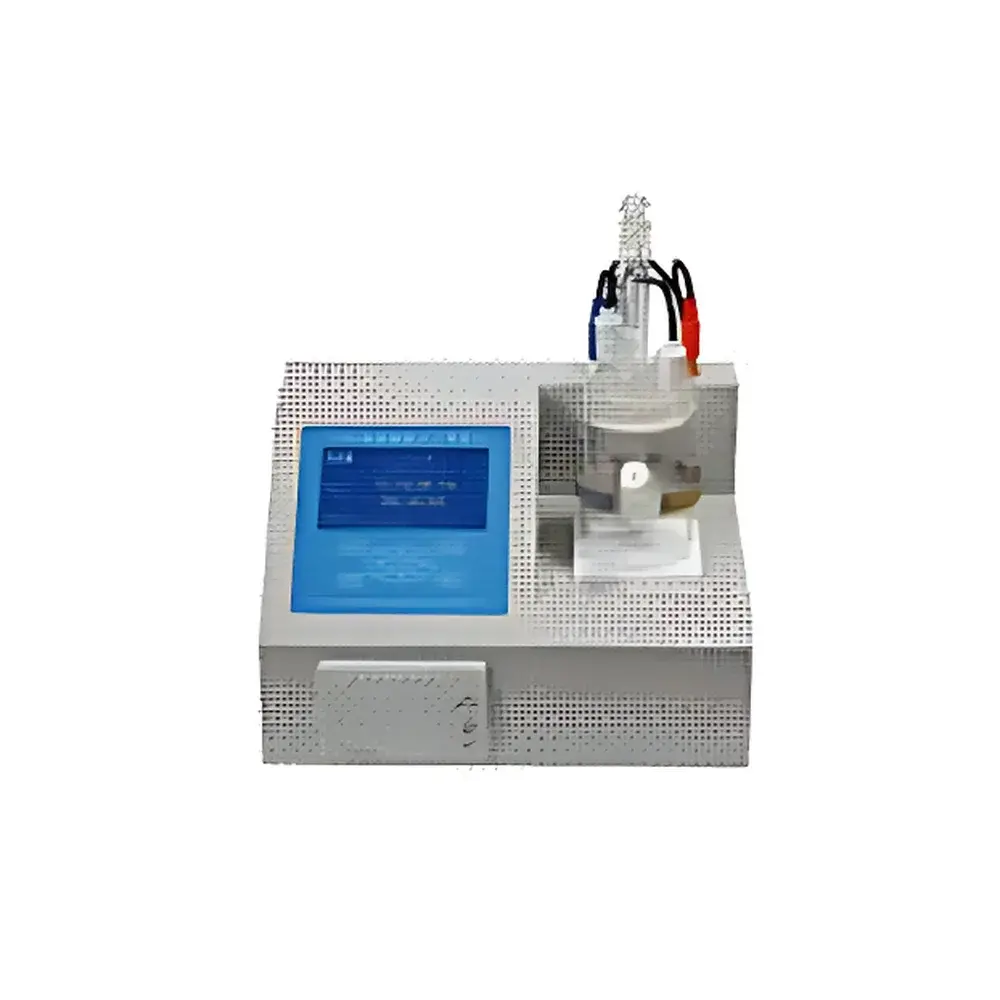
TimePower TP553 Automated Coulometric Karl Fischer Moisture Titrator
| Brand | TimePower |
|---|---|
| Origin | Beijing, China |
| Manufacturer Type | OEM Manufacturer |
| Country of Origin | China |
| Model | TP553 |
| Pricing | Available Upon Request |
Overview
The TimePower TP553 Automated Coulometric Karl Fischer Moisture Titrator is a precision laboratory instrument engineered for trace water quantification in liquid and soluble solid samples using the coulometric Karl Fischer titration principle. Unlike volumetric KF systems, the TP553 generates iodine electrochemically at the anode via controlled current (0–400 mA), enabling highly sensitive detection down to 0.1 µg H₂O. This method eliminates reagent delivery variability and ensures stoichiometric accuracy per Faraday’s law—ideal for low-moisture matrices where reproducibility below 10 µg is critical. Designed for routine QC/QA labs in regulated environments, the TP553 meets the fundamental metrological requirements of ISO 8533, ASTM E203, and USP , and is validated for compliance with GB/T 1600, GB/T 7600, GB/T 6283, GB/T 11133, SH/T 0246, and SH/T 0255 test protocols.
Key Features
- Coulometric generation of iodine with dual-circuit balanced titration architecture—minimizes drift-induced error and improves measurement repeatability across repeated injections.
- Real-time compensation algorithms for blank current offset and endpoint drift, dynamically correcting baseline shifts caused by ambient humidity or electrolyte aging.
- Hermetically sealed, moisture-resistant electrolytic cell with optimized electrode geometry—reduces equilibration time to under 3 minutes and extends electrolyte service life beyond 200 tests per fill.
- High-resolution 128×64 dot-matrix LCD with Chinese-language interface (fully configurable for English firmware localization) and intuitive step-by-step operation prompts.
- Non-volatile memory storing up to 256 test records with timestamp, sample ID, water content, and operator tag—retained for ≥10 years without power.
- Low-power standby mode (4 W) and integrated screen-saver function to mitigate LCD degradation during extended idle periods.
Sample Compatibility & Compliance
The TP553 is validated for direct analysis of low-viscosity organic solvents—including alcohols, ethers, esters, ketones, hydrocarbons (e.g., hexane, toluene), chlorinated solvents, and polar aprotic media (e.g., DMF, DMSO)—as well as dissolved solids such as pharmaceutical actives, polymer precursors, and agrochemical intermediates. It supports both single-component and multi-component sample introduction via syringe or automated sampler (optional). Instrument design conforms to IEC 61010-1 safety standards for electrical equipment in laboratory use. Data integrity features—including audit-trail-capable event logging and user-access-level controls—support alignment with GLP and GMP documentation practices. While not pre-certified for 21 CFR Part 11, the system architecture permits integration with compliant LIMS or electronic lab notebook (ELN) platforms through RS-232/USB data export.
Software & Data Management
Data output is provided via ASCII-formatted text files (.csv or .txt) containing timestamp, sample identifier, measured water mass (µg), calculated water concentration (ppm or %), titration curve metadata, and system status flags. The built-in real-time clock enables chronological sorting and batch traceability. All stored results remain accessible after power loss due to EEPROM-based memory retention. Optional PC connectivity allows remote monitoring and report generation using third-party spreadsheet or statistical analysis tools. No proprietary software installation is required; raw data files are natively readable in Excel, Python (pandas), or R environments.
Applications
- Petroleum refining: Quantification of residual moisture in transformer oils, lubricants, and jet fuels per ASTM D6304 and IEC 60814.
- Pharmaceutical manufacturing: Water content verification of hygroscopic APIs, excipients, and lyophilized formulations per USP and EP 2.5.12.
- Chemical synthesis: In-process control of dehydration reactions, catalyst hydration state assessment, and solvent purity screening.
- Agrochemical QA: Moisture verification in technical-grade pesticides and wettable powders per CIPAC MT 30.2.
- Electronics materials: Detection of trace H₂O in photoresists, etchants, and cleaning solvents where ppm-level contamination affects lithographic fidelity.
FAQ
What is the minimum detectable water mass?
The TP553 achieves a resolution of 0.1 µg H₂O, with guaranteed accuracy of ±3 µg for measurements between 10–1000 µg, and ±0.3% relative error above 1000 µg.
Can the instrument be used for solid samples?
Yes—soluble solids may be dissolved in suitable KF-compatible solvents (e.g., methanol, chloroform, or specialized anhydrous solvents) prior to injection.
Is the electrolyte cell replaceable or field-serviceable?
The cell is designed as a modular, user-replaceable unit with standardized O-ring seals and electrode alignment fixtures—no calibration recalibration required after replacement.
Does the device support external sample autosamplers?
The TP553 includes TTL-level trigger I/O and RS-232 command protocol documentation, enabling seamless integration with third-party autosamplers upon configuration.
How often must the electrolyte be replaced?
Under typical usage (≤50 tests/week), the electrolyte remains stable for ≥6 months or 200+ determinations—monitored automatically via real-time blank current trending.
Related Products






