
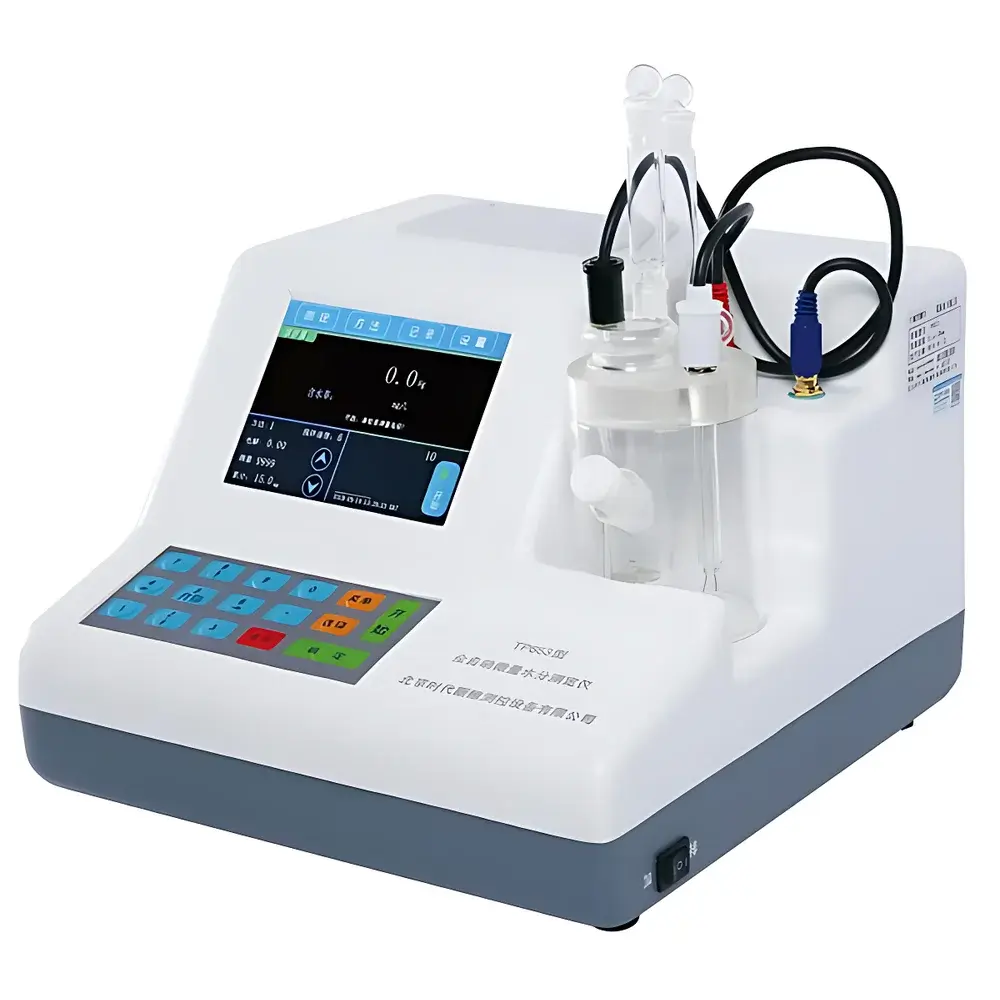
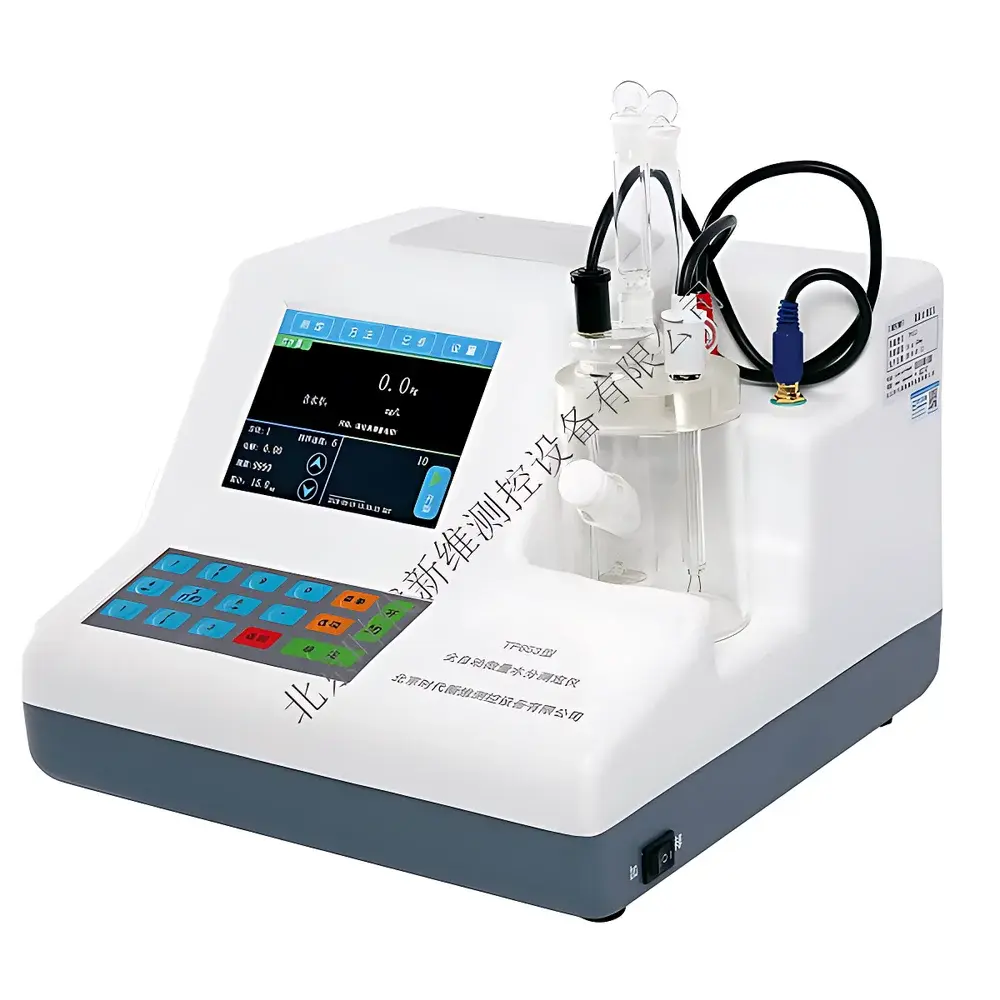
Timepower TP653 Automated Coulometric Karl Fischer Moisture Analyzer
| Brand | Timepower |
|---|---|
| Origin | Beijing, China |
| Manufacturer Type | Direct Manufacturer |
| Instrument Type | Coulometric Karl Fischer Moisture Analyzer |
| Measurement Range | 3 µg – 100 mg H₂O |
| Resolution | 0.1 µg |
| Accuracy | ±20% at 3 µg H₂O |
| Titration Control Precision | 0.1 µg |
| Minimum Dispensing Increment | 1/2000 |
| Electrolysis Current Control | 0–400 mA, auto-regulated |
| Display | 5.6-inch color TFT-LCD touchscreen |
| Interface | RS-232 for balance & PC connectivity |
| Printer | Integrated thermal printer |
| Operating Environment | 20–30 °C, ≤85% RH |
| Power Supply | AC 220 V ±10%, 50 Hz ±10% |
| Max Power Consumption | ≤40 W |
| Dimensions | 300 × 290 × 200 mm |
| Weight | 3.7 kg |
Overview
The Timepower TP653 is an automated coulometric Karl Fischer (KF) moisture analyzer engineered for high-precision quantification of trace water content in liquid, solid, and gaseous samples. It operates on the fundamental electrochemical principle of coulometric KF titration: iodine is generated *in situ* via controlled electrolysis at the anode, where the stoichiometric reaction I₂ + SO₂ + H₂O + 3RN + CH₃OH → 2RN·HI + RN·SO₃CH₃ consumes one mole of iodine per mole of water. The total charge passed during electrolysis—measured in coulombs—is directly proportional to the amount of iodine produced and thus to the water mass present, per Faraday’s law. This method eliminates reagent standardization and delivers exceptional sensitivity down to 3 µg H₂O, making the TP653 suitable for applications demanding strict adherence to pharmacopeial and industrial standards including ASTM D6304, ISO 15512, USP , EP 2.5.12, and GB/T 7600, GB/T 6283, SH/T 0246, and SH/T 0255.
Key Features
- 32-bit embedded microprocessor with real-time mini-OS for deterministic control and low-latency response.
- Coulometric titration mode with automatic current regulation (0–400 mA), ensuring stable electrolysis and minimized over-titration risk.
- High-resolution 0.1 µg detection limit and reproducible quantification across the full 3 µg–100 mg measurement range.
- Dual-input operation: intuitive 5.6-inch color touchscreen complemented by tactile physical keys for glove-compatible or gloved-hand use in regulated labs.
- Real-time dynamic electrolysis curve display, enabling immediate visual assessment of reagent activity, endpoint stability, and system responsiveness.
- Twelve programmable analysis methods; six frequently used methods can be stored onboard for rapid recall and protocol consistency.
- Integrated fluid handling: automatic reagent dispensing and waste evacuation reduce operator exposure and improve workflow hygiene.
- Hermetically sealed, moisture-resistant electrolytic cell with optimized electrode geometry—reduces equilibration time and extends electrolyte service life.
- Full RS-232 interface support for seamless integration with analytical balances (auto-sample weight import) and laboratory PCs (data export, remote monitoring).
- Onboard thermal printer with timestamped output for GLP-compliant hard-copy records.
Sample Compatibility & Compliance
The TP653 accommodates diverse sample matrices without modification: volatile organics (alcohols, ethers, esters, ketones), hydrocarbons (alkanes, aromatics, lubricants), polar solvents (acetonitrile, DMF), viscous substances (oils, resins, polymers), powders (APIs, excipients, catalysts), and gases (via optional gas sampling kit). Its coulometric architecture avoids volumetric reagent consumption variability, delivering consistent accuracy for low-water-content samples (<100 ppm) where volumetric KF systems face precision limitations. The instrument supports audit-ready data integrity through time-stamped event logging (method execution, reagent replacement, calibration events) and meets foundational requirements for GMP/GLP environments. While not natively 21 CFR Part 11 compliant out-of-the-box, its data export capability (CSV/ASCII) enables integration into validated LIMS or ELN platforms supporting electronic signatures and audit trails.
Software & Data Management
Data acquisition and processing occur locally within the embedded OS. All measurements include automatic timestamping, sample ID entry (via keypad or barcode scanner interface), and method-specific metadata (electrolyte batch, cell status, ambient temperature/humidity if logged externally). Results are stored internally with capacity for ≥1,000 test records. Export is supported via RS-232 to PC-based software (supplied) for report generation, statistical analysis (mean, SD, RSD), and trend visualization. Raw current/time profiles and endpoint detection logs are retained for troubleshooting and method validation. Calibration verification is performed using certified water standards (e.g., 1.00 mg/g sodium tartrate dihydrate); system suitability tests (SST) can be scheduled and documented per USP/EP guidelines.
Applications
- Pharmaceutical QA/QC: residual moisture in lyophilized products, active pharmaceutical ingredients (APIs), and excipients per USP .
- Petrochemical testing: water in transformer oils (IEC 60814), jet fuels (ASTM D6304), and lubricants per ISO 15512.
- Chemical manufacturing: quality release of solvents, monomers, and intermediates where water catalyzes degradation or polymerization side reactions.
- Agrochemical analysis: moisture in pesticides and herbicide formulations affecting stability and shelf life.
- Food ingredient certification: water activity precursors in emulsifiers, lecithins, and flavor carriers.
- Electronics-grade material screening: ultra-trace water in lithium battery electrolytes and semiconductor process chemicals.
FAQ
What sample types require special handling or accessories?
Solid or viscous samples may necessitate optional heating accessories or homogenization prior to injection; gaseous samples require a dedicated gas sampling valve and carrier gas flow controller.
How often must the electrolyte be replaced?
Replacement frequency depends on cumulative water load and ambient humidity; the instrument alerts when accumulated water approaches the electrolyte’s rated capacity (typically 100–200 mg H₂O per 100 mL), as indicated by rising baseline current or prolonged endpoint detection.
Is the TP653 compatible with LIMS integration?
Yes—via RS-232 serial output, it supports ASCII-formatted data transmission for ingestion into validated LIMS platforms with appropriate middleware configuration.
What safety precautions apply to KF electrolyte handling?
All KF reagents contain pyridine or imidazole derivatives, methanol, and iodine—requiring use in a certified fume hood, chemical-resistant gloves, and eye protection per SDS guidelines.
Can the instrument perform system suitability testing (SST)?
Yes—users can execute SST using certified water standards and document results manually or via exported CSV files aligned with internal SOPs.
Related Products





