
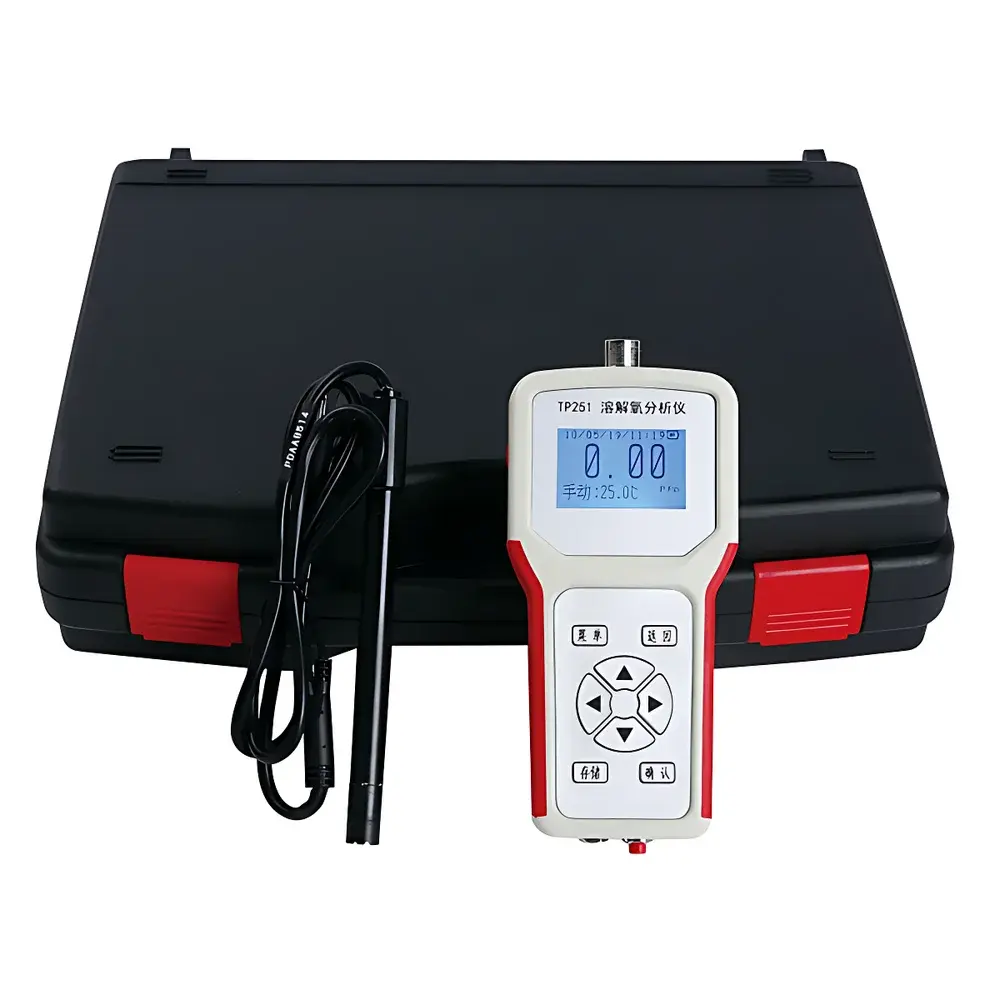
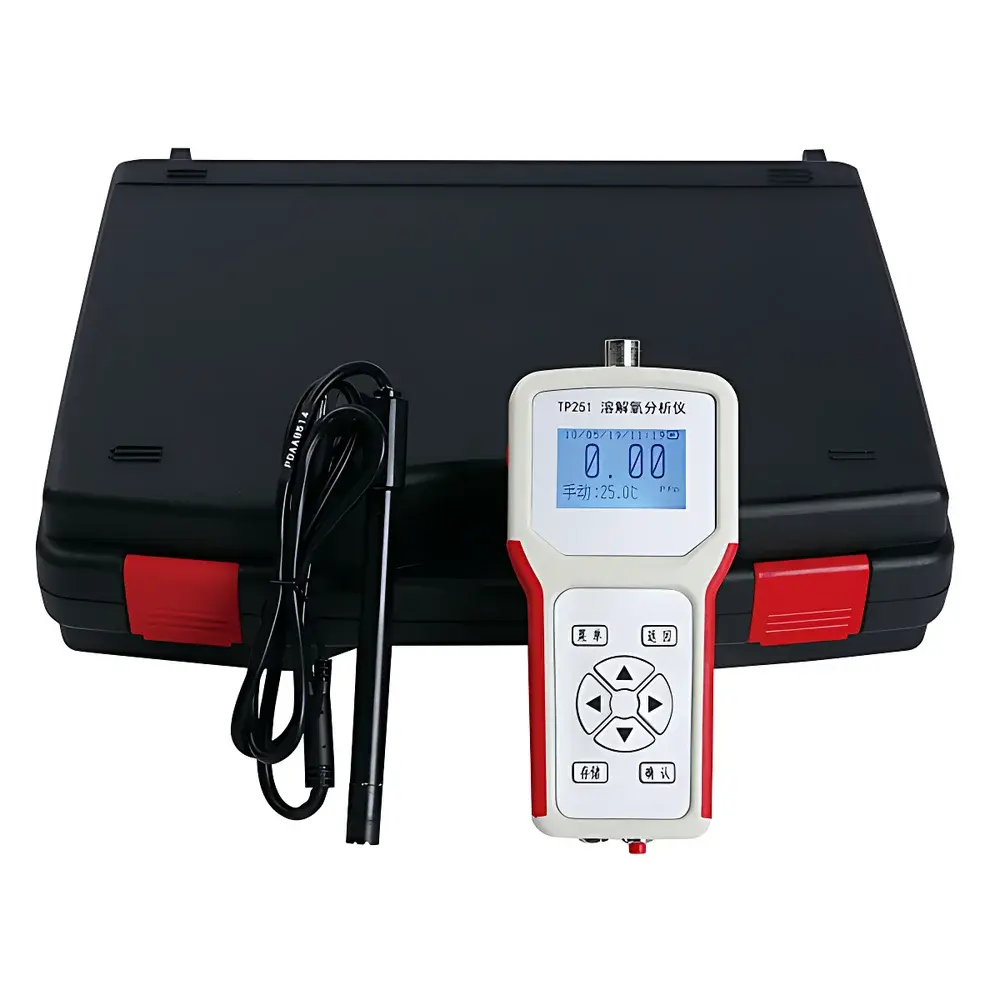
Timepower TP251 Portable Dissolved Oxygen Analyzer
| Brand | Timepower |
|---|---|
| Model | TP251 |
| Origin | Beijing, China |
| Manufacturer | Timepower Measurement & Control Equipment Co., Ltd. |
| Type | Polarographic (Clark-type) Membrane Electrode-Based Portable DO Meter |
| Measurement Range | 0.00–20.00 mg/L |
| Accuracy | ±1.5% F.S. |
| Resolution | 0.01 mg/L |
| Repeatability | ≤1% |
| Stability | ±1% F.S./4 h |
| Response Time (T90) | <5 min at 25°C |
| Temperature Compensation Range | 0.1–60.0°C |
| Sample Temp. Range | 5–60°C |
| Operating Ambient | 5–45°C, ≤90% RH (non-condensing) |
| Power | AC 220 V ±10%, 50 Hz |
| Battery Life | Up to 8 h continuous operation (internal rechargeable battery) |
| Dimensions | 162 × 82 × 33 mm |
| Weight | 0.2 kg |
| Display | 128×64 dot-matrix LCD with Chinese interface |
| Data Storage | Cyclic memory with >10-year data retention after power loss |
| A/D Converter | 24-bit |
| Temperature Sensor | Pt1000 integrated in probe |
Overview
The Timepower TP251 Portable Dissolved Oxygen Analyzer is a field-deployable, membrane-based electrochemical instrument engineered for precise, real-time measurement of dissolved oxygen (DO) concentration in aqueous solutions across environmental monitoring, wastewater treatment, aquaculture, and industrial process control applications. It operates on the Clark-type polarographic principle: molecular oxygen diffuses through a gas-permeable membrane into an electrolyte-filled chamber, where it undergoes reduction at a cathode (typically gold or platinum) under a fixed polarizing voltage. The resulting diffusion-limited current is linearly proportional to the partial pressure of dissolved O₂, enabling quantification in mg/L (ppm) units after temperature compensation and calibration. Designed for rugged portability without compromising metrological integrity, the TP251 integrates a high-stability Pt1000 temperature sensor directly within the DO probe assembly, ensuring accurate automatic temperature compensation across its full operational range (0.1–60.0°C). Its compact form factor (162 × 82 × 33 mm), lightweight construction (0.2 kg), and 8-hour battery endurance support extended unattended field surveys and rapid spot-checking in remote or infrastructure-limited locations.
Key Features
- High-precision 24-bit analog-to-digital conversion ensures minimal quantization error and stable baseline performance under variable ambient conditions.
- Optimized Clark-type membrane electrode with short T90 response time (<5 min at 25°C), facilitating reliable measurements in dynamic or low-flow environments such as activated sludge tanks or stream sampling points.
- Integrated Pt1000 thermistor enables real-time, algorithm-driven temperature compensation—critical for maintaining accuracy across seasonal or diurnal thermal gradients in natural waters.
- Robust single-board architecture employing surface-mount technology (SMT) and monolithic circuit design enhances long-term reliability and resistance to mechanical shock and humidity exposure.
- Intuitive Chinese-language menu system displayed on a 128×64 dot-matrix LCD reduces operator training burden while preserving navigational clarity in multilingual field teams.
- Cyclic non-volatile memory retains up to 10 years of logged data post-power-loss, supporting compliance with GLP documentation requirements and longitudinal trend analysis.
- Low-power consumption (<0.5 W nominal) extends operational uptime and minimizes thermal drift during prolonged use.
Sample Compatibility & Compliance
The TP251 is validated for use with freshwater, seawater (with appropriate salinity correction), municipal and industrial wastewater, cooling tower water, and aquaculture effluents. It complies with fundamental metrological practices aligned with ISO 5814:2012 (Water quality — Determination of dissolved oxygen — Electrochemical probe method) and supports adherence to EPA Method 360.1 and ASTM D888-22 (Standard Test Methods for Dissolved Oxygen in Water). While not certified to IEC 61000-6-2/6-4 for EMC immunity, its design incorporates filtering and shielding suitable for typical laboratory and plant-floor electromagnetic environments. The instrument meets general safety requirements per GB 4793.1–2007 (equivalent to IEC 61010-1), and its IP65-rated probe housing provides protection against dust ingress and water jets during field deployment.
Software & Data Management
Data acquisition and export are managed via onboard cyclic memory with automatic overwrite logic—eliminating manual file management overhead. Stored records include timestamp, DO value (mg/L), temperature reading (°C), and probe status flags. Export functionality is supported through optional USB-to-serial adapters (not included), enabling transfer to spreadsheet or LIMS-compatible formats (CSV, TXT). The firmware implements audit-trail–capable event logging—including calibration events, zero/span adjustments, and sensor diagnostics—which satisfies basic traceability needs under GLP and internal QA protocols. Though not natively compliant with FDA 21 CFR Part 11, the device’s immutable timestamped storage and password-protected configuration menus provide foundational elements for regulated environments undergoing risk-based validation.
Applications
- Wastewater treatment plant optimization: monitoring DO profiles in aerobic digesters, oxidation ditches, and membrane bioreactors (MBRs) to maintain optimal nitrification kinetics.
- Environmental field surveys: assessing eutrophication risk in lakes, rivers, and estuaries via spatial and temporal DO profiling.
- Aquaculture health management: verifying dissolved oxygen thresholds for species-specific survival (e.g., trout ≥5 mg/L; tilapia ≥3 mg/L) during feeding cycles or thermal stress events.
- Industrial boiler feedwater and cooling water system surveillance: detecting oxygen ingress that may accelerate corrosion in carbon steel piping networks.
- Educational laboratories: demonstrating principles of aquatic respiration, biochemical oxygen demand (BOD) pre-testing, and sensor calibration methodology.
FAQ
What calibration standards are required for the TP251?
The instrument requires two-point calibration: zero-oxygen (using sodium sulfite solution) and saturated-air (100% air-saturated water at measured temperature). Calibration coefficients are stored in non-volatile memory.
Can the TP251 measure DO in seawater?
Yes—when used with salinity correction enabled (manual input of ppt or PSU), though accuracy degrades above 40 ppt without dedicated marine-grade membrane replacement.
Is the DO probe replaceable, and what is its expected service life?
The polarographic probe is field-replaceable; typical membrane and electrolyte service life is 3–6 months under continuous use, depending on sample fouling and maintenance frequency.
Does the TP251 support automatic barometric pressure compensation?
No—barometric correction must be applied manually during calibration or data post-processing, as the unit lacks an integrated pressure sensor.
How is data retrieved from the internal memory?
Via RS232 serial interface using Timepower-provided terminal software or generic terminal emulators; no proprietary cloud platform or mobile app is supported.






