
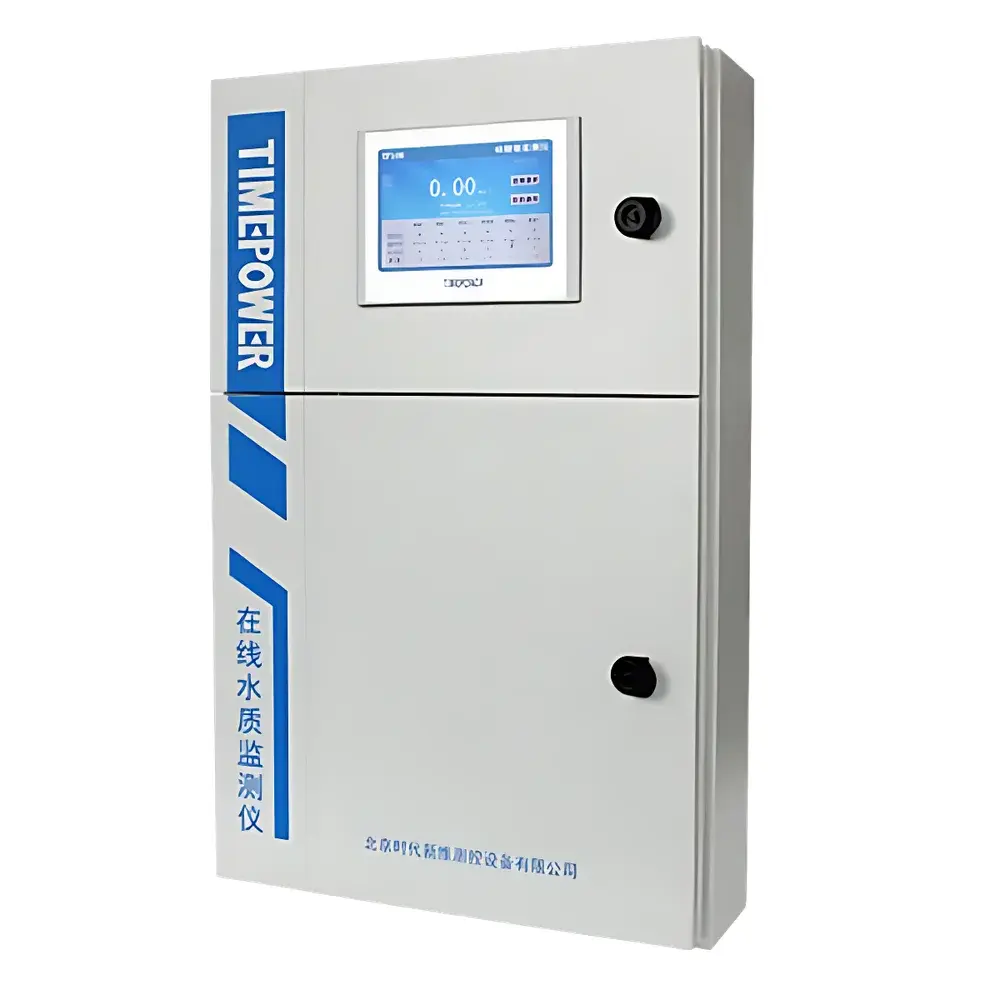
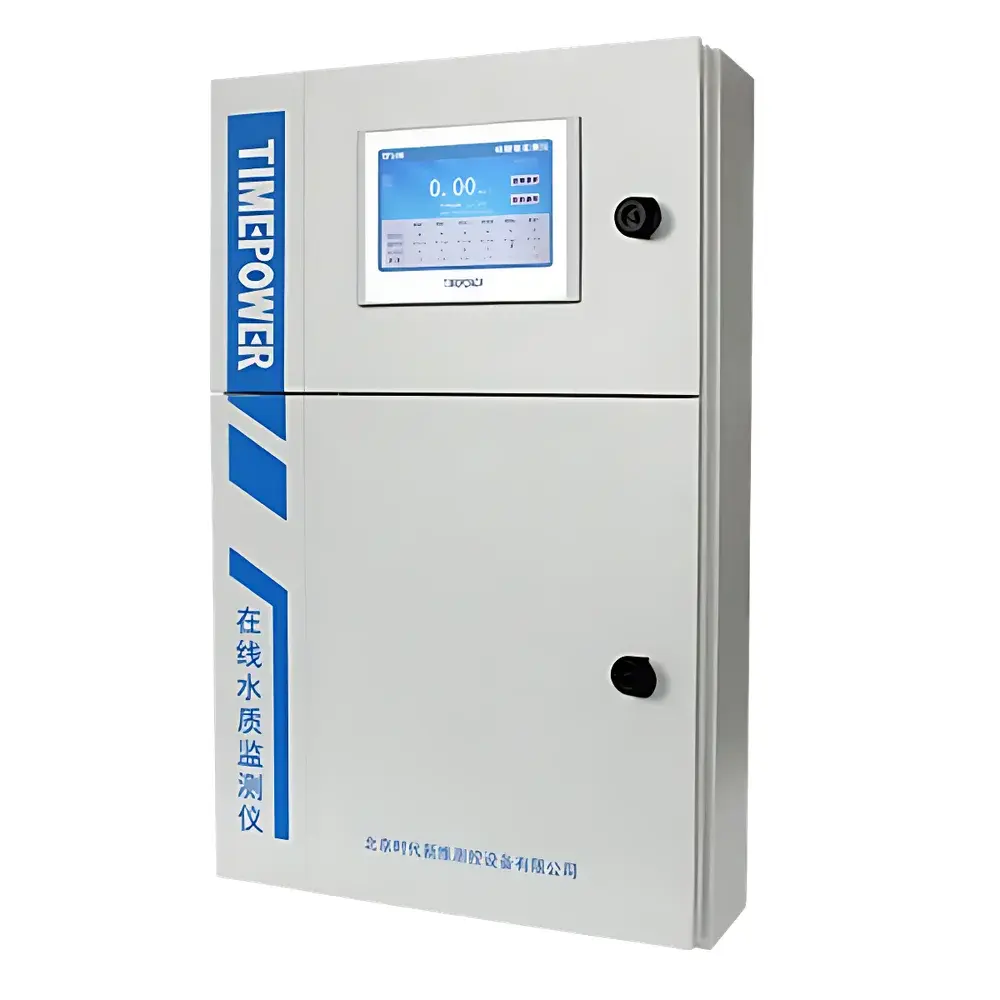
TimePower TP106 Online Silica Analyzer
| Brand | TimePower |
|---|---|
| Model | TP106 |
| Type | Online Analyzer |
| Origin | Beijing, China |
| Manufacturer | TimePower Instrument Co., Ltd. |
| Measurement Principle | Molybdenum Blue Photometric Method (based on GB/T 12149–2017) |
| Measurement Range | 0.0–200.0 μg/L or 0.0–2000 μg/L (selectable) |
| Accuracy | ±2% F.S. |
| Repeatability | ≤±1% F.S. |
| Drift | <±1% F.S./24 h |
| Response Time | <10 min |
| Cycle Time | ~10 min per channel |
| Sample Flow Rate | 10–40 L/h |
| Sample Temperature | 5–50 °C |
| Particulate Limit | <5 µm, non-colloidal |
| Ambient Temperature | 5–45 °C |
| Relative Humidity | ≤90% RH (non-condensing) |
| Light Source | Monochromatic cold LED |
| Display | 7.0-inch color LCD touchscreen, Chinese interface |
| Output Signals | Isolated 0–20 mA / 4–20 mA / 0–10 mA (configurable) |
| Alarm Outputs | Independent high/low limit and flow-loss alarms per channel |
| Power Supply | AC 85–265 V, 45–65 Hz |
| Power Consumption | ≤100 W |
| Dimensions | 460 × 280 × 720 mm (W × D × H) |
| Panel Cutout | 670 × 410 mm |
| Weight | 22 kg |
| Channel Options | 1–6 channels configurable |
| Data Storage | 30 days of historical data (timestamped) |
| Reagent Consumption | ~3 L/month per reagent (4 reagents total) |
| Compliance | GB/T 12149–2017 |
Overview
The TimePower TP106 Online Silica Analyzer is a dedicated photometric instrument engineered for continuous, real-time quantification of dissolved silica (as silicate ion, SiO₃²⁻) in aqueous process streams. It operates on the standardized molybdenum blue method—fully compliant with GB/T 12149–2017, the People’s Republic of China national standard for silica determination in industrial circulating cooling water and boiler feedwater. The analytical sequence begins with acidification to pH 1.1–1.3, enabling quantitative reaction between soluble silicate and ammonium molybdate to form a yellow heteropoly-molybdosilicic acid complex. This intermediate is then selectively reduced by 1-amino-2-naphthol-4-sulfonic acid (1,2,4-acid) to yield an intensely colored silicon-molybdenum blue chromophore. Absorbance is measured at a fixed wavelength using a stable monochromatic cold LED light source and precision optical path. Concentration is calculated via the Lambert–Beer law, ensuring linearity and traceability across the full dynamic range (0.0–200.0 μg/L or 0.0–2000 μg/L). Designed for unattended operation in demanding industrial environments, the TP106 delivers high reproducibility (≤±1% F.S.), low drift (<±1% F.S./24 h), and rapid response (<10 min), making it suitable for closed-loop monitoring and feedwater purity control in high-pressure steam cycles.
Key Features
- Modular multi-channel architecture supporting 1–6 independent measurement streams—enabling cost-effective monitoring of multiple sample points from a single analyzer cabinet.
- High-reliability fluidic system incorporating imported solenoid valves with extended service life and sub-milliliter dosing accuracy for reagent addition and sample aspiration.
- 7.0-inch color LCD touchscreen with native Chinese UI, capable of simultaneous real-time curve display for all active channels—each trace rendered in distinct color coding for intuitive trend analysis.
- Configurable analog outputs (0–20 mA, 4–20 mA, or 0–10 mA) with galvanic isolation—designed for direct integration into plant DCS, PLC, or automated chemical dosing systems without signal interference.
- Robust mechanical design featuring front-panel cutout mounting (670 × 410 mm cutout), compact footprint (460 × 280 × 720 mm), and sealed enclosure rated for ambient operation at 5–45 °C and ≤90% RH (non-condensing).
- Onboard data logging retains timestamped measurement records for up to 30 days—supporting root-cause investigation, regulatory review, and operational auditing without external storage dependency.
Sample Compatibility & Compliance
The TP106 is validated for use with clarified, non-colloidal aqueous samples containing suspended solids <5 µm. It is not intended for raw or turbid waters without pre-filtration. Sample temperature must remain within 5–50 °C; deviations may affect reaction kinetics and photometric stability. The analyzer meets the metrological and procedural requirements of GB/T 12149–2017, including reagent purity specifications, calibration protocol, and interference mitigation (e.g., phosphate masking via tartaric acid addition where required). While not certified to ISO/IEC 17025 or ASTM D859, its measurement traceability aligns with principles of GLP-compliant water chemistry monitoring. For regulated pharmaceutical or power generation applications, users are advised to perform site-specific validation per internal SOPs and relevant regional guidelines (e.g., USP , EP 2.2.43).
Software & Data Management
The embedded firmware supports local configuration, calibration, alarm threshold setting, and channel activation via the touchscreen interface. All measurement events—including calibration updates, reagent low warnings, flow interruption alerts, and out-of-spec readings—are time-stamped and stored in non-volatile memory. Historical data export is available via USB port in CSV format for offline analysis in Excel or LIMS platforms. The system does not include network connectivity (Ethernet/Wi-Fi) or cloud-based telemetry; however, analog outputs and discrete alarm contacts enable seamless connection to third-party SCADA or historian systems. Audit trail functionality is limited to event logs (no user-action tracking); for FDA 21 CFR Part 11 compliance, external data acquisition software with electronic signature and change-control capabilities is recommended.
Applications
- Boiler feedwater and condensate monitoring in thermal power plants—ensuring silica levels remain below critical thresholds (<20 μg/L) to prevent turbine blade deposition and corrosion.
- Process water quality control in semiconductor manufacturing rinse stages, where ultra-low silica contamination (<5 μg/L) is essential for wafer yield.
- Effluent compliance monitoring in chemical, fertilizer, and metallurgical facilities discharging to municipal or natural water bodies under local discharge permits.
- Pharmaceutical purified water (PW) and water-for-injection (WFI) loop surveillance—supporting USP silica specification verification during routine QC testing.
- Drinking water treatment optimization—tracking silica breakthrough in anion exchange or reverse osmosis trains to schedule resin regeneration or membrane cleaning.
FAQ
What reagents are required for daily operation?
Four reagents are consumed continuously: sulfuric acid (for acidification), ammonium molybdate (for complex formation), 1,2,4-acid (reducing agent), and tartaric acid (phosphate masking agent). Typical consumption is ~3 liters per month per reagent.
Can the TP106 be integrated into a DCS system?
Yes—via its isolated 4–20 mA analog outputs (configurable per channel) and discrete relay outputs for alarm signaling. No proprietary protocol or driver is needed.
Is remote diagnostics or firmware update supported?
No. Firmware updates require physical USB access and must be performed by authorized service personnel using TimePower-provided tools.
What maintenance intervals are recommended?
Daily visual inspection of tubing and flow cells; weekly cleaning of sample filter and flow cell windows; monthly calibration verification using NIST-traceable silica standards; annual valve and pump actuator inspection.
Does the analyzer support automatic zero and span calibration?
Yes—programmable auto-calibration sequences can be scheduled, using deionized water for zero and certified silica standard solutions for span adjustment.







