
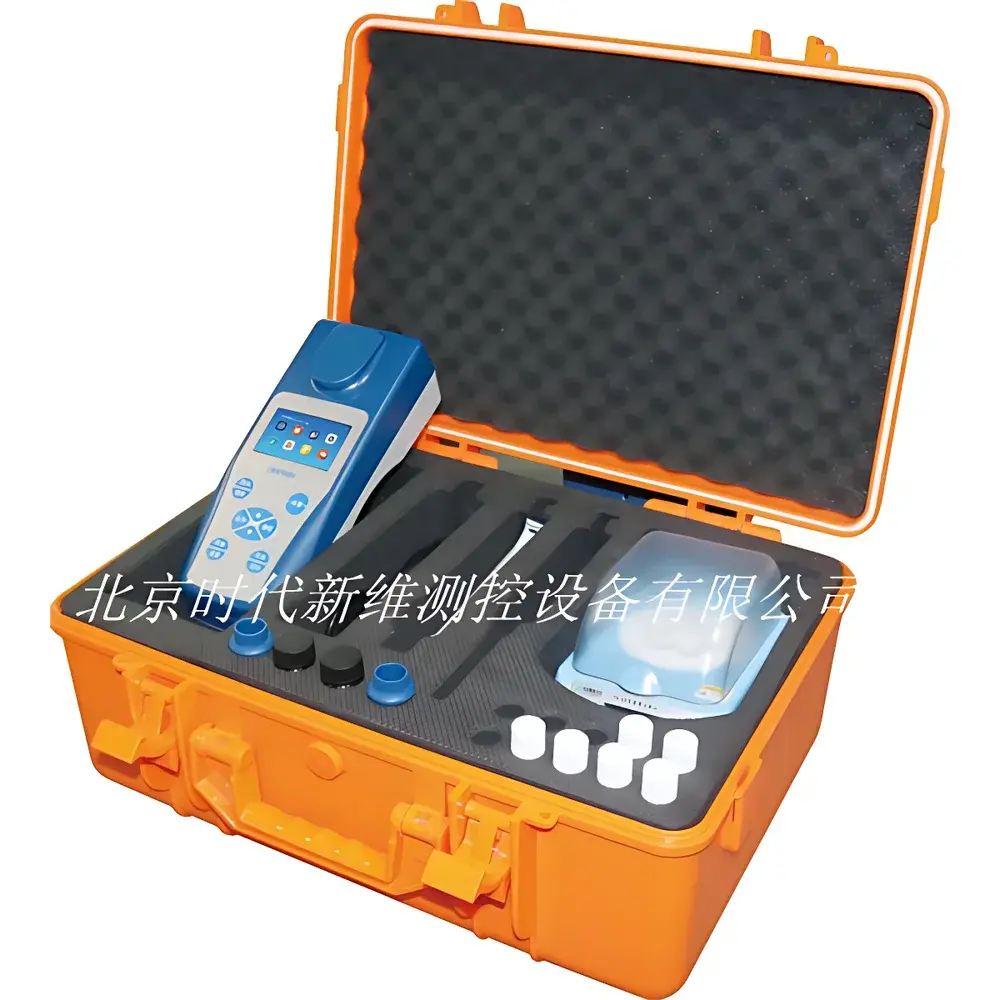
Timepower TP2111 Portable COD Analyzer
| Brand | Timepower |
|---|---|
| Origin | Beijing, China |
| Manufacturer Type | Manufacturer |
| Origin Category | Domestic |
| Model | TP2111 |
| Instrument Type | Portable |
| Measurement Principle | Photometric Colorimetry (based on Lambert-Beer Law) |
| Wavelength | 610 nm (for medium/high range), 420 nm (for low range) |
| Measurement Range | 0–2000 mg/L COD (dilution applicable for higher concentrations) |
| Accuracy | ≤ ±5% FS |
| Repeatability | ≤ 3% RSD |
| Detection Limit | 0.1 mg/L |
| Measurement Time | 15 min per batch |
| Batch Capacity | 15 or 30 samples |
| Optical System | Imported cold-light source with high photometric stability |
| Temperature Control | PID-controlled heating block, 0–200 °C adjustable (COD digestion set at 165 °C) |
| Temperature Accuracy | ±1 °C |
| Digestion Time | 1–999 min programmable (standard COD digestion: 15 min) |
| Data Storage | 50 calibration curves + 500 measurement records with timestamp (YYYY-MM-DD hh:mm:ss), absorbance, and transmittance |
| Power Supply | Rechargeable lithium-ion battery |
| Enclosure | Molded ABS housing, IP65 rated |
| Dimensions (Analyzer) | 80 × 230 × 55 mm |
| Dimensions (Digestor) | 105 × 160 × 90 mm |
| Weight (Analyzer) | 0.5 kg |
| Weight (Digestor) | 1.0 kg |
| Interface | USB port for data export and PC connectivity |
| Data Protection | Built-in power-loss memory retention |
| Chloride Interference Tolerance | ≤ 2000 mg/L Cl⁻ |
Overview
The Timepower TP2111 Portable COD Analyzer is a field-deployable, dual-component system engineered for accurate and reliable chemical oxygen demand (COD) determination in diverse aqueous matrices—including surface water, municipal wastewater, and industrial effluents. It operates on the fundamental principle of photometric colorimetry, grounded in the Lambert-Beer Law: the absorbance of a chromophoric reaction product formed during acidic dichromate oxidation is directly proportional to the concentration of oxidizable organic matter in the sample. Unlike integrated benchtop systems, the TP2111 decouples digestion and measurement functions—ensuring thermal isolation between the high-temperature digestion block and optical detection module, thereby eliminating thermal drift and preserving long-term photometric accuracy. The analyzer employs dual-wavelength optics (420 nm for low-range measurements and 610 nm for medium-to-high-range quantification), enabling extended dynamic linearity across the full 0–2000 mg/L COD span without manual range switching.
Key Features
- Dual-module architecture: Independent, thermally isolated digestion unit and photometric analyzer prevent cross-interference and support concurrent sample preparation and measurement.
- PID-driven temperature control system with ±1 °C precision over 0–200 °C range; pre-programmed 165 °C digestion profile compliant with ISO 6060 and APHA Standard Methods 5220D.
- Imported cold-light source ensures minimal spectral drift and >10,000-hour operational lifetime—critical for field use where lamp replacement is impractical.
- Embedded 16-bit microcontroller delivers deterministic real-time processing, low-power operation (<2.5 W average), and robust electromagnetic compatibility (EMC Class B).
- IP65-rated ABS enclosure provides dust-tight and water-jet resistant protection—validated for outdoor deployment in rain, humidity, and dusty environments.
- Onboard data management: Stores up to 50 user-defined calibration curves and 500 timestamped results (including absorbance, transmittance, and calculated COD values) with automatic date/time stamping (year-month-day hour:minute:second).
- USB interface supports direct data retrieval, CSV export, and firmware updates—compatible with Windows-based LIMS integration and audit-trail-enabled reporting workflows.
Sample Compatibility & Compliance
The TP2111 accommodates standard 16-mm round glass or quartz digestion vials and supports chloride interference suppression up to 2000 mg/L Cl⁻—enabling direct analysis of saline-influenced wastewaters without pretreatment. Its measurement protocol aligns with internationally recognized methodologies: digestion conditions satisfy ISO 6060:2022 (Water quality — Determination of chemical oxygen demand) and APHA Standard Methods 5220D (Closed Reflux, Colorimetric Method). The instrument’s repeatability (≤3% RSD) and accuracy (≤±5% FS) meet performance criteria outlined in US EPA Method 410.4 for field-portable COD analyzers. All stored data include immutable timestamps and are retained during battery discharge—supporting GLP-compliant recordkeeping and FDA 21 CFR Part 11–aligned electronic signature readiness when paired with validated software.
Software & Data Management
Data acquisition and reporting are managed via embedded firmware supporting automated calibration curve generation (linear, quadratic, or polynomial fitting) and multi-point standardization. Each measurement record includes raw absorbance, % transmittance, calculated COD concentration, operator ID (if configured), and full timestamp metadata. USB connectivity enables secure transfer to laboratory PCs for further statistical analysis (e.g., Shewhart control charts, trend analysis) or import into enterprise LIMS platforms. Optional PC software provides audit-trail logging, user access controls, and PDF report generation with digital signature fields—facilitating compliance with ISO/IEC 17025:2017 documentation requirements.
Applications
- Routine monitoring of influent and effluent streams at municipal wastewater treatment plants (WWTPs).
- Field verification of industrial discharge compliance against local environmental permits (e.g., China’s GB 8978-1996, EU Urban Wastewater Treatment Directive).
- Emergency response screening during spill incidents or accidental releases.
- Educational laboratories requiring portable, safe, and curriculum-aligned COD training tools.
- Research campaigns involving spatial-temporal water quality mapping in rivers, lakes, and coastal zones.
FAQ
What digestion method does the TP2111 employ?
It uses closed-reflux digestion with potassium dichromate (K₂Cr₂O₇) under strongly acidic conditions at 165 °C for 15 minutes—fully aligned with ISO 6060 and APHA 5220D.
Can the instrument measure samples with high chloride content?
Yes—the system tolerates chloride concentrations up to 2000 mg/L without requiring mercury sulfate masking agents.
Is the device suitable for unattended operation in remote locations?
With its rechargeable lithium-ion battery (rated for ≥8 hours continuous operation) and IP65 ingress protection, it supports multi-site surveys without AC power infrastructure.
How is data integrity ensured during power interruption?
All measurement data and calibration parameters are written to non-volatile flash memory prior to display—ensuring zero loss during unexpected shutdowns.
Does the TP2111 support regulatory audit trails?
When used with validated PC software, it enables time-stamped, operator-logged, and digitally signed reports meeting GLP, GMP, and 21 CFR Part 11 requirements.







