
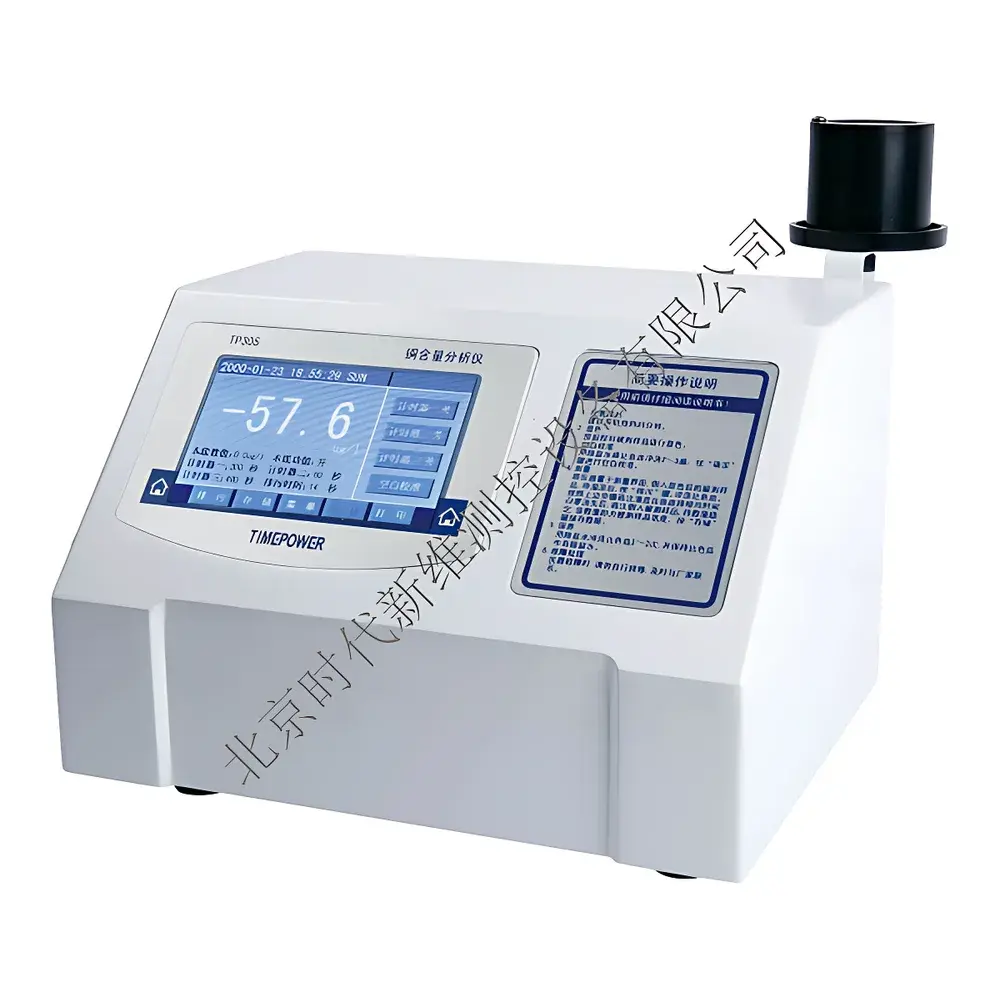
TimePower TP305 Copper Ion Concentration Analyzer
| Brand | TimePower |
|---|---|
| Origin | Beijing, China |
| Manufacturer Type | Manufacturer |
| Country of Origin | Domestic (China) |
| Model | TP305 |
| Price | Upon Request |
Overview
The TimePower TP305 Copper Ion Concentration Analyzer is a dedicated photometric instrument engineered for trace-level quantification of dissolved copper (Cu²⁺) in ultra-pure and process water streams across thermal power generation, nuclear facilities, and high-reliability industrial cooling systems. It operates on the fundamental principle of photometric absorption spectroscopy—specifically, single-wavelength visible-light absorbance measurement based on the Lambert-Beer Law. When monochromatic light passes through a sample solution containing a copper-specific chromogenic complex (typically formed via reaction with neocuproine or bathocuproine disulfonic acid under controlled pH), the measured absorbance at 450 nm is linearly proportional to copper ion concentration within the defined analytical range. This method delivers high specificity for Cu²⁺ in matrices where interfering transition metals are minimized through optimized reagent chemistry and sample pretreatment protocols.
Key Features
- Integrated optical architecture featuring a precision-calibrated imported cold LED light source (450 nm ± 2 nm bandwidth), ensuring long-term photometric stability, low thermal drift, and >50,000-hour operational lifetime.
- High-density surface-mount technology (SMT) PCB design with embedded microcontroller unit (MCU), delivering robust signal processing, low power consumption (<30 W), and immunity to electromagnetic interference in plant-floor environments.
- 5.0-inch capacitive touchscreen LCD with native Chinese UI—engineered for intuitive operation by plant chemists and shift technicians without specialized software training.
- Automated timing sequence control with audible/visual alerts for digestion, color development, and measurement phases—reducing operator dependency and minimizing procedural variability.
- Dual-point calibration workflow: zero-point blank compensation eliminates electronic and optical baseline drift; full-scale calibration maintains linearity across the entire 0.0–200 μg/L range.
- Circular data buffer storing up to 256 measurement records with timestamp, sample ID, and operator tag; automatic overwrite logic prevents data loss during extended unattended operation.
Sample Compatibility & Compliance
The TP305 is validated for direct analysis of boiler feedwater, condensate, steam cycle sampling points, generator stator cooling water, drum boiler water, and natural surface waters following ASTM D1068–22 (Standard Test Methods for Copper in Water) and ISO 8575:2021 (Water quality — Determination of copper — Spectrophotometric method). Sample introduction requires no external peristaltic pump; manual pipetting into the supplied quartz cuvette (10 mm pathlength) suffices. To ensure metrological integrity, users must employ Type I or II reagent water per ISO 3696 or ASTM D1193, store all reagents in certified polyethylene containers, and maintain strict adherence to reagent expiration dates. Routine verification includes daily blank calibration and biweekly multi-point calibration curve validation—practices aligned with GLP documentation requirements for utility chemistry laboratories.
Software & Data Management
While the TP305 operates as a standalone benchtop analyzer with no external PC dependency, its internal firmware supports audit-trail-capable data logging compliant with basic 21 CFR Part 11 principles: each stored record contains immutable timestamps, user-defined identifiers, and calibration status flags. Data export is supported via USB flash drive (FAT32 formatted) in CSV format for integration into LIMS or SCADA historian systems. Firmware updates are performed offline using signed binary packages distributed through authorized TimePower service channels—ensuring version control and traceability in regulated environments.
Applications
- Monitoring copper corrosion products in fossil-fueled and combined-cycle power plant water-steam cycles to prevent turbine blade deposition and stress corrosion cracking.
- Ensuring compliance with EPRI guidelines for generator cooling water (<5 μg/L Cu) to avoid insulation degradation in hydrogen-cooled turbogenerators.
- Verifying copper leaching from brass and copper-nickel piping in district heating and HVAC secondary loops.
- Supporting ISO 14644-1 cleanroom water qualification where copper serves as a surrogate indicator of particulate metal contamination.
- Field-deployable verification of copper removal efficiency in ion exchange and electrodeionization (EDI) polishing units.
FAQ
What is the required sample volume per measurement?
A minimum of 15 mL of filtered, particle-free water sample is required for reproducible colorimetric development.
Does the TP305 support automatic reagent dispensing?
No—the system relies on manual addition of pre-measured reagent sachets or calibrated droppers to maintain simplicity, reduce maintenance complexity, and eliminate fluidic wear components.
Is the instrument suitable for seawater or high-salinity samples?
Not without prior matrix-matched dilution and spike recovery validation; chloride interference must be assessed per ASTM D1068 Annex A for saline matrices.
How often must the optical path be cleaned?
The cuvette holder and LED/receiver optics require cleaning only if visible residue accumulates—typically every 2–3 months under normal use; isopropyl alcohol and lint-free wipes are recommended.
Can calibration curves be imported from external spectrophotometers?
No—calibration is instrument-specific due to LED spectral profile and detector response; only factory-provided or user-generated multi-point curves via the onboard interface are supported.





