
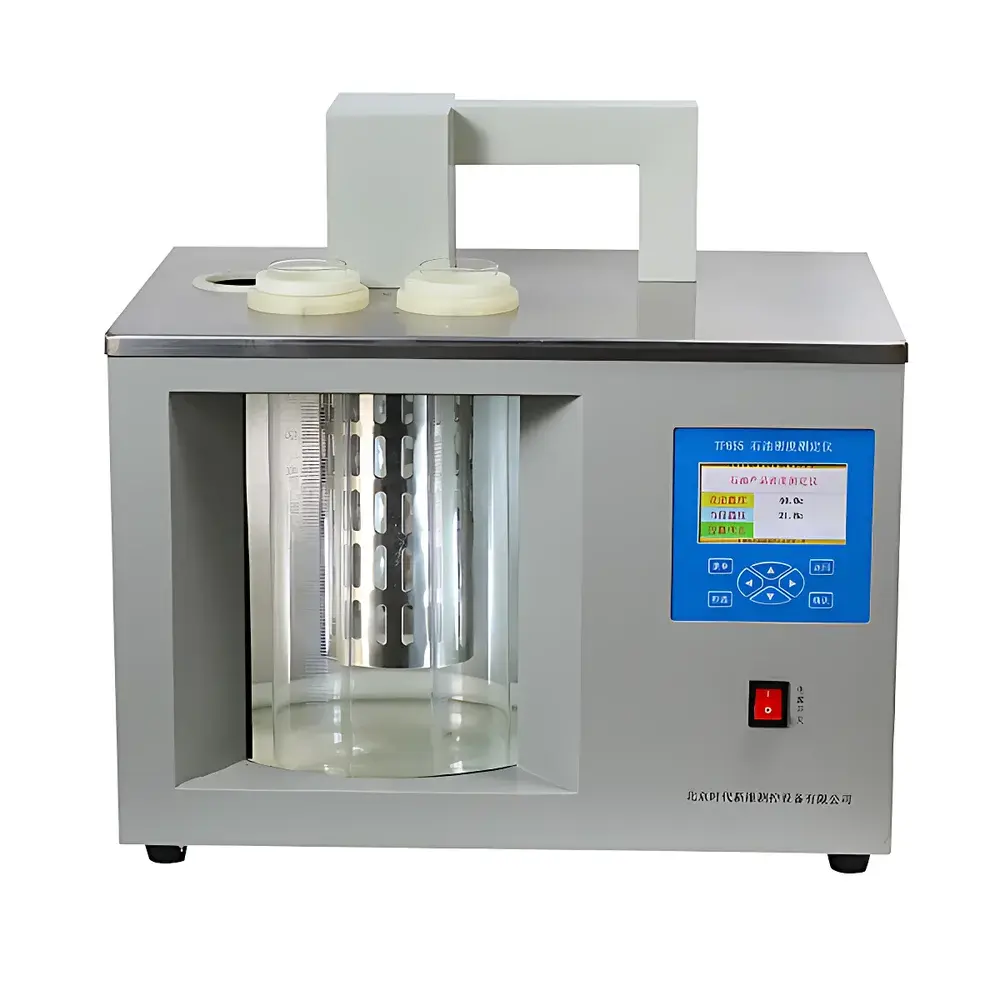
Timepower TP655 Petroleum Density Analyzer
| Brand | Timepower |
|---|---|
| Origin | Beijing, China |
| Manufacturer Type | Direct Manufacturer |
| Country of Origin | China |
| Model | TP 655 |
| Pricing | Upon Request |
| Temperature Control Range | 0–110 °C |
| Temperature Resolution | 0.1 °C |
| Temperature Stability | ±0.1 °C |
| Heating Power | ≤1500 W |
| Total Power Consumption | 1800 W |
| Dual-Sample Capacity | 2 independent test positions |
| Ambient Operating Conditions | 5–40 °C, ≤85% RH |
| Electrical Supply | AC 220 V ±10%, 50 Hz ±10% |
| Dimensions (W×D×H) | 510 × 365 × 470 mm |
| Net Weight | 20 kg |
Overview
The Timepower TP655 Petroleum Density Analyzer is a precision laboratory instrument engineered for the accurate determination of density in liquid petroleum products at controlled temperatures, in strict accordance with internationally recognized standard test methods—including ASTM D1298 (Standard Test Method for Density, Relative Density (Specific Gravity), or API Gravity of Crude Petroleum and Liquid Petroleum Products by Hydrometer Method), ISO 3675 (Petroleum Liquids — Laboratory Determination of Density — Hydrometer Method), and GB/T 1884 (Chinese national standard equivalent to ISO 3675). It implements the hydrometer-based density measurement principle, wherein a calibrated glass hydrometer is immersed in a thermally stabilized sample, and the meniscus-intercept reading—corrected to a reference temperature (typically 15 °C or 20 °C)—is used to calculate standard density (kg/m³) or API gravity. The TP655 integrates a dual-position thermostatic bath system with PID-driven temperature regulation, enabling simultaneous or sequential analysis of two samples under identical thermal conditions—a critical requirement for inter-laboratory reproducibility and quality control workflows in refineries, third-party testing labs, and petrochemical R&D facilities.
Key Features
- PID-controlled thermostatic bath with ±0.1 °C temperature stability across the full 0–110 °C operating range—ensuring compliance with repeatability requirements of ASTM D1298 and ISO 3675
- Dual independent test positions allow parallel density determinations, reducing throughput time without compromising thermal uniformity or operator intervention
- Integrated LED illumination system provides consistent, flicker-free, glare-free backlighting for precise hydrometer scale reading—eliminating parallax error and enhancing visual accuracy during manual observation
- Configurable cooling capability: optional integrated refrigeration unit enables sub-ambient density measurements (e.g., for low-volatility distillates or bituminous fractions), while heating-only configuration is available upon request
- Robust stainless-steel and high-impact polymer construction ensures long-term mechanical stability and resistance to hydrocarbon solvent exposure in routine QC environments
- Intuitive front-panel interface with digital temperature display, real-time setpoint tracking, and status indicators for heating/cooling phase transitions
Sample Compatibility & Compliance
The TP655 is validated for use with all liquid petroleum products covered under ASTM D1298 and ISO 3675 scope—including crude oil, gasoline, diesel fuel, jet fuel, lubricating oils, and residual fuels. Sample volume per test position is optimized for standard ASTM hydrometers (e.g., ASTM IP 151, ASTM D1298 Type A/B/C). The instrument’s thermal mass and circulation design minimize axial and radial temperature gradients (<0.05 °C deviation across bath depth), satisfying the “uniform temperature” prerequisite defined in Clause 7.2 of ASTM D1298. All materials in contact with samples conform to chemical compatibility standards for hydrocarbon media. The system supports GLP-compliant operation through traceable temperature calibration (NIST-traceable RTD sensor included), documented maintenance logs, and audit-ready operational records when paired with external lab management software.
Software & Data Management
While the TP655 operates as a standalone benchtop instrument with no embedded PC or proprietary software, its analog/digital temperature outputs (0–10 V or 4–20 mA optional) are compatible with common laboratory data acquisition systems (e.g., LabVIEW, DeltaV, or custom SCADA platforms). Users may integrate temperature logging, alarm thresholds, and run-time metadata capture via external controllers. For fully compliant environments subject to FDA 21 CFR Part 11 or ISO/IEC 17025 requirements, the instrument supports electronic record generation when connected to validated LIMS or ELN solutions—enabling secure user authentication, electronic signatures, and immutable audit trails for density test reports.
Applications
- Quality assurance of refinery streams and finished fuels against specification limits (e.g., ASTM D975 for diesel, ASTM D1655 for jet fuel)
- Density-to-API gravity conversion for custody transfer calculations in pipeline and marine logistics
- Batch release testing of base oils and specialty lubricants per OEM technical data sheets
- Research-scale characterization of biofuel blends (e.g., FAME, HVO) where thermal expansion behavior impacts volumetric energy content
- Calibration verification of online density meters (e.g., Coriolis-based analyzers) using certified reference materials
- Teaching laboratories demonstrating fundamental principles of fluid density, thermal expansion, and hydrometer metrology
FAQ
Does the TP655 include a built-in hydrometer or require external calibration tools?
No—the TP655 is a thermostatic bath platform only. Users must supply ASTM-certified hydrometers appropriate for their sample density range and temperature class.
Can the instrument maintain temperature below ambient without the optional chiller?
No—sub-ambient operation requires the factory-installed refrigeration module. Units ordered without this option are heating-only (minimum bath temperature = ambient + ~2 °C).
Is temperature calibration traceable to national standards?
Yes—the integrated Pt100 RTD sensor is supplied with a NIST-traceable calibration certificate (as delivered), and field recalibration procedures align with ISO/IEC 17025 Section 6.5.
What safety protections are implemented in the heating system?
Dual independent overtemperature cutoffs (mechanical and electronic), ground-fault circuit interruption (GFCI), and automatic power-down on lid-open detection per IEC 61010-1.
How is compliance with ASTM D1298’s “thermal equilibrium” requirement verified?
The bath’s thermal homogeneity profile is mapped per ASTM E740; validation documentation confirms <0.05 °C spatial variation and <15-minute stabilization time from setpoint change—both exceeding D1298 Annex A1 tolerances.





