
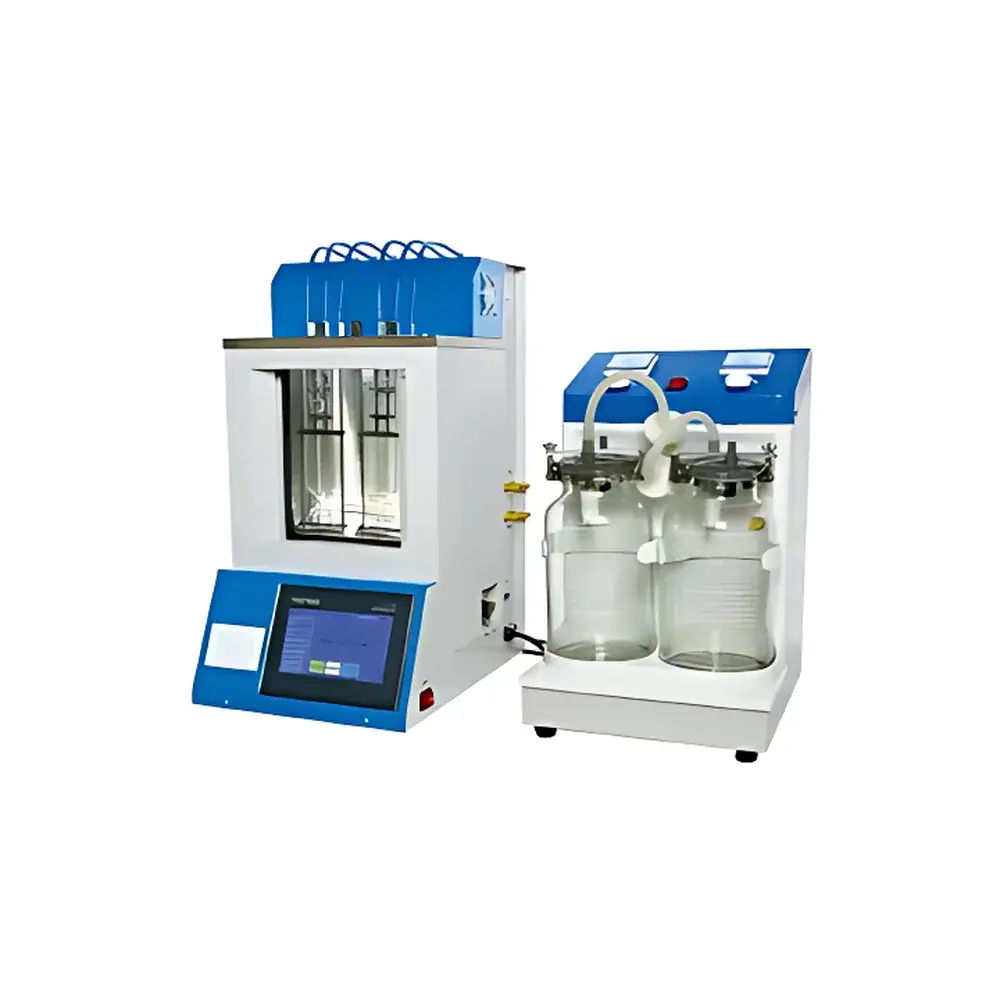
TimePower TP725 Fully Automated Kinematic Viscosity Tester
| Brand | TimePower |
|---|---|
| Model | TP725 |
| Origin | Beijing, China |
| Manufacturer | TimePower Instrument Co., Ltd. |
| Application Domain | Petroleum, Power, Chemical, Inspection & Research |
| Temperature Control Range | Ambient to 100 °C |
| Temperature Stability | ±0.01 °C |
| Temperature Resolution | 0.01 °C |
| Kinematic Viscosity Resolution | 0.00001 mm²/s |
| Power Supply | AC 220 V ±10%, 50 Hz ±10% |
| Max Power Consumption | ≤1500 W |
| Dimensions | 370 × 300 × 650 mm |
| Weight | ~28 kg |
Overview
The TimePower TP725 Fully Automated Kinematic Viscosity Tester is an engineered solution for precise, repeatable determination of kinematic viscosity in petroleum-based liquids—including lubricating oils, transformer oils, jet fuels, and base stocks—according to standardized capillary viscometry principles. It operates on the fundamental physical relationship defined by Poiseuille’s law, where kinematic viscosity (ν) is calculated as the product of flow time (t) and the calibrated viscometer constant (C), i.e., ν = C × t. The instrument implements a Ubbelohde-type capillary viscometer system immersed in a precisely controlled thermostatic bath, ensuring laminar flow conditions required by ASTM D445, ISO 3104, and GB/T 265. Its dual-channel architecture enables asynchronous analysis of two independent samples at identical or different setpoints, significantly improving laboratory throughput without compromising measurement integrity.
Key Features
- Dual-CPU microprocessor control architecture ensures deterministic timing, fault-tolerant operation, and real-time thermal equilibrium monitoring.
- Automated sequence execution: bath temperature stabilization → sample aspiration → efflux time detection → viscosity calculation → capillary cleaning → hot-air drying—all executed without manual intervention.
- High-stability thermostatic bath with ±0.01 °C temperature control accuracy over the full operating range (ambient to 100 °C), verified via traceable platinum resistance thermometers (PRTs).
- U.S.-sourced optical detection module employing infrared beam interruption technology—immune to ambient lighting variations and offering sub-millisecond timing resolution for efflux event capture.
- Self-diagnostic firmware continuously monitors critical subsystems (temperature sensors, fluid valves, motor drivers, and optical detectors), logging error codes for rapid troubleshooting.
- Modular design supports optional chiller integration for sub-ambient testing down to 4 °C, extending compliance with ASTM D445 Annex A2 for low-temperature applications.
- Human-interface optimized with backlit LCD display and proximity-sensing membrane keys—reducing accidental input and enabling glove-compatible operation in industrial environments.
Sample Compatibility & Compliance
The TP725 is validated for use with transparent and slightly opaque Newtonian and near-Newtonian petroleum products within the kinematic viscosity range of 0.2 to 300,000 mm²/s (cSt), depending on selected capillary dimensions and test temperature. It accommodates standard Ubbelohde viscometers (e.g., Cannon-Fenske Routine, Ostwald types) conforming to ISO 3105 geometry tolerances. All operational sequences comply with GLP documentation requirements: timestamped test logs, operator ID tagging (via optional network authentication), and immutable result records. The system supports audit-ready data export in CSV and PDF formats, satisfying FDA 21 CFR Part 11 electronic record retention criteria when deployed with validated IT infrastructure.
Software & Data Management
Embedded firmware provides local storage of ≥1000 test records with full metadata (date/time, bath temperature, efflux time, calculated ν, capillary ID, cleaning cycle status). Optional Ethernet or RS-232 connectivity enables integration into LIMS environments via Modbus RTU or ASCII command protocol. No proprietary software installation is required; raw data and summary reports are accessible via USB mass-storage mode or direct printout using built-in thermal printer support. Calibration constants are stored per-capillary ID with checksum verification, preventing erroneous application of mismatched constants during multi-viscometer workflows.
Applications
- Quality control of insulating oils in power generation and transmission facilities per IEC 60296 and ASTM D877.
- Routine monitoring of turbine and hydraulic oils in refineries and OEM maintenance labs.
- Research-grade characterization of viscosity–temperature behavior (ASTM D341) for formulation development.
- Compliance testing for commercial fuel specifications (e.g., ASTM D975, EN 590) requiring kinematic viscosity at 40 °C and 100 °C.
- Verification of viscosity index improvers (VIIs) in multigrade engine oils using sequential measurements across temperature gradients.
FAQ
What capillary viscometers are compatible with the TP725?
Standard Ubbelohde-type viscometers meeting ISO 3105 dimensional tolerances and calibrated with NIST-traceable reference oils are supported. Each capillary must be registered in the system with its unique constant and calibration date.
Does the TP725 meet regulatory requirements for auditable testing?
Yes—the instrument maintains tamper-evident test logs with timestamps, operator identifiers (when configured), and full parameter traceability. When paired with validated network storage and user access controls, it satisfies GLP and FDA 21 CFR Part 11 electronic record requirements.
Can the TP725 operate unattended overnight?
Yes. Its robust thermal management, automatic oil-level sensing, and fail-safe shutdown logic (triggered by overheating, low bath fluid, or mechanical obstruction) enable extended unattended operation under supervised laboratory conditions.
Is external chiller integration mandatory for low-temperature testing?
No—it is optional. The base configuration supports minimum bath temperatures near ambient (~15 °C). For tests at 4 °C or 0 °C per ASTM D445 Annex A2, a certified recirculating chiller must be connected via the auxiliary coolant port.
How is viscosity tube cleaning validated?
Cleaning efficacy is confirmed through post-cycle optical verification: the infrared detector confirms absence of residual film interference during air-dry phase. Users may perform periodic validation using blank solvent runs and visual inspection of capillary bore clarity.
Related Products




