
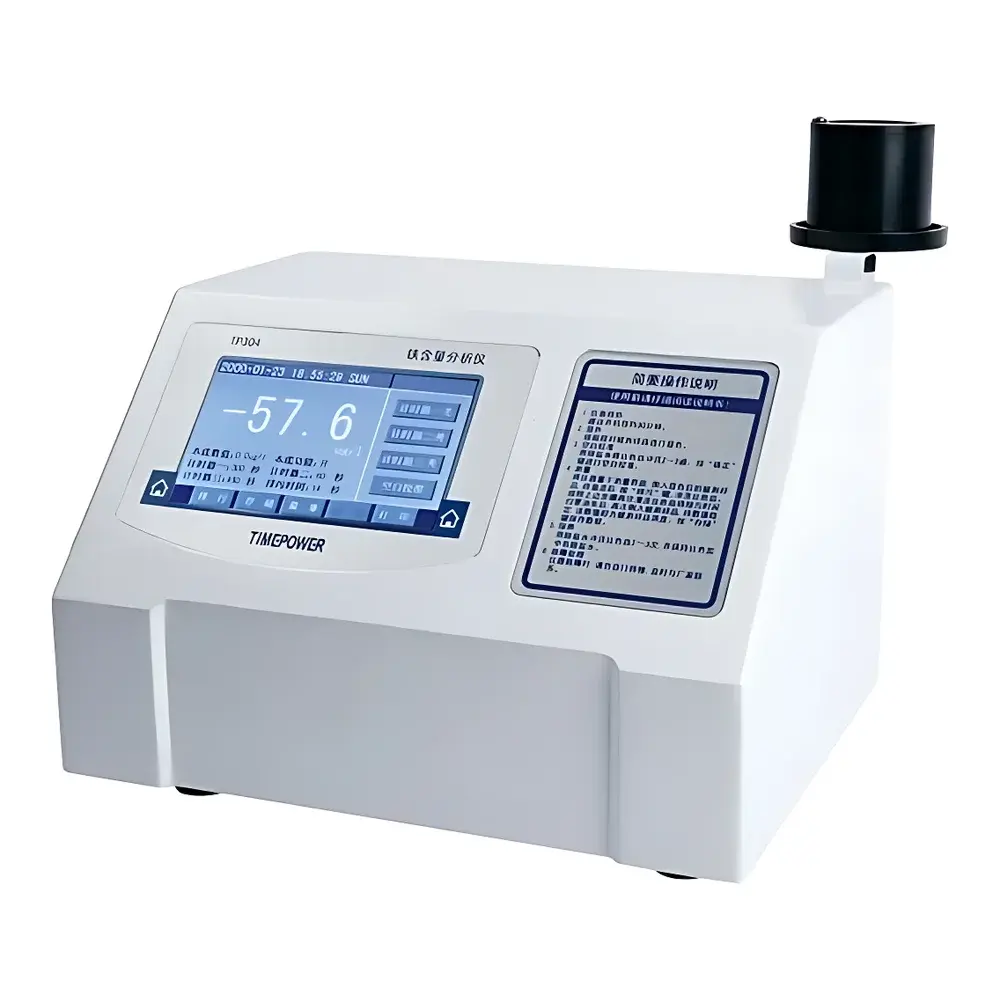
Timepower TP-304 Iron Content Analyzer
| Brand | Timepower |
|---|---|
| Origin | Beijing, China |
| Manufacturer Type | Direct Manufacturer |
| Regional Classification | Domestic (China) |
| Model | TP-304 |
| Pricing | Available Upon Request |
Overview
The Timepower TP-304 Iron Content Analyzer is a dedicated benchtop photometric analyzer engineered for precise quantification of dissolved ferrous (Fe²⁺) and total iron (Fetotal) in low-conductivity, low-particulate aqueous matrices. It operates on the principle of visible-spectrum spectrophotometry using the 1,10-phenanthroline (o-phenanthroline) colorimetric method — a standardized, highly selective reaction where Fe²⁺ forms a stable, orange-red complex with 1,10-phenanthroline under controlled pH and reducing conditions. This method is widely referenced in ASTM D1066, ISO 8586, and USP for trace metal analysis in high-purity water systems. The instrument is specifically designed for continuous monitoring and periodic verification of iron contamination in critical thermal power and nuclear utility water cycles, including boiler feedwater, condensate, steam condensate, generator internal cooling water, drum boiler water, and natural surface water sources where iron concentrations typically range from 0 to 1000 µg/L.
Key Features
- 5.0-inch capacitive touch color LCD with intuitive Chinese-language interface — optimized for on-site operation by plant chemists and QC technicians without specialized software training.
- Integrated optical architecture featuring imported monochromatic cold-light source (peak wavelength ~510 nm), delivering exceptional signal stability, low thermal drift, and extended operational lifetime (>10,000 hours).
- Microcontroller-based embedded system with advanced SMT (Surface Mount Technology) PCB design — ensuring robust electromagnetic compatibility (EMC), low power consumption (<5 W standby), and long-term reliability in industrial control room or laboratory environments.
- Automated timing sequence for reagent addition, color development, and measurement — eliminates manual stopwatch dependency and reduces operator-induced variability.
- Digital zero-point calibration function — performs electronic blank compensation to correct for optical path drift, detector baseline shift, and cuvette-related scatter, enhancing measurement reproducibility across shifts and maintenance intervals.
- Circular data buffer supporting up to 256 measurement records — includes timestamp, sample ID (user-defined), concentration value, and calibration status; overflow management ensures uninterrupted logging during unattended operation.
Sample Compatibility & Compliance
The TP-304 is validated for use with clarified, particle-free water samples having turbidity < 0.5 NTU and conductivity < 5 µS/cm. Sample pretreatment (e.g., filtration through 0.45 µm membrane, optional ascorbic acid reduction for total iron determination) follows standard utility chemistry protocols. While not certified to IEC 61000-6-2/6-4 or ATEX, the analyzer meets GB/T 18268.1–2010 (Chinese EMC standard for laboratory equipment) and conforms to general safety requirements per GB 4793.1–2007. Its methodology aligns with regulatory expectations for routine iron surveillance under ASME PTC 19.11, EPRI TR-102513, and China’s DL/T 502.2–2019 standard for thermal power plant water and steam quality testing.
Software & Data Management
Data export is supported via USB 2.0 port (FAT32 formatted drive) in CSV format for downstream integration into LIMS or SCADA historian systems. No proprietary software installation is required. All stored records include audit-relevant metadata: date/time stamp, operator ID (manually entered), calibration reference ID, and pass/fail flag against user-defined action limits. While the device does not implement full 21 CFR Part 11 compliance (e.g., electronic signatures, role-based access control), its immutable timestamped log structure supports GLP-aligned documentation practices when used within defined SOP frameworks.
Applications
- Real-time iron monitoring in high-pressure boiler feedwater systems to detect early-stage corrosion product transport from economizers and feedwater heaters.
- Verification of condensate polisher performance and identification of condenser tube leakage (e.g., Cu–Fe co-elevation patterns).
- Assessment of internal corrosion in hydrogen-cooled turbine generators via dissolved iron trending in stator cooling water.
- Baseline iron profiling in raw makeup water and demineralized storage tanks to evaluate resin degradation or carbon filter breakthrough.
- Field-deployable verification tool for third-party lab intercomparisons and round-robin testing programs under ISO/IEC 17043.
FAQ
What is the detection range and typical LOD for the TP-304?
The instrument is calibrated for a linear working range of 0–1000 µg/L Fe, with a method limit of detection (LOD) of approximately 5 µg/L under optimal laboratory conditions.
Does the TP-304 require daily recalibration?
A single blank calibration before the first measurement of each shift is sufficient; re-calibration is recommended if ambient temperature changes exceed ±5°C or after cleaning the optical cell.
Can it measure total iron without sample digestion?
Yes — total iron determination requires pre-reduction of Fe³⁺ to Fe²⁺ using ascorbic acid (included in standard reagent kit); no acid digestion or high-temperature treatment is needed.
Is the reagent kit compatible with other photometers?
The 1,10-phenanthroline reagents are chemically generic; however, concentration ratios and reaction kinetics are optimized for TP-304’s fixed incubation time and optical path length — cross-platform use may compromise accuracy.
What maintenance is required beyond routine cleaning?
Annual verification of photometric linearity using NIST-traceable iron standard solutions and inspection of LED spectral output are recommended for continued metrological confidence.
Related Products




