
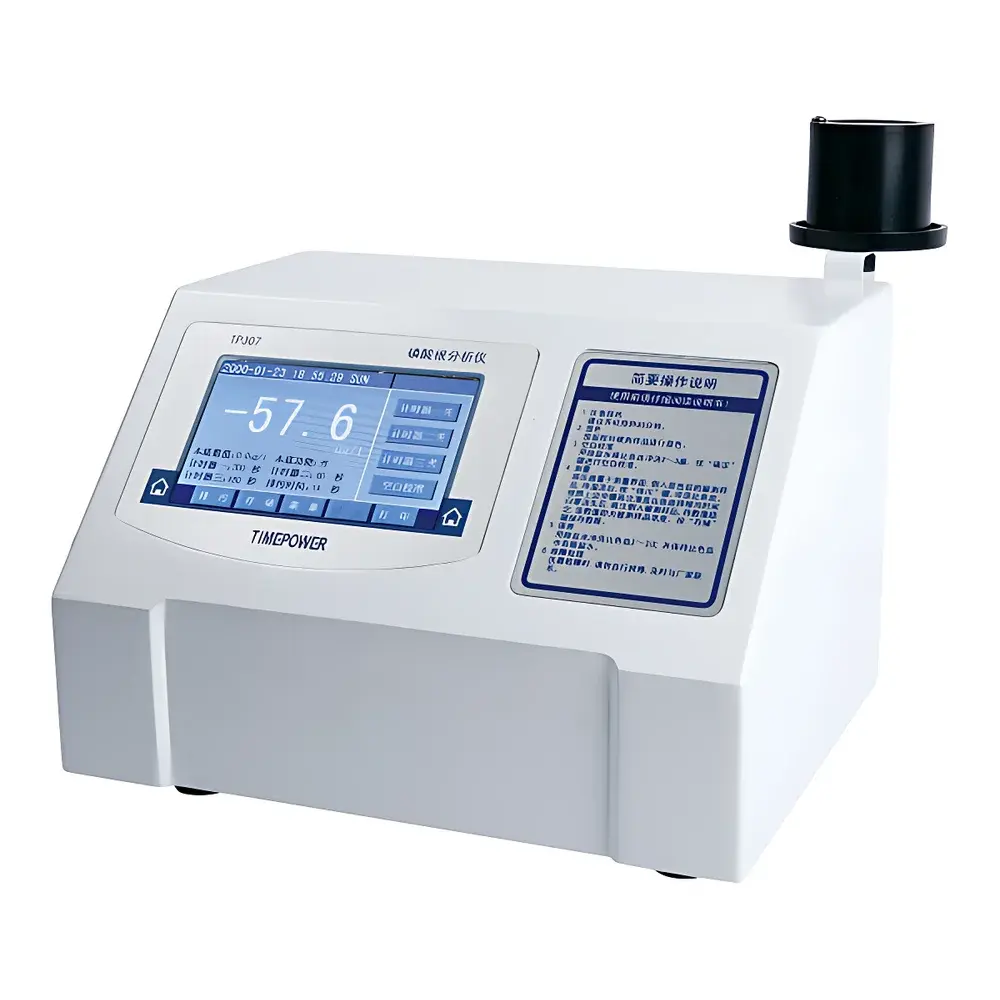
TimePower TP307 Micro-Phosphate Colorimeter for Laboratory Orthophosphate Analysis
| Brand | TimePower |
|---|---|
| Origin | Beijing, China |
| Manufacturer Type | Direct Manufacturer |
| Country of Origin | China |
| Model | TP307 |
| Pricing | Available Upon Request |
Overview
The TimePower TP307 Micro-Phosphate Colorimeter is a benchtop laboratory instrument engineered for precise quantification of orthophosphate (PO₄³⁻) in ultra-pure and process water matrices. It operates on the principle of vanadomolybdophosphoric acid colorimetry: in acidic medium, orthophosphate reacts with ammonium metavanadate and ammonium molybdate to form a stable yellow-colored heteropoly acid complex—phosphovanadomolybdic acid—whose absorbance at 420 nm is directly proportional to phosphate concentration. This reaction is fully compliant with classical wet-chemistry methods referenced in ASTM D859–22 (Standard Test Method for Silica in Water) and adapted for phosphate via ISO 6878:2004 (Water quality — Determination of phosphorus — Ammonium molybdate spectrophotometric method). The instrument employs single-beam photometric detection based on the Lambert–Beer law, ensuring linearity and traceability across its calibrated range. Designed specifically for high-reliability monitoring in power generation and regulated pharmaceutical manufacturing environments, the TP307 delivers consistent performance under GLP-aligned operational protocols.
Key Features
- Integrated microprocessor-controlled architecture with embedded ARM-based single-chip system for deterministic timing, low-power operation, and thermal stability.
- Imported cold-light monochromatic LED source (peak wavelength 420 ± 2 nm), providing superior photometric stability (>99.5% signal retention over 1,000 h), minimal heat generation, and immunity to ambient light interference.
- 5.0-inch capacitive touch LCD interface with native Chinese language support, intuitive menu navigation, and real-time graphical display of calibration curves and measurement history.
- Automated timing sequence for color development and measurement—eliminates manual stopwatch dependency and reduces inter-operator variability.
- Dual-point drift compensation: automatic blank calibration routine corrects for both electronic zero drift and optical baseline shift prior to each sample batch.
- Circular data buffer storing up to 256 measurement records with timestamp, sample ID, and operator tag; overflow management ensures continuous logging without manual intervention.
Sample Compatibility & Compliance
The TP307 is validated for analysis of orthophosphate in deionized water, condensate, boiler feedwater, and process streams from chemical, pharmaceutical, and synthetic fiber production facilities. Sample matrix requirements include pH 1 mg/L, Fe³⁺ > 0.5 mg/L, or suspended solids), and turbidity < 1 NTU. Instrument compliance includes adherence to IEC 61000-4 electromagnetic compatibility standards and mechanical safety per GB 4793.1–2007 (equivalent to IEC 61010-1). While not FDA 21 CFR Part 11–certified out-of-the-box, audit trails, user access logs, and calibration record export (via USB) support GMP/GLP documentation workflows when operated under controlled SOPs.
Software & Data Management
Data output is supported via USB 2.0 interface for direct export of CSV-formatted reports containing date/time stamp, measured absorbance, calculated concentration (mg/L as PO₄), calibration status flag, and operator ID. Internal firmware supports user-defined calibration curve storage (up to 5 multi-point curves), slope/intercept validation alerts, and auto-recall of last-used method parameters. No proprietary software installation is required—raw files are readable in Excel or LIMS-compatible platforms. Firmware updates are delivered via signed binary packages with SHA-256 checksum verification to ensure integrity.
Applications
- Monitoring phosphate carryover in steam-cycle chemistry control programs per EPRI TR-102297 and ASME PTC 19.11 guidelines.
- Verification of phosphate dosing accuracy in drum-type boiler water treatment systems (e.g., coordinated phosphate-pH control).
- QC release testing of purified water (PW) and water for injection (WFI) per USP and Ph. Eur. 2.2.48.
- Process validation support for cleaning-in-place (CIP) rinse water in biopharmaceutical manufacturing lines.
- Environmental compliance reporting for effluent discharge limits under local regulatory frameworks (e.g., China’s GB 8978–1996).
FAQ
What reagent purity is required for accurate TP307 measurements?
Analytical-grade or higher reagents must be used—specifically ammonium molybdate, ammonium metavanadate, and sulfuric acid—and dissolved exclusively in Type I ultrapure water (resistivity ≥18.2 MΩ·cm, TOC < 5 ppb) generated by mixed-bed ion exchange or EDI systems.
How frequently must calibration be performed?
A blank calibration is mandatory before each analytical session; full multi-point calibration (minimum 3 points) is recommended every 14 days or after any maintenance event affecting optical path integrity.
Can the TP307 measure total phosphorus?
No—the TP307 is specific to orthophosphate (reactive phosphorus). Total phosphorus determination requires prior persulfate or UV digestion, which is outside the instrument’s built-in functionality.
Is temperature compensation available during measurement?
The instrument does not feature active temperature compensation; however, its optical and electronic design maintains ±1% F.S. stability over 5–45°C ambient range, provided samples are equilibrated to room temperature prior to analysis.
What is the minimum detectable concentration?
Based on signal-to-noise ratio (S/N ≥ 3) and resolution of 0.01 mg/L, the practical limit of detection is 0.03 mg/L PO₄ in the 0–20 mg/L range.






