
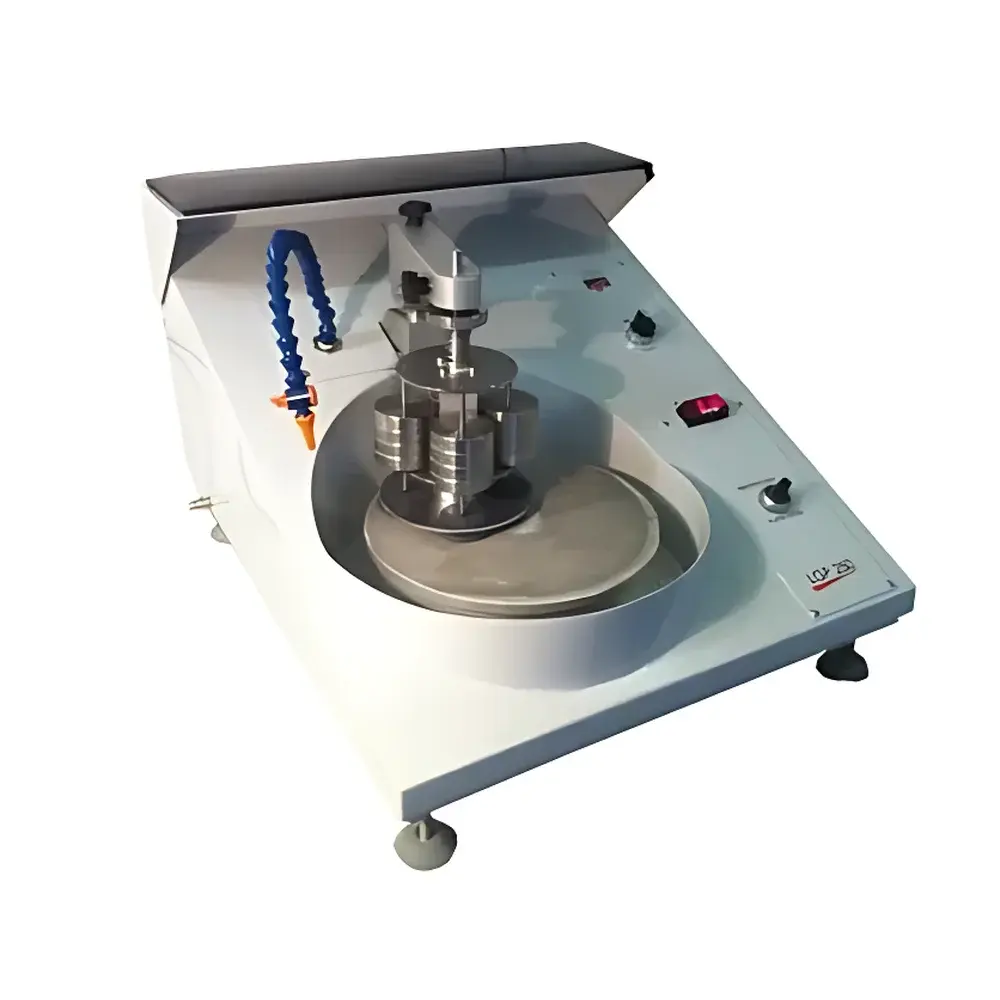
FLOXLAB LGP 250-P Semi-Automatic Polishing Machine
| Brand | FLOXLAB |
|---|---|
| Origin | France |
| Model | LGP 250-P |
| Rotational Speed | 10–600 rpm |
| Sample Dimensions | 30 × 45 mm (1 × 1.5 in) |
| Polishing Plate Diameter | 250 mm |
| Dimensions (W × D × H) | 526 × 589 × 380 mm |
| Weight | 50 kg |
| Power Supply | 220 V, 50/60 Hz |
Overview
The FLOXLAB LGP 250-P Semi-Automatic Polishing Machine is a precision-engineered instrument designed for controlled, repeatable surface preparation of geological and petroleum core samples prior to petrographic, SEM-EDS, or micro-CT analysis. Unlike fully manual systems, the LGP 250-P integrates motorized rotational control with operator-guided sample positioning—enabling consistent material removal rates while minimizing operator-induced variability. Its operational principle relies on controlled abrasive contact between rotating silicon carbide or diamond-impregnated polishing plates and mounted rock specimens under regulated pressure and speed. The system is optimized for thin-section preparation, grain boundary exposure, and pore-network preservation in reservoir rock analogs—including sandstones, carbonates, and shale matrix samples—commonly encountered in upstream petroleum laboratories and core analysis service providers.
Key Features
- Variable-speed DC motor drive delivering precise rotational control from 10 to 600 rpm, enabling tailored abrasion kinetics for soft clays versus hard dolomitic matrices.
- 250 mm diameter polishing plate with standardized mounting interface compatible with industry-standard consumables (e.g., 6-inch diameter pads, 3M Trizact™, Buehler MetaServ™).
- Dedicated sample holder accommodating rectangular specimens up to 30 × 45 mm (1 × 1.5 in), engineered to maintain orthogonal alignment during polishing and prevent edge rounding or tilting artifacts.
- Robust cast-iron base and vibration-damped column structure ensuring mechanical stability during extended polishing cycles (up to 30 min per stage), critical for achieving sub-micron surface flatness.
- Integrated digital speed display with push-button start/stop and emergency cutoff—designed for ISO 13850-compliant operation in shared laboratory environments.
- No integrated water delivery system; configured for external drip-feed or manual lubricant application to comply with hydrocarbon-safety protocols in petroleum labs handling volatile cuttings or oil-saturated cores.
Sample Compatibility & Compliance
The LGP 250-P is validated for use with consolidated and unconsolidated rock specimens extracted via rotary or coring methods per API RP 13B-1 and ASTM D4700. It supports preparation of samples conforming to ISO 14688-1 (geotechnical classification) and ASTM D2937 (density of soil in place) preparatory requirements. While not an analytical instrument per se, its output surfaces directly impact measurement validity in downstream techniques such as mercury intrusion porosimetry (ASTM D4404), image-based porosity quantification (ISO 15901-3), and XRD phase identification (ASTM E142). The machine’s mechanical repeatability meets GLP documentation standards when paired with logbook entries tracking speed, time, abrasive grade, and operator ID—supporting audit readiness under regulatory frameworks including EU REACH Annex XVII and US EPA Method 8082A sample prep guidelines.
Software & Data Management
The LGP 250-P operates as a stand-alone electromechanical system without embedded firmware or digital connectivity. All operational parameters are set manually via front-panel controls, eliminating cybersecurity risks associated with networked lab equipment. This architecture aligns with petroleum industry cybersecurity best practices outlined in NIST SP 800-82 Rev. 2 and API RP 1164. Process documentation—including polishing sequence (e.g., 240 → 600 → 1200 grit progression), dwell time per stage, and final surface roughness verification (measured separately via profilometry per ISO 4287)—must be recorded in laboratory notebooks or LIMS-integrated electronic logs. No proprietary software license or driver installation is required, ensuring long-term interoperability across Windows, macOS, and Linux-based data management platforms.
Applications
- Preparation of polished thin sections for reflected-light microscopy and fluorescence imaging of hydrocarbon-bearing pores in carbonate reservoirs.
- Surface planarization of drill cuttings prior to elemental mapping via SEM-EDS, supporting geochemical logging correlation (e.g., gamma-ray equivalent modeling).
- Controlled abrasion of shale plugs for hydraulic fracturing simulation studies requiring preserved natural fracture networks.
- Routine maintenance polishing of metallographic mounts containing embedded formation samples for hardness testing (ASTM E384).
- Calibration specimen preparation for field-portable XRF analyzers used in real-time lithology assessment during wireline logging operations.
FAQ
Is the LGP 250-P suitable for polishing metallic alloy samples used in downhole tool analysis?
Yes—the machine’s torque profile and plate rigidity support polishing of non-ferrous alloys (e.g., Inconel, Monel) commonly found in subsurface instrumentation housings, provided appropriate conductive cooling and non-aqueous lubricants are applied.
Does the unit include consumables such as polishing cloths or diamond suspensions?
No—consumables are procured separately to allow users to select grade-specific abrasives aligned with API RP 13B-2 or internal method validation protocols.
Can the LGP 250-P be integrated into an automated sample prep workflow?
It functions as a semi-automated node within sequential workflows but lacks robotic arm interfaces or PLC communication ports; integration requires external staging fixtures and manual transfer between grinding, polishing, and cleaning stations.
What electrical safety certifications does the device carry?
The unit complies with IEC 61000-6-2 (immunity) and IEC 61000-6-4 (emissions), and bears the CE marking for machinery under Directive 2006/42/EC; full test reports are available upon request from FLOXLAB’s technical documentation portal.
Is service support available outside the European Union?
Yes—FLOXLAB authorizes certified third-party service technicians in North America, the Middle East, and Asia-Pacific regions; spare parts inventory is maintained at regional distribution hubs in Houston, Dubai, and Singapore.





