
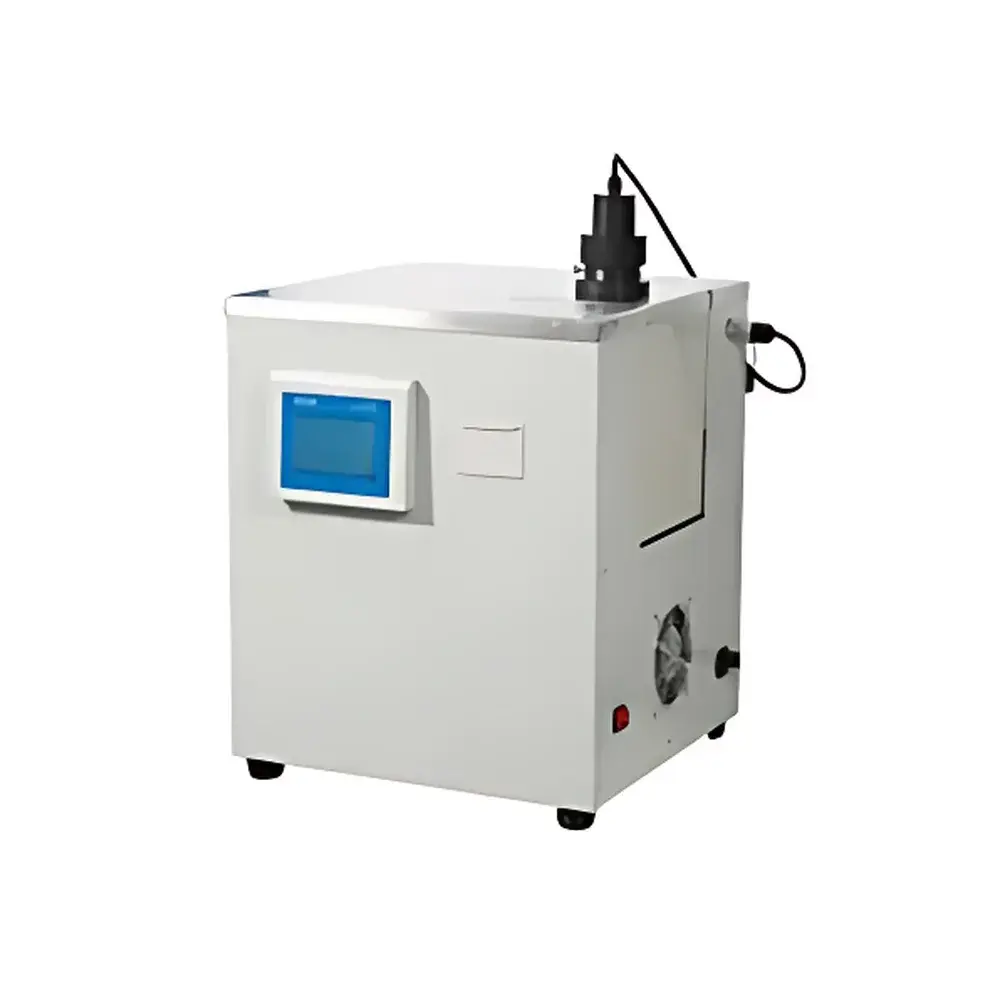
Timepower TP526 Automatic Cloud Point and Pour Point Tester
| Brand | Timepower |
|---|---|
| Origin | Beijing, China |
| Manufacturer | Timepower Co., Ltd. |
| Model | TP526 |
| Measurement Range | Ambient to –70 °C |
| Accuracy | ±1 °C |
| Resolution | 0.1 °C |
| Cooling Capacity | –70 °C (compressor-based) |
| Heating Capability | up to 50 °C |
| Display | LCD touchscreen |
| Printer | Thermal, 36-character Chinese/English output |
| Power Supply | AC 220 V ±10%, 50 Hz ±10% |
| Power Consumption | <300 W |
| Dimensions | 460 × 310 × 480 mm |
| Weight | 21.3 kg |
| Compliance | GB/T 510, GB/T 3535, ASTM D2386, ASTM D97 |
Overview
The Timepower TP526 Automatic Cloud Point and Pour Point Tester is a fully automated, dual-function analytical instrument engineered for precise determination of cloud point (CP) and pour point (PP) in petroleum products—including lubricating oils, diesel fuels, residual fuels, and dark-colored hydrocarbon samples. It operates on standardized thermal gradient cooling combined with real-time optical detection and programmable tilt mechanics, ensuring strict adherence to the physical phase transition behaviors defined in ASTM D2386 (cloud point), ASTM D97 (pour point), GB/T 510, and GB/T 3535. Unlike manual or semi-automated systems, the TP526 eliminates operator subjectivity by integrating synchronized temperature ramping, automatic sample tube inclination at prescribed intervals, and high-sensitivity visual detection of wax crystal formation (for CP) or cessation of flow (for PP). Its dual-range thermal control—from +50 °C to –70 °C—enables reliable testing across low-viscosity distillates and highly viscous residuals without pre-dilution or viscosity-based exclusion.
Key Features
- Intelligent dual-mode thermal control system featuring high-efficiency hermetic compressor refrigeration (–70 °C minimum) and PTC heating (up to +50 °C), enabling rapid thermal stabilization and reproducible cooling rates.
- Programmable tilt mechanism compliant with ASTM D97 and GB/T 510 requirements—automatically inclines the test tube at user-defined intervals (e.g., every 1 °C or 3 °C) to assess flow cessation under gravity.
- Optical detection module with ambient-light compensation, capable of identifying subtle turbidity onset (cloud point) and complete flow arrest (pour point) with sub-degree resolution.
- Touchscreen LCD interface with intuitive navigation, multilingual support (English/Chinese), and embedded calibration verification prompts.
- Integrated thermal printer delivering traceable hard-copy reports—including test ID, date/time stamp, method parameters, observed points, and pass/fail flags per standard criteria.
- Self-diagnostic firmware that monitors refrigerant pressure, heater status, sensor drift, and mechanical actuator response—displaying actionable error codes and maintenance alerts.
- Configurable test protocols: users may select “Standard Mode” (full compliance cycle) or “Rapid Screening Mode” (accelerated cooling with adaptive endpoint logic) without compromising metrological integrity.
Sample Compatibility & Compliance
The TP526 accommodates standard ASTM D2386/D97 sample tubes (19 mm OD × 150 mm L) and accepts undiluted samples regardless of kinematic viscosity—eliminating the need for solvent dilution commonly required by older capillary-based instruments. It supports opaque, dyed, and heavily sooted petroleum fractions where transmission-based analyzers fail. All operational sequences follow documented procedures aligned with ISO/IEC 17025 technical competence requirements. The instrument’s firmware logs all critical events—including temperature setpoints, tilt timing, detection triggers, and operator interventions—supporting audit readiness for GLP and GMP environments. Data output meets basic traceability requirements for internal quality control; optional RS232/USB export enables integration into LIMS platforms compliant with FDA 21 CFR Part 11 when paired with validated electronic signature workflows.
Software & Data Management
The TP526 operates via embedded real-time operating system (RTOS) firmware—not PC-dependent software—ensuring deterministic response times and immunity to host OS vulnerabilities. Test parameters (cooling rate, hold times, tilt angle, detection sensitivity) are stored in non-volatile memory with password-protected access levels (Operator / Supervisor / Service). Each test generates a timestamped record containing raw temperature vs. time profiles, tilt event markers, and final CP/PP determinations. Reports include method identification (e.g., “ASTM D97-22 Annex A1”), environmental conditions (ambient temp/humidity), and instrument serial number—fulfilling essential elements of laboratory documentation standards. Export options include plain-text CSV via USB flash drive for offline statistical analysis (e.g., Shewhart control charts, repeatability studies per ASTM E691).
Applications
This instrument serves routine and regulatory testing needs across multiple sectors: power generation facilities monitoring turbine oil cold-flow safety; refining QC labs verifying winter-grade diesel specifications; petrochemical R&D teams evaluating additive performance on wax inhibition; third-party inspection agencies performing contract testing per SGS/BV/API protocols; and academic research groups studying low-temperature phase behavior of bio-derived fuels. Its broad temperature range and viscosity-agnostic design make it particularly suitable for emerging applications involving Fischer–Tropsch liquids, hydrotreated esters, and synthetic lubricants where conventional pour point methods yield inconsistent results due to non-Newtonian crystallization kinetics.
FAQ
What standards does the TP526 comply with?
It is designed and verified for full conformance with GB/T 510–2018, GB/T 3535–2019, ASTM D2386–21, and ASTM D97–22, including their respective annexes governing apparatus geometry, cooling rate tolerances, and endpoint interpretation rules.
Can the TP526 test samples with very high viscosity?
Yes—unlike optical transmission analyzers, it relies on mechanical tilt and visual flow observation, allowing direct measurement of residuals, bitumens, and spent lubricants without dilution or preheating beyond standard conditioning steps.
Is calibration traceable to national standards?
The unit includes factory calibration certificates traceable to CNAS-accredited reference laboratories; end-users may perform field verification using NIST-traceable PT100 probe standards at key points (0 °C, –30 °C, –60 °C).
Does it support network connectivity or remote monitoring?
The base configuration features isolated RS232 and USB device ports; Ethernet or Wi-Fi modules are available as OEM add-ons under custom integration agreements.
What maintenance is required for long-term reliability?
Annual compressor oil inspection, condenser coil cleaning, and optical window polishing are recommended; firmware updates are delivered via USB and include version-controlled release notes compliant with IEC 62304 software lifecycle requirements.






