
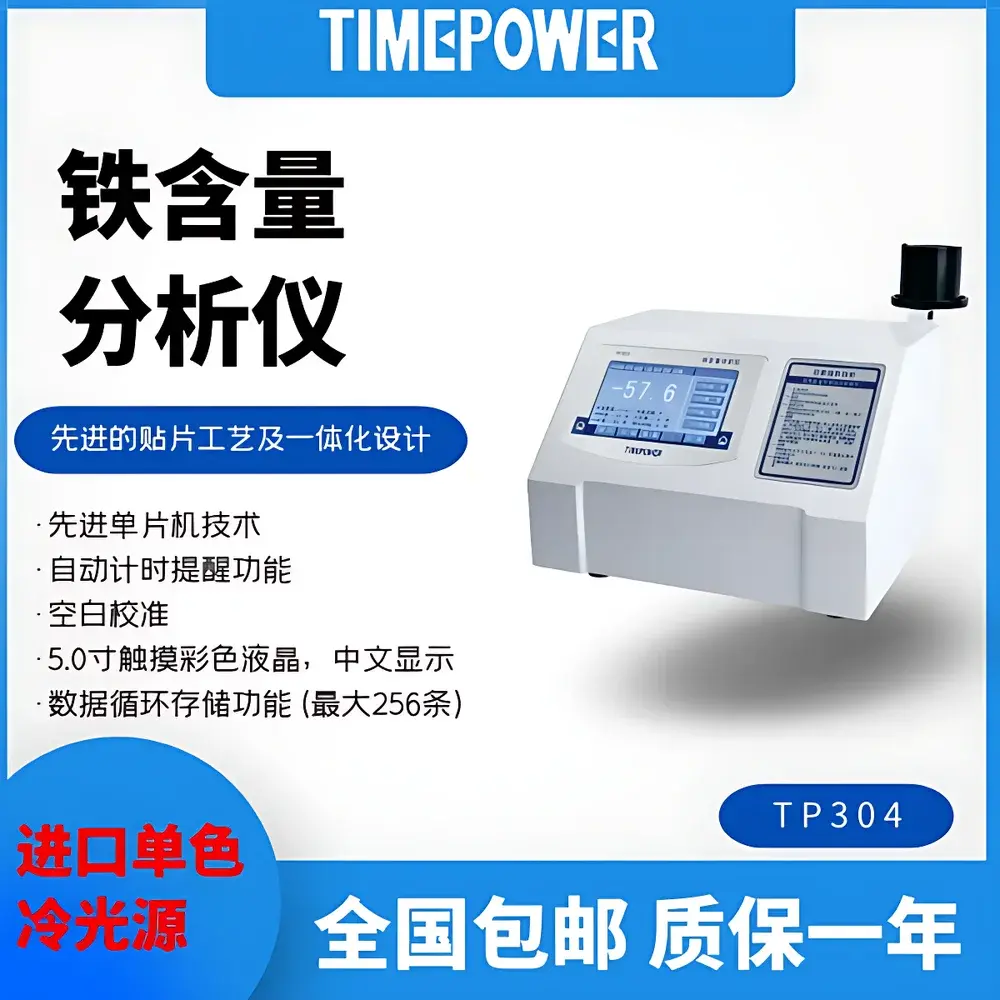
TimePower TP305 Copper Ion Analyzer
| Brand | TimePower |
|---|---|
| Origin | Beijing, China |
| Manufacturer Type | Manufacturer |
| Model | TP305 |
| Measurement Principle | Photometric Colorimetry (Based on Lambert-Beer Law) |
| Display | 5.0-inch color TFT touchscreen, Chinese interface |
| Measurement Range | 0.0–200 µg/L |
| Accuracy | ±3% FS |
| Resolution | 0.1 µg/L |
| Repeatability | ≤1% |
| Stability | ±1.5% FS / 4 h |
| Operating Temperature | 5–45 °C |
| Relative Humidity | ≤90% RH (non-condensing) |
| Power Supply | AC 85–265 V, 45–65 Hz |
| Power Consumption | ≤30 W |
| Dimensions | 260 × 200 × 180 mm |
| Weight | 3.2 kg |
| Data Storage | Up to 256 records (circular buffer) |
| Calibration | Automatic zero calibration, periodic curve calibration recommended every 2 weeks |
| Compliance | Designed for routine water quality monitoring in power plant and industrial boiler systems |
Overview
The TimePower TP305 Copper Ion Analyzer is a dedicated photometric instrument engineered for trace-level copper (Cu²⁺) quantification in ultra-pure and process water streams critical to thermal power generation and high-reliability industrial systems. It operates on the fundamental principle of photometric colorimetry—specifically, the Lambert-Beer law—where absorbance at a defined wavelength (typically 590–620 nm, corresponding to the Cu-BCO or Cu-NEC complex) is linearly proportional to copper ion concentration in solution. Unlike general-purpose spectrophotometers, the TP305 integrates a fixed-wavelength optical path, pre-optimized reagent chemistry, and embedded calibration logic to deliver reproducible sub-ppb sensitivity without user spectral configuration. Its design targets continuous compliance with ASTM D858 (Standard Test Methods for Copper in Water), ISO 8573-1 (for compressed air system water analysis), and internal utility water specifications aligned with EPRI guidelines for boiler feedwater purity (e.g., <5 µg/L Cu in turbine condensate). The analyzer is not intended for wastewater or high-turbidity matrices; it assumes sample pretreatment (e.g., filtration ≤0.45 µm, acid digestion if particulate-bound copper is suspected) per standard method protocols.
Key Features
- Integrated cold-light LED source with narrow spectral bandwidth (50,000 hours).
- High-density surface-mount PCB architecture with industrial-grade microcontroller (ARM Cortex-M4 core), enabling deterministic real-time signal processing and low-power standby mode (<1.2 W).
- Zero-drift compensation via automated blank calibration—performed at system startup and configurable for daily execution—correcting for cuvette path variation, photodiode aging, and electronic offset.
- 5.0-inch resistive touchscreen with localized Chinese GUI, supporting direct parameter entry, calibration logging, and on-screen trend review without external PC dependency.
- Circular memory buffer storing up to 256 measurement records with timestamp, operator ID field (optional), and calibration event flags—retained during power cycling.
- Modular reagent delivery path compatible with standardized 10-mL glass vials; no pumps or valves—reducing maintenance points and cross-contamination risk.
Sample Compatibility & Compliance
The TP305 is validated for use with low-conductivity water matrices including boiler feedwater (conductivity <0.3 µS/cm), turbine condensate, generator stator cooling water, and natural surface waters pretreated to remove suspended solids. Sample introduction requires manual pipetting into the supplied quartz cuvette (10-mm path length); no autosampler is integrated. All measurements assume strict adherence to reagent purity: copper-specific chromogenic agents (e.g., bathocuproine disulfonic acid or neocuproine) must be analytical grade (≥99.5%), dissolved in Type I ultrapure water (resistivity ≥18.2 MΩ·cm, TOC <2 ppb). The instrument meets mechanical and electrical safety requirements per GB 4793.1–2007 (equivalent to IEC 61010-1) and electromagnetic compatibility per GB/T 18268.1–2010. While not 21 CFR Part 11–certified out-of-box, audit trails (calibration logs, measurement history) are exportable as CSV for GLP/GMP documentation workflows.
Software & Data Management
Data handling is performed entirely onboard: no proprietary software installation is required. Measurement records include date/time stamp, measured value (µg/L), calibration status flag, and user-defined sample ID. Export occurs via USB 2.0 port to FAT32-formatted flash drives—no drivers needed. Each exported file contains ISO 8601–formatted timestamps and UTF-8 encoding for multilingual report integration. Firmware updates are delivered as signed .bin files via USB; version history and checksum verification are displayed pre-installation. The system supports optional RS-485 Modbus RTU output (addressable node ID, 9600 baud) for integration into DCS or SCADA platforms—configuration managed via terminal command set documented in the Engineering Manual.
Applications
- Monitoring copper leaching from brass condenser tubes in fossil-fueled power plants to prevent turbine blade deposition.
- Verifying compliance with ASME PTC 19.11 limits for copper in steam-cycle makeup water (≤10 µg/L).
- Diagnosing corrosion under deposit (CUD) in once-through boilers by trending copper spikes in blowdown samples.
- Supporting ISO 55001 asset management programs through quantitative correlation between copper concentration and feedwater heater tube integrity.
- Field validation of online copper analyzers during commissioning or periodic verification per IEC 62282-3-100.
FAQ
What reagents are required for operation?
The TP305 requires copper-specific colorimetric reagents—typically a two-part kit comprising a reducing agent (e.g., hydroxylamine hydrochloride) and a chelating chromogen (e.g., bathocuproine). TimePower supplies certified reagent sets (Cat. No. TP-Cu-REAG-01) with lot-specific calibration certificates.
Is daily calibration mandatory?
Yes. A blank calibration must be executed each operating day using ultrapure water to correct for optical and electronic zero drift. Full multi-point calibration using NIST-traceable copper standards is recommended every 14 days or after reagent batch change.
Can the TP305 measure total copper (dissolved + particulate)?
No. It measures only dissolved, filterable Cu²⁺ ions. For total copper, samples must undergo acid digestion (EPA Method 200.7) prior to analysis—and the resulting matrix must be verified for interference-free color development.
What maintenance intervals apply?
Optical window cleaning every 30 days with lint-free tissue and spectroscopic-grade ethanol; cuvette inspection for scratches or residue before each use; annual verification of LED intensity and photodiode linearity using factory-provided reference filters.
Does the instrument support remote diagnostics?
Not natively. Remote troubleshooting requires physical access or coordination with TimePower’s authorized service partner network in APAC; firmware-level diagnostics are accessible only via local USB console connection.





