
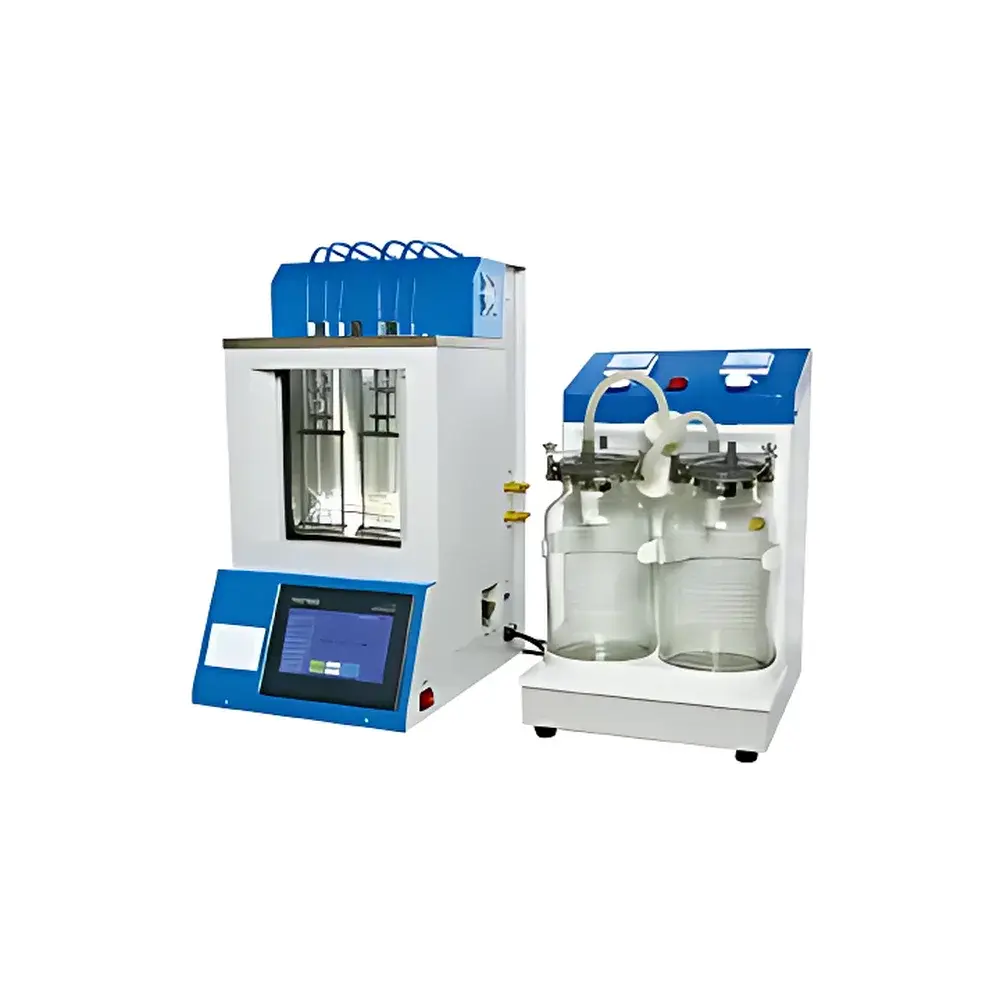
TimePower TP 725 Kinematic Viscosity Tester for Petroleum Products
| Brand | TimePower |
|---|---|
| Model | TP 725 |
| Origin | Beijing, China |
| Manufacturer | TimePower Instrument Co., Ltd. |
| Type | Fully Automated Ubbelohde Capillary Viscometer System |
| Temperature Control Range | Ambient to 100 °C |
| Temperature Stability | ±0.01 °C |
| Temperature Resolution | 0.01 °C |
| Kinematic Viscosity Resolution | 0.00001 mm²/s |
| Power Supply | AC 220 V ±10%, 50 Hz ±10%, ≤1500 W |
| Dimensions | 370 × 300 × 650 mm |
| Weight | ~28 kg |
Overview
The TimePower TP 725 Kinematic Viscosity Tester is a fully automated capillary viscometer system engineered for precise and repeatable determination of kinematic viscosity in petroleum products—consistent with ASTM D445, ISO 3104, and GB/T 265–1988 test standards. It employs the classical Ubbelohde (Ostwald-type) capillary method, where kinematic viscosity (ν) is derived from the efflux time (t) of a fixed volume of liquid under gravity at a precisely controlled temperature: ν = C × t, where C is the calibrated viscometer constant. The instrument maintains thermal equilibrium within a thermostatically regulated oil bath, ensuring compliance with standardized immersion depth, temperature uniformity, and timing accuracy requirements essential for regulatory reporting in refinery QC, lubricant formulation, and fuel specification verification.
Key Features
- Fully automated dual-channel operation: independent temperature control, timing measurement, calculation, capillary cleaning, and drying for two samples simultaneously—eliminating manual intervention and cross-contamination risk.
- High-stability temperature regulation: PID-controlled oil bath with ±0.01 °C accuracy across 20–100 °C range; resolution of 0.01 °C ensures conformity with ASTM D445 repeatability criteria (≤0.35% RSD for duplicate tests).
- Optical detection system: imported U.S.-sourced infrared liquid-level sensor provides immunity to ambient light interference, enabling reliable meniscus transit-time detection without operator alignment or visual bias.
- Dual-CPU embedded architecture: separates real-time motion control from data processing—enhancing system robustness, fault tolerance, and deterministic response during viscosity timing cycles.
- Integrated maintenance sequence: automatic solvent flush, compressed-air drying, and waste oil drainage via dedicated outlet port—reducing downtime and supporting GLP-compliant instrument qualification (IQ/OQ/PQ).
- User interface: backlit LCD display with capacitive touch-sensitive keys; real-time clock retains date/time during power loss—critical for audit-trail generation in regulated environments.
Sample Compatibility & Compliance
The TP 725 accommodates standard Ubbelohde viscometers (e.g., Cannon-Fenske, SUS, or ASTM D2161-calibrated types) with nominal capillary diameters from 0.4 to 1.2 mm. It supports transparent and mildly opaque petroleum liquids—including base oils, diesel fuels, jet fuels (Jet A-1), transformer oils, hydraulic fluids, and residual fuel oils—provided they meet minimum flow-time requirements (>200 s per ASTM D445). All operational sequences comply with ISO/IEC 17025 documentation requirements. Optional chiller integration enables sub-ambient testing down to 4 °C for low-temperature diesel or biodiesel blends—extending applicability to cold-flow property screening per ASTM D97 and D4539.
Software & Data Management
Data acquisition and reporting are handled via on-board firmware with non-volatile memory storage for ≥1000 test records—including sample ID, bath temperature, efflux time(s), calculated ν (mm²/s), calibration constant, operator ID, and timestamp. Export is supported via RS-232 serial interface to LIMS or Excel-compatible CSV files. Audit trail functionality logs all parameter changes, cleaning events, and error codes—meeting FDA 21 CFR Part 11 requirements for electronic records when paired with user-access controls and digital signature protocols. Calibration verification routines support traceable NIST-traceable reference oil validation per ISO 17034.
Applications
- Refinery quality control: batch release testing of naphtha, kerosene, gas oil, and lube base stocks against API RP 14E and ASTM D975 specifications.
- Transformer oil monitoring: trending of oxidation-induced viscosity increase per IEEE C57.106 for predictive maintenance in power substations.
- Lubricant R&D: evaluation of VI improver efficiency and shear stability per ASTM D6278 and D2603.
- Marine fuel compliance: verification of residual fuel viscosity prior to bunkering per ISO 8217 Annex A.
- Contract laboratory services: accredited testing for ISO/IEC 17025-certified reports submitted to customs authorities (e.g., CIQ, APHIS) and petrochemical trading partners.
FAQ
What viscosity standards does the TP 725 comply with?
ASTM D445, ISO 3104, GB/T 265–1988, and IP 71—fully aligned with international petroleum product specification frameworks.
Can the instrument be validated for GMP/GLP environments?
Yes—its deterministic timing logic, electronic audit trail, calibration traceability, and automated cleaning cycle support IQ/OQ/PQ execution per ASTM E2500 and EU Annex 11.
Is external chiller integration supported?
Yes—the system features a dedicated coolant inlet/outlet port and programmable low-temperature setpoints; optional refrigerated circulator kits are available for −20 °C to 100 °C extended-range operation.
How is capillary contamination mitigated between runs?
Each test concludes with an automated sequence: solvent rinse (user-selectable solvent), vacuum-assisted aspiration, hot-air drying at 120 °C, and purge—verified by IR level-sensing before next sample loading.
What maintenance is required for long-term reliability?
Annual verification using certified reference oils (e.g., NIST SRM 2789), quarterly oil bath fluid replacement, and biannual inspection of IR emitter/detector alignment—documented in the included Maintenance Log Template.






