
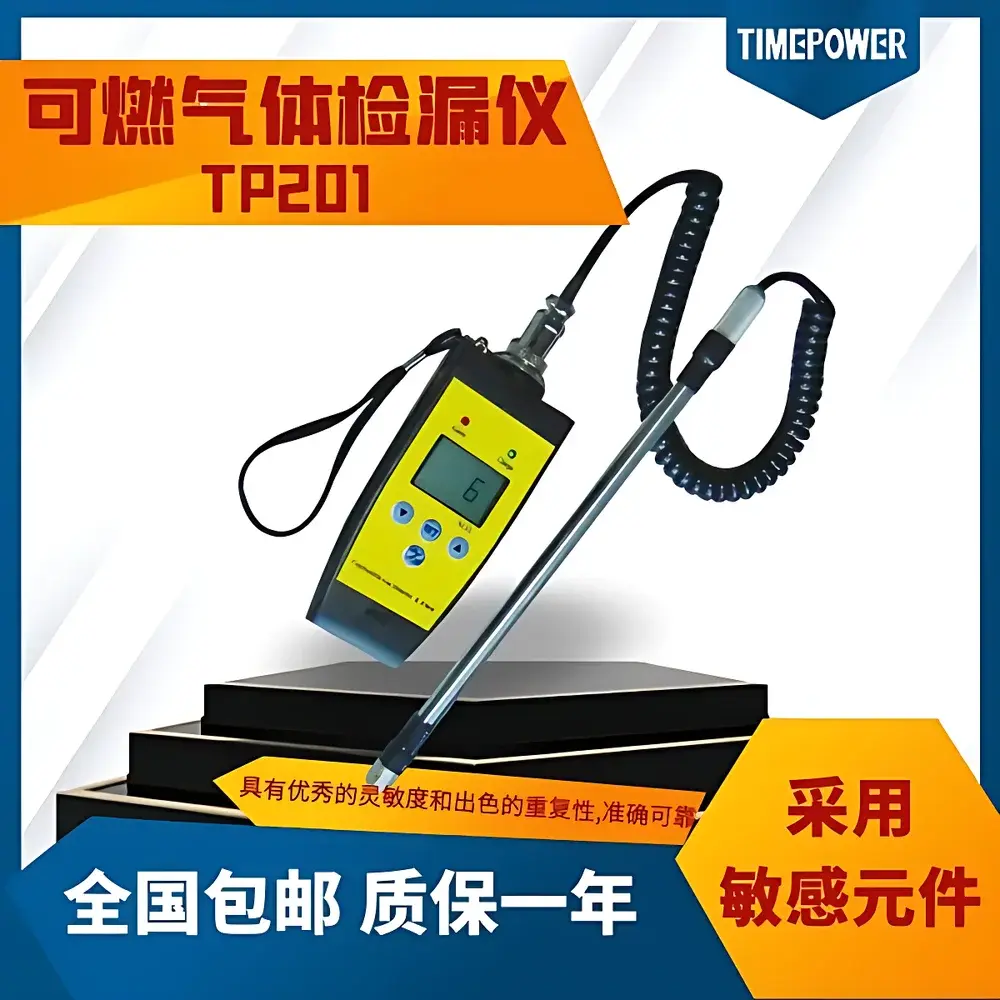
TimePower TP/201 Portable Combustible Gas Leak Detector
| Brand | TimePower |
|---|---|
| Model | TP/201 |
| Detection Principle | Catalytic Bead (Pellistor) Sensor |
| Gas Coverage | H₂, CH₄, C₄H₁₀ (iso-butane), C₃H₈, C₅H₁₂, acetylene, ethylene, gasoline vapor, ethanol, methanol, xylene, and other combustible hydrocarbons & vapors |
| Alarm Threshold | Adjustable (typically 10–50% LEL default) |
| Display | Backlit LCD with digital concentration readout (% LEL) |
| Power Supply | Rechargeable Ni-MH battery with low-voltage warning |
| Certification | Ex ia II CT3 (Intrinsically Safe for Zone 0/1) |
| Operating Temperature | −20 °C to +50 °C |
| Relative Humidity | ≤95% RH (non-condensing) |
| Enclosure Rating | IP65 |
| Compliance | GB 15322.1–2019, EN 60079-0, EN 60079-11, IEC 61779-1 |
Overview
The TimePower TP/201 Portable Combustible Gas Leak Detector is an intrinsically safe, hand-held instrument engineered for rapid, reliable detection of combustible gases and volatile organic vapors in industrial and confined-space environments. It operates on the catalytic bead (pellistor) sensing principle: a heated platinum coil coated with catalyst material oxidizes target gases exothermically, causing a measurable resistance change proportional to gas concentration. The detector reports readings in percent Lower Explosive Limit (% LEL), providing immediate, quantitative feedback critical for hazard assessment prior to entry or during routine maintenance. Designed for field use across upstream and downstream energy infrastructure—including wellheads, pipeline right-of-ways, compressor stations, refinery perimeters, LNG terminals, and underground utility vaults—the TP/201 delivers real-time leak localization without requiring external calibration gases during standard operation.
Key Features
- Intrinsically safe architecture certified to Ex ia II CT3, permitting safe deployment in Zone 0 (continuous hazardous atmosphere) and Zone 1 (occasional hazardous atmosphere) per IEC 60079 series standards.
- Catalytic bead sensor with high selectivity toward hydrocarbon-based fuels and common industrial solvents—hydrogen, methane, propane, butane, acetylene, ethylene, gasoline, ethanol, methanol, and xylene vapors.
- Large backlit LCD display showing real-time % LEL value, battery status, alarm mode, and sensor health indicator—optimized for readability under low-light or high-glare conditions.
- Programmable dual-stage audible and visual alarm: pre-alarm at user-defined threshold (e.g., 10% LEL) and full alarm at critical level (e.g., 25% or 50% LEL), configurable via onboard menu.
- Rechargeable nickel-metal hydride (Ni-MH) battery pack supporting ≥8 hours of continuous operation; integrated low-voltage warning prevents unexpected shutdown during inspection cycles.
- Ruggedized IP65-rated housing resistant to dust ingress and water jets, enabling consistent performance in outdoor, humid, or intermittently wet environments.
- Microprocessor-controlled signal conditioning with temperature compensation and automatic baseline drift correction—ensuring measurement stability across ambient ranges from −20 °C to +50 °C.
Sample Compatibility & Compliance
The TP/201 is validated for qualitative and semi-quantitative detection of combustible gases and vapors within their respective flammability limits. It meets national and international requirements for portable gas detection equipment used in occupational safety applications. Compliance includes GB 15322.1–2019 (Chinese standard for point-type combustible gas detectors), EN 60079-0 (general requirements for explosive atmospheres), EN 60079-11 (intrinsic safety “i” protection), and IEC 61779-1 (performance requirements for portable detectors). While not intended for regulatory compliance reporting under OSHA 1910.120 or EPA Method 21, it serves as a primary screening tool aligned with good engineering practice (GEP) and process safety management (PSM) protocols. Calibration verification using certified span gas (e.g., 50% LEL methane in air) is recommended prior to each shift or after exposure to sensor-poisoning agents (e.g., silicones, sulfides, lead compounds).
Software & Data Management
The TP/201 operates as a standalone field instrument with no embedded data logging or Bluetooth/Wi-Fi connectivity. All operational parameters—including alarm setpoints, backlight timeout, and unit of measure—are configured locally via membrane keypad navigation. For traceability and audit readiness, users are advised to record inspection timestamps, location identifiers, and observed readings manually or via compatible mobile inspection apps. When integrated into broader facility-wide gas monitoring systems, the TP/201 supports manual data entry into CMMS platforms (e.g., IBM Maximo, SAP EAM) or digital permit-to-work (PTW) workflows compliant with ISO 45001 and OHSAS 18001 frameworks. No firmware updates or PC-based configuration utilities are required—minimizing IT dependency and cybersecurity surface area.
Applications
- Pipeline integrity verification: pinpointing fugitive emissions along transmission mains, metering stations, and valve boxes.
- Refinery and petrochemical plant turnaround support: verifying isolation and purging effectiveness before hot work permits are issued.
- Underground infrastructure surveys: detecting soil-gas migration near buried natural gas distribution lines or sewer conduits.
- Liquefied petroleum gas (LPG) and compressed natural gas (CNG) refueling station leak audits—prior to daily startup and after vehicle coupling events.
- Mine ventilation monitoring: identifying localized methane accumulation in coal seam entries or development headings.
- Confined space entry pre-check: validating atmospheric safety in tanks, silos, trenches, and utility tunnels per ANSI Z117.1 and CSA Z1006.
FAQ
What gases does the TP/201 detect?
It detects combustible gases including hydrogen, methane, propane, butane, acetylene, ethylene, and vapors from gasoline, ethanol, methanol, and xylene—based on catalytic oxidation response.
Is the TP/201 suitable for use in Class I Division 1 areas?
Yes—its Ex ia II CT3 certification confirms suitability for Zone 0/1 classified locations under IEC and NEC Article 500 equivalency.
How often should the sensor be calibrated?
Full calibration with certified test gas is recommended before each day’s use or after exposure to high-concentration gas, sensor poisoning, or physical shock.
Does the device store historical readings?
No—the TP/201 is a real-time indicating instrument without internal memory or data export capability.
Can the alarm thresholds be customized?
Yes—users may adjust both pre-alarm and high-alarm setpoints within the 10–50% LEL range via the onboard menu system.
Related Products







