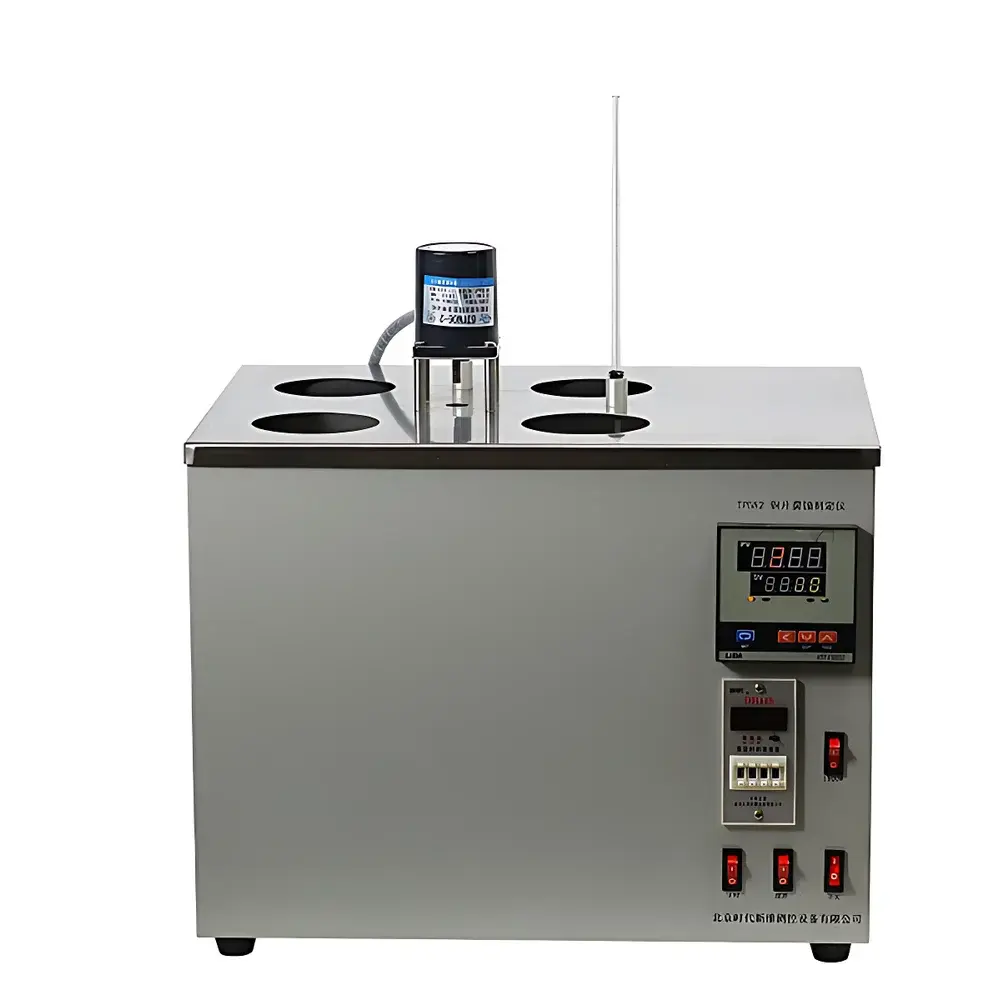
TimePower TP582 Copper Strip Corrosion Tester
| Brand | TimePower |
|---|---|
| Model | TP582 |
| Origin | Beijing, China |
| Manufacturer Type | Direct Manufacturer |
| Compliance Standards | GB/T 5096, GB/T 7327, SH/T 0232, SH/T 0023, ASTM D130 |
| Temperature Control Range | Ambient to 100 °C |
| Temperature Accuracy | ±1 °C |
| Temperature Sensor | Pt100 |
| Heating Power | Main 600 W + Auxiliary 1000 W |
| Timing Range | 1 min to 24 h |
| Sample Capacity | 4 sample wells (expandable to 12 test positions) |
| Display | LED digital display for temperature and time |
| Power Supply | 220 V ±10%, 50 Hz |
| Ambient Operating Conditions | ≤35 °C, RH ≤85% |
| Dimensions | 420 × 315 × 550 mm |
| Weight | 16.8 kg |
| Total Power Consumption | ≤1800 W |
Overview
The TimePower TP582 Copper Strip Corrosion Tester is a precision-engineered instrument designed for evaluating the corrosive tendency of petroleum products—particularly gasoline, diesel, jet fuel, lubricating oils, and hydrocarbon solvents—toward copper and copper alloys. It operates in strict accordance with internationally recognized standard test methods, including ASTM D130, GB/T 5096, GB/T 7327, SH/T 0232, and SH/T 0023. The instrument employs a controlled thermal immersion environment where polished copper strips are exposed to the test sample under precisely regulated temperature and time conditions. Corrosion assessment is performed visually by comparing the discolored strip against standardized ASTM Copper Corrosion Rating Strips (ASTM D130 Color Chart), enabling quantitative classification from Class 1a (no discoloration) to Class 4 (severe darkening or tarnishing). This method provides a rapid, reproducible, and widely accepted indicator of active sulfur compounds—such as mercaptans, sulfides, and elemental sulfur—that can degrade fuel system components and catalytic converters.
Key Features
- Integrated metal-block heating bath with dual-stage thermal regulation: primary 600 W heater for stable baseline control and auxiliary 1000 W heater for rapid temperature ramp-up and recovery after sample insertion.
- PID-based digital temperature control system with Pt100 platinum resistance sensor, ensuring ±1 °C accuracy across the full operating range (ambient to 100 °C).
- Intelligent self-diagnostic firmware that continuously monitors sensor integrity, heater status, and thermal stability—alerting users to deviations before test initiation.
- Four independent sample wells with standardized 15 mL glass test tubes; modular design supports up to 12 simultaneous tests via optional expansion kits for high-throughput QC labs.
- Dual LED digital displays for real-time monitoring of both setpoint temperature and elapsed exposure time, configurable from 1 minute to 24 hours with audible end-of-test alarm.
- Robust aluminum alloy chassis with insulated thermal housing, optimized airflow management, and EMI-shielded electronics for long-term operational reliability in refinery and third-party testing environments.
Sample Compatibility & Compliance
The TP582 accommodates all liquid petroleum products specified in ASTM D130 and equivalent national standards—including aviation turbine fuels (Jet A-1, JP-8), automotive gasoline (E10, E15), ultra-low-sulfur diesel (ULSD), biodiesel blends (B5–B20), and industrial solvents. Each test requires a standardized 15 mm × 15 mm × 1.5 mm electrolytic copper strip (ASTM B115 grade), polished per ASTM D130 procedures prior to immersion. The instrument’s thermal uniformity and dwell-time repeatability meet GLP requirements for routine quality control, and its calibration traceability supports ISO/IEC 17025-accredited laboratories. All electrical components comply with IEC 61010-1 safety standards for laboratory equipment.
Software & Data Management
While the TP582 operates as a standalone hardware platform without embedded PC software, its digital interface supports manual data logging compatible with LIMS integration. Temperature and timing parameters are stored in non-volatile memory for audit trail generation. For laboratories requiring electronic records compliant with FDA 21 CFR Part 11, external data acquisition systems can be interfaced via RS-232 or analog voltage output (optional module). Firmware updates are delivered via USB port and include version-stamped calibration logs and diagnostic history—enabling full traceability during internal audits or regulatory inspections.
Applications
- Refinery quality assurance: final product release testing for copper corrosion compliance prior to pipeline transfer or storage.
- Fuel additive evaluation: screening of antioxidant, metal deactivator, and sulfur-scavenging formulations for efficacy in mitigating copper corrosion.
- Storage stability studies: accelerated aging assessments of fuel batches held in aboveground tanks or marine bunkering facilities.
- Contract laboratory services: accredited testing for ASTM D130 certification reports issued to OEMs, blending terminals, and international trading partners.
- Research and development: correlation studies between copper strip ratings and quantitative sulfur speciation (e.g., GC-SCD, XRF) to refine predictive models of material degradation.
FAQ
What standards does the TP582 fully support?
ASTM D130, GB/T 5096, GB/T 7327, SH/T 0232, and SH/T 0023 — all implemented with hardware-level thermal and temporal fidelity.
Can the instrument perform tests at temperatures below ambient?
No — the TP582 is a heating-only system with a minimum operating temperature equal to ambient laboratory conditions (typically ≥15 °C).
Is calibration certificate included with shipment?
A factory-issued calibration report referencing NIST-traceable Pt100 and timer standards is provided; on-site verification using ASTM-certified reference strips is recommended quarterly.
How is sample cross-contamination prevented during multi-position testing?
Each well is thermally isolated via separate metal blocks and sealed with individual glass tube caps; no shared fluid paths or vapor interconnects exist between positions.
Does the TP582 require external cooling water or compressed air?
No — it is a self-contained, air-cooled unit requiring only standard AC power and ambient ventilation.