
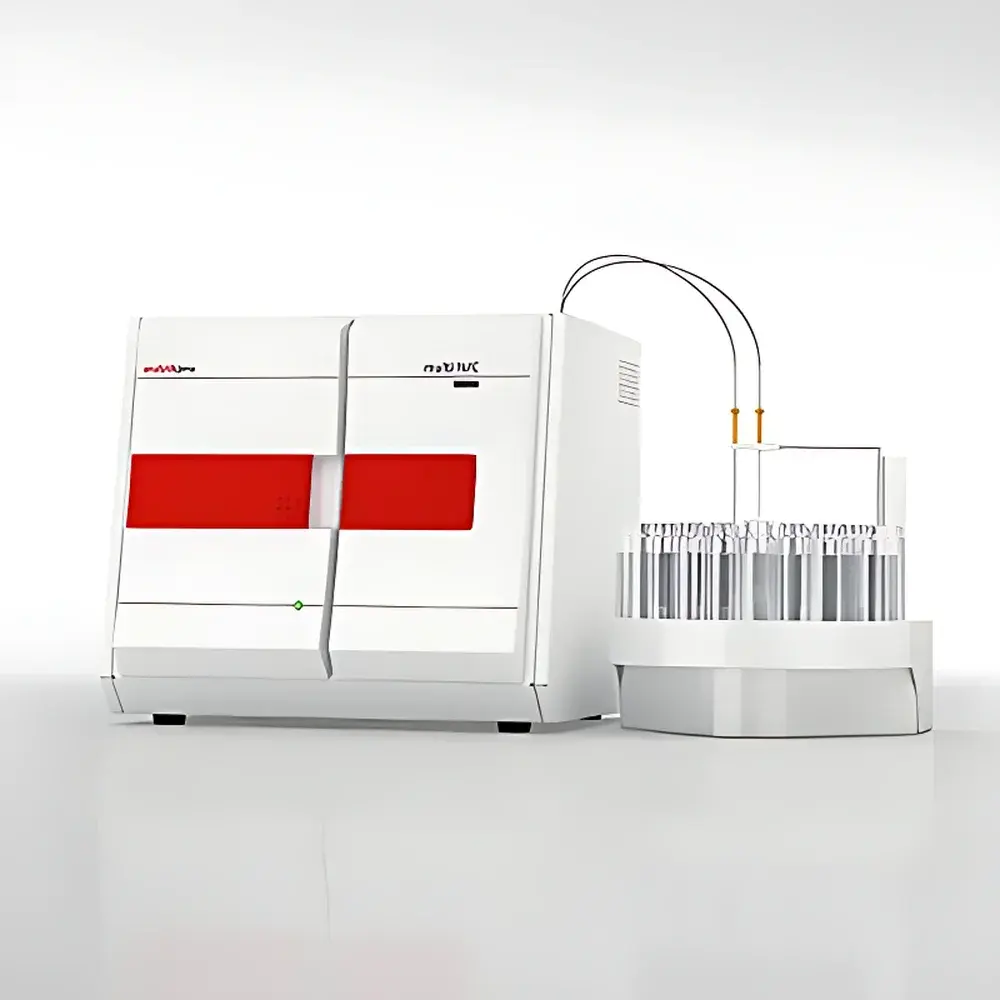
analytik jena multi N/C ® Pharma UV Total Organic Carbon and Total Nitrogen Analyzer for Pharmaceutical Applications
| Brand | analytik jena |
|---|---|
| Origin | Germany |
| Manufacturer | analytik jena GmbH |
| Product Type | Laboratory TOC/TN Analyzer |
| Model | multi N/C ® Pharma UV |
| Detection Principle | Non-Dispersive Infrared (NDIR) Absorption |
| Oxidation Method | UV/Persulfate Wet Oxidation |
| Measurement Range | 0–10,000 ppm C or N |
| Accuracy | ±3% |
| Resolution | 0.001 ppb |
| Detection Limit | 2 ppb |
| Repeatability | <3% |
| Compliance | Designed for USP <643>, EP 2.2.44, JP 17, FDA 21 CFR Part 11, and GMP/GLP environments |
Overview
The analytik jena multi N/C ® Pharma UV is a high-performance, regulatory-compliant laboratory analyzer engineered specifically for total organic carbon (TOC) and total bound nitrogen (TNb) quantification in pharmaceutical water systems and cleaning validation matrices. It employs wet chemical oxidation via ultraviolet (UV) irradiation combined with persulfate catalysis—ensuring complete mineralization of recalcitrant organic compounds—including humic substances, low-molecular-weight organics, and nitrogen-containing pharmaceutical residuals. The resulting CO2 and NOx gases are detected using dual-channel, temperature-stabilized non-dispersive infrared (NDIR) detectors for carbon and chemiluminescence detection (CLD) or conductivity detection (ChD) for nitrogen. This orthogonal detection architecture eliminates spectral interference and enables simultaneous, independent quantification of TOC, TC, TIC, NPOC, POC, and TNb without sample dilution across the full 0–10,000 ppm dynamic range.
Key Features
- Pharma-grade validation support: Pre-configured IQ/OQ/PQ documentation packages compliant with EU Annex 15, ASTM D5905, and ISO 29881 standards
- VITA® patented flow control technology: Real-time compensation for pressure and viscosity fluctuations to maintain consistent carrier gas flow and detector response stability
- Easy Cal® single-point calibration: Eliminates multi-point standard preparation; achieves traceable calibration using one certified reference material (e.g., potassium hydrogen phthalate), validated per USP system suitability requirements
- Integrated System Suitability Test (SST): Automated execution of sucrose and 1,4-benzoquinone challenge tests with built-in report generation (SST summary, recovery %, RSD, pass/fail status)
- Swab-test solid sampling module: Optional accessory enabling direct analysis of swab extracts from equipment surfaces per FDA Guidance for Industry on Process Validation
- SCS Safety Control System: Continuous monitoring of UV lamp status, reagent levels, pressure differentials, and thermal cutoffs to prevent operator exposure and hardware damage
- Modular architecture: Field-upgradable TNb detection unit, optional high-sensitivity 0.001 ppb resolution mode, and customizable autosampler integration (e.g., AS 100 or AS 700)
Sample Compatibility & Compliance
The multi N/C ® Pharma UV is validated for use with purified water (PW), water for injection (WFI), and clean-in-place (CIP) rinse solutions per USP and Ph. Eur. 2.2.44. It accommodates liquid samples (0.1–5 mL injection volume), aqueous swab extracts, and acidified digestates from solid-phase extraction. All fluidic pathways employ PFA and quartz components resistant to aggressive oxidants and trace metal leaching. Instrument firmware and software comply with FDA 21 CFR Part 11 requirements—including electronic signatures, audit trails with immutable timestamps, role-based access control, and data integrity safeguards aligned with ALCOA+ principles. Full traceability is maintained from raw signal acquisition through final report export (PDF, CSV, XML).
Software & Data Management
The instrument is operated via the certifiable multiWin® Pharma software suite—designed and verified under IEC 62304 Class B medical device software standards. It provides automated method sequencing, real-time chromatogram visualization, configurable alarm thresholds, and integrated LIMS connectivity via ASTM E1384 or HL7 interfaces. All analytical runs generate timestamped, digitally signed PDF reports containing raw detector output, calibration history, SST logs, and metadata required for GMP audits. Audit trails record every user action—including parameter edits, result overrides, and report exports—with no ability to delete or modify historical entries. Software validation kits include installation qualification (IQ) checklists, operational qualification (OQ) test protocols, and performance qualification (PQ) templates aligned with ISPE GAMP 5 guidelines.
Applications
- Regulatory release testing of WFI and PW per USP , EP 2.2.44, and JP 17
- Cleaning validation of manufacturing equipment using swab and rinse sampling protocols
- Monitoring bioburden-related organics in cell culture media and buffer preparation systems
- Investigating carbon carryover in chromatography systems and ultrafiltration loops
- Supporting environmental monitoring programs in aseptic processing suites
- Method development and transfer for TOC/TNb testing across global manufacturing sites
FAQ
Does the multi N/C ® Pharma UV meet USP system suitability requirements?
Yes—the instrument includes pre-validated SST routines for sucrose (oxidizable carbon) and 1,4-benzoquinone (oxidizable nitrogen), with automatic calculation of recovery, precision, and detection limit per USP specifications.
Can it quantify both TOC and TNb in a single run?
Yes—dual-channel detection (NDIR for CO2, CLD/ChD for NOx) enables concurrent measurement without hardware switching or method reconfiguration.
Is the software compliant with FDA 21 CFR Part 11?
Yes—multiWin® Pharma implements electronic signatures, audit trail archiving, and role-based permissions as defined in the regulation’s Subpart B requirements.
What sample volumes are supported for swab-test analysis?
The optional solid sampling module accepts 1–10 mL of extracted swab solution, with programmable dilution and spike recovery correction algorithms.
How is calibration traceability ensured?
All calibrations reference NIST-traceable CRM materials (e.g., NIST SRM 1028c), with certificate-of-analysis integration into the software’s calibration log and electronic signature workflow.
Related Products







